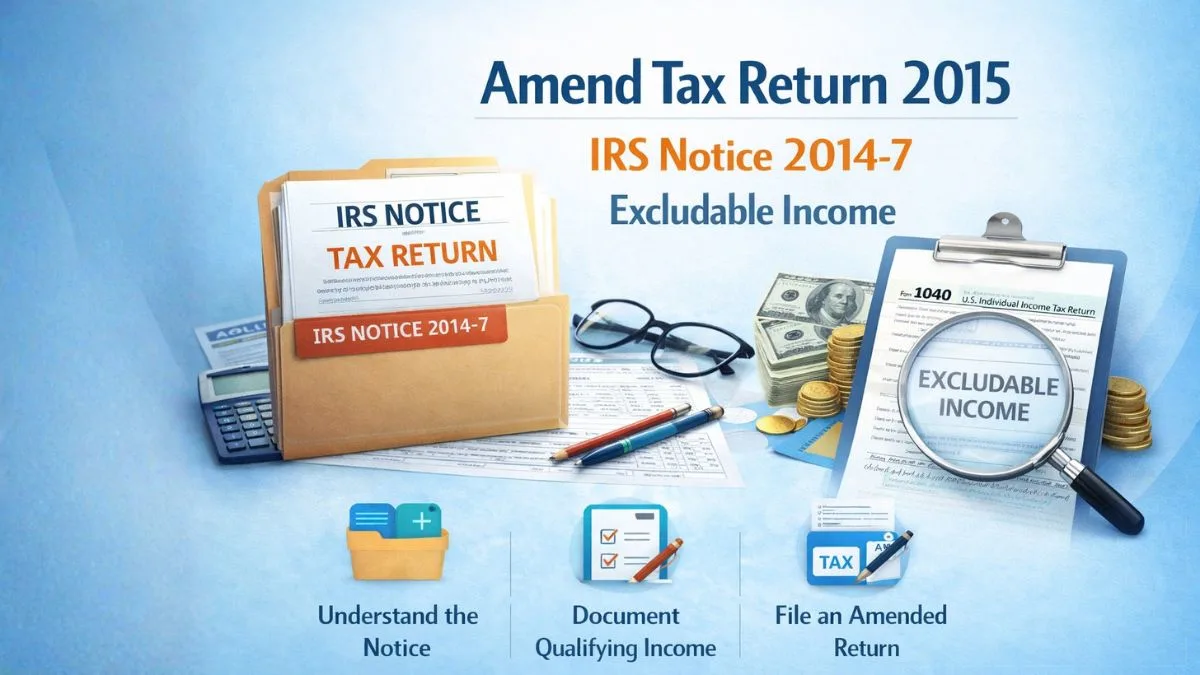
So… why are people suddenly digging up 2015 tax returns?
Honestly, it’s a bit strange at first.
I mean, 2015 feels like a lifetime ago in tax terms. Most people barely remember what they had for lunch last week, let alone what went into their income tax return back then.
But then someone mentions IRS Notice 2014-7…
And suddenly, things don’t feel so “closed” anymore.
You start wondering:
“Did I include income that wasn’t even supposed to be taxed?”
That thought alone is enough to pull anyone back into old paperwork.
Let’s break this down—without the jargon
At its core, IRS Notice 2014-7 is about one thing:
Some caregiving payments — especially under Medicaid waiver programs — may be treated as excludable income.
Meaning… you don’t pay tax on it.
Simple enough, right?
Well, not really.
Because back in 2015, a lot of people didn’t know this. Or they weren’t told clearly. So they reported that income, paid tax, and moved on.
No second thoughts.
Until now.
And here’s where it gets slightly messy
There’s a standard rule floating around — you’ve probably seen it already:
To change a 2015 tax return for Notice 2014-7, which is about Medicaid waiver payments that do not have to be included in your income, you need to fill out Form 1040-X, which is called the "Amended U.S. Individual Income Tax Return." If you want your money back, the Internal Revenue Service usually wants you to send in the amended return within 3 years of when you sent in your tax return.
However, the rules for Notice 2014-7, which is about Medicaid waiver payments, might still apply, so you can still get a refund for these Medicaid waiver payments.
Now pause.
Read that again slowly.
Because that one sentence… it’s doing a lot of heavy lifting.
The timeline problem (this is where most people get stuck)
Here’s the uncomfortable part.
The IRS generally allows:
- 3 years from the original filing date
- Or 2 years from when you paid the tax
After that?
Getting a refund becomes… difficult.
Not impossible in every scenario, but definitely not straightforward.
And for a 2015 return — yeah, that window has mostly passed.
Still, people try. And sometimes, there are nuances.
Wait — so is it even worth trying?
Good question.
Let’s not rush the answer.
Think about this:
If you reported Medicaid waiver payments as taxable income, but they actually qualified as excludable, then technically… your original filing wasn’t accurate.
Now whether you can fix it and actually get money back — that’s a different story.
But correcting the record? That can still matter.
Especially if it impacts other parts of your tax profile.
What actually qualifies as excludable income here?
This part gets misunderstood a lot.
For IRS Notice 2014-7, payments may be treated as excludable income if:
- The payment comes from a Medicaid waiver program
- You’re providing care in your home
- The person receiving care lives with you
That last condition — living in your home — is where many cases fail.
It sounds small. But it changes everything.
Real-life scenario
Let’s say someone is taking care of a parent.
They receive payments. They report it as income. Pay tax.
Years later, they find out—wait, this might have been excludable.
You can almost feel the frustration.
Because it is not like they were trying to do anything. The people just did not have the information about the things they were doing.
The people just did not know what to do because they did not have the information.
Filing amended returns — what it actually looks like
If you decide to move forward with amended returns, here’s the rough process:
- Use Form 1040-X
- Adjust your original income. Tax return
- Remove the excludable income
- Recalculate your total income and tax
- Claim a refund if applicable
- Clearly mention IRS Notice 2014-7
That’s the structured version.
In reality? It’s rarely that neat.
Things that quietly complicate everything
Most people think it’s just about removing one number.
It’s not.
When you change your income, it can affect:
- Credits
- Deductions
- Eligibility thresholds
So one adjustment leads to another… and then another.
Before you know it, the entire return needs a careful rework.
Common mistakes
You’ll see these patterns again and again:
- Assuming all caregiving payments are excludable
- Ignoring the residency condition
- Filing amendments without proper explanation
- Forgetting to attach supporting details
- Expecting a refund without checking time limits
And sometimes… people rely on guesswork.
That rarely ends well with the IRS.
About the refund—let's be realistic
Everyone’s thinking about this.
Naturally.
If you overpaid tax, you want it back.
But here’s the thing:
If your income is something that does not have to be included, the Internal Revenue Service can still say no to giving you your money if you file the amendment after the deadline.
The Internal Revenue Service system is set up that way.
Frustrating? Yes.
Unexpected? Not really, once you understand the rules.
A small thought that changes perspective
Most people ask:
“Will I get money back?”
But maybe the better question is
“Was my original filing even correct?”
Because sometimes, clarity matters more than the outcome.
Documentation—the quiet deal breaker
Let’s not ignore this part.
If you’re making a case under IRS Notice 2014-7, you should have:
- Proof of payments
- Details of the Medicaid waiver program
- Confirmation that care was provided in your home
- Residency proof
Without this, even a valid claim can fall apart.
And the IRS won’t just take your word for it.
Should you try handling this yourself?
Honestly… depends.
If your situation is straightforward, you might manage your own amendments.
But if there’s any confusion around the following:
- Eligibility
- Calculations
- Timelines
Then doing it alone can get risky.
Because once you submit an amended return, fixing errors later becomes more complicated.
One last thing people don’t talk about enough:
Sometimes, this isn’t just about tax.
It’s about hindsight.
Looking back and realizing, “I could have done this differently.”
That feeling? It’s pretty common in cases like this.
Closing thoughts
If you’re revisiting your 2015 income tax return because of IRS Notice 2014-7, take your time with it.
Don’t rush into filing amended returns just because you heard someone else did.
Check the facts.
Understand whether your income truly qualifies as excludable.
And most importantly, see if a refund is even realistically possible.
And if at any point things start feeling unclear, getting a second opinion can make a big difference. Platforms like Callmyca.com can help you walk through the details — not in a complicated way, just enough to make sure you’re not missing something important.