
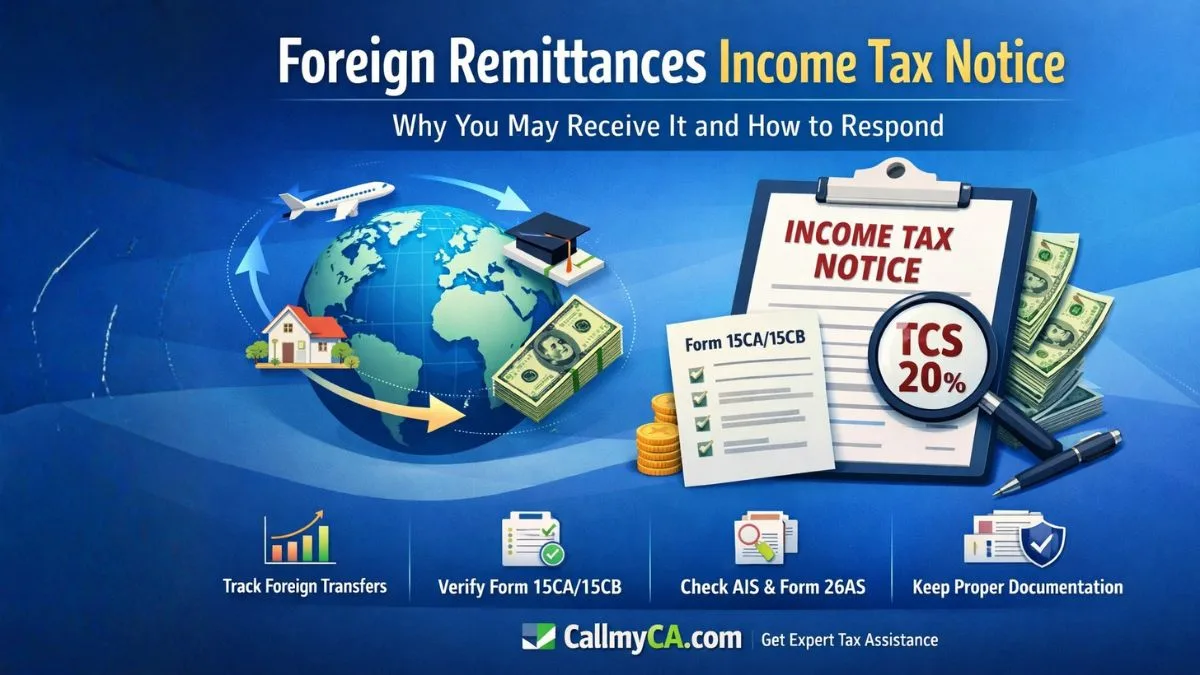
Understanding the Foreign Remittances Income Tax Notice
International money transfers have become extremely common today. People send money abroad for education, investment, property purchases, family support, or travel expenses. But here’s something most people don’t realize—large foreign remittances are closely tracked by the Income Tax Department.
And that’s where the Foreign Remittances Income Tax Notice comes in.
Many taxpayers are surprised when they receive an official notice asking them to explain their overseas remittance transactions. The reason is usually simple: the tax department has data showing that you sent money abroad, but your income tax return doesn’t fully reflect it.
How the Government Tracks Foreign Remittances
India allows individuals to send money abroad under the Liberalized Remittance Scheme (LRS). Under this scheme, a resident individual can send money outside India for permitted purposes such as education, investments, gifts, or travel.
However, there is an important rule attached.
Foreign remittances from India exceeding ₹7 lakh (or ₹10 lakh from April 1, 2025) per financial year under the Liberalized Remittance Scheme (LRS) incur a 20% Tax Collected at Source (TCS) by banks, excluding specific education/medical cases. Failure to report these, or mismatches with Form 15CA/CB filings, triggers income tax notices.
That’s a long sentence, but the idea is simple.
When large foreign remittances happen, the banking system automatically reports them to the tax department.
So even if you forget to report the transaction, the government already knows.
This is where things start getting interesting.
What Is Tax Collected at Source (TCS) on Foreign Remittances?
When you make a large remittance abroad, banks collect a certain percentage as taxes in advance. This is called Tax Collected at Source (TCS).
For most foreign remittances, the TCS rate is currently 20% on amounts exceeding the threshold.
But there are a few exceptions.
For example:
-
Education payments funded by education loans have lower taxes.
-
Medical treatment transfers may be exempt.
-
Some specific government-approved cases have reduced rates.
But for most standard transfers—investments, gifts, property purchases, and foreign assets—the full rule applies.
Which means the bank collects TCS and reports the transaction.
Now the Income Tax Department has the data.
And this data shows up in your tax records.
Why People Receive a Foreign Remittances Income Tax Notice
Receiving a Foreign Remittances Income Tax Notice does not always mean something is wrong. Sometimes it's just a request for clarification.
But in most cases, the notice appears because of a data mismatch.
Let’s understand the most common reasons.
1. Income Does Not Match the Remittance
Suppose someone sends ₹25 lakh abroad.
But their income tax return shows annual income of ₹6 lakh.
Naturally, the tax department asks a simple question:
Where did the money come from?
This triggers scrutiny of foreign remittances.
2. Missing or Incorrect Form 15CA / 15CB
Whenever certain international remittance transactions are made, Form 15CA or Form 15CB may be required.
These forms confirm that proper taxes have been paid before sending money abroad.
If the form is missing, incorrect, or mismatched, it often triggers a Foreign Remittances Income Tax Notice.
3. AIS / TIS Data Mismatch
Another common reason is a mismatch with the AIS (Annual Information Statement).
Banks report all foreign remittances to the Income Tax Department.
If your tax return does not match this data, the system flags it automatically.
And the notice is generated.
4. Unreported Foreign Investments
Some people send money abroad to invest in the following:
-
US stocks
-
Foreign mutual funds
-
Overseas real estate
-
Crypto exchanges
These investments involve foreign remittances, and they must be properly disclosed.
Failure to do so can lead to a Foreign Remittances Income Tax Notice.
How the Income Tax Department Detects Foreign Remittances
This is the part most taxpayers underestimate.
The tax department does not rely on voluntary disclosure anymore.
Instead, it receives automated data from multiple sources.
For example:
-
Banks report large foreign remittances
-
TCS entries appear in Form 26AS
-
Data appears in AIS and TIS
-
International reporting agreements track overseas financial activity
So when a large remittance happens, the system already records it.
Even before you file your return.
What To Do If You Receive a Foreign Remittances Income Tax Notice
First thing — don’t panic.
Seriously.
Most foreign remittance income tax notice cases are simply requests for explanation.
But ignoring the notice is a mistake.
Here’s what you should do.
Step 1: Read the notice carefully.
Understand what exactly the tax department is asking.
Usually the notice mentions the following:
-
Amount of foreign remittances
-
Financial year
-
Bank or reporting entity
-
Required explanation
Step 2: Check Your AIS and Form 26AS
Verify whether the remittance transaction appears in your AIS.
If it does, compare it with your tax return.
Look for mismatches.
Step 3: Gather Supporting Documents
The department may ask for documents explaining the source of funds.
These may include:
-
Bank statements
-
Investment records
-
Salary slips
-
Property sale documents
-
Gift deeds
Basically, anything proving the source of money used for foreign remittances.
Step 4: Respond Through the Income Tax Portal
Most notices are answered online through the e-filing portal.
Your response should clearly explain:
-
Why the remittance was made
-
Source of funds
-
Whether applicable taxes were paid
Clear explanations usually resolve the matter quickly.
Common Situations That Lead to Notices
Let’s look at some real-life scenarios where people receive a foreign remittance income tax notice.
Sending Money for Foreign Investments
Many Indians now invest in US stocks or global ETFs.
This involves foreign remittances under LRS.
If these investments are not properly disclosed, the system flags them.
Paying for Overseas Education
Parents sending large payments for university fees abroad often cross the threshold.
Even though education may have lower taxes, the remittance still gets reported.
So documentation becomes important.
Buying Property Abroad
Property purchases outside India involve large foreign remittances.
If the income declared in the tax return does not justify the payment, a notice may be issued.
The Role of TCS in Foreign Remittance Reporting
Here’s the interesting part.
TCS does not mean extra taxes.
It simply means tax collected in advance.
The amount collected can be claimed as credit while filing your tax return.
But many people forget to report the corresponding foreign remittances on their return.
That mismatch often leads to a Foreign Remittances Income Tax Notice.
Key Rules You Should Remember
If you regularly send money abroad, keep these points in mind.
-
Track all foreign remittances made during the financial year.
-
Ensure correct remittance purpose codes are used.
-
File Form 15CA/CB when required.
-
Verify AIS and Form 26AS before filing returns.
-
Report foreign assets when applicable.
Simple habits like these can prevent unnecessary tax scrutiny.
The Bigger Picture Behind Foreign Remittance Monitoring
Let’s take a step back for a moment.
Governments worldwide are increasing transparency in international financial transactions.
India is no exception.
Tracking foreign remittances helps authorities detect the following:
-
Undisclosed income
-
Tax evasion
-
Offshore asset concealment
-
Illegal capital movement
That’s why large remittance transactions automatically appear in tax databases.
So receiving a foreign remittances income tax notice is simply part of this monitoring system.
Final Thoughts
International money transfers are perfectly legal. Millions of Indians send foreign remittances every year for education, investments, and family needs.
But transparency is key.
Because when foreign remittances from India exceeding ₹7 lakh (or ₹10 lakh from April 1, 2025) per financial year under the Liberalised Remittance Scheme (LRS) incur a 20% Tax Collected at Source (TCS) by banks, excluding specific education/medical cases. Failure to report these, or mismatches with Form 15CA/CB filings, triggers income tax notices; the tax department expects proper reporting.
Most foreign remittance income tax notice cases are resolved easily once the taxpayer provides correct documentation.
So the real takeaway is simple.
Keep records.
Report transactions honestly.
And review your tax data before filing.
That alone prevents most problems.
If you’ve received a foreign remittances income tax notice or want help handling foreign remittances, remittance compliance, or international taxes, it’s always better to get professional guidance. You can explore expert assistance and practical solutions directly through Callmyca.com, where tax professionals help individuals handle notices and stay fully compliant with income tax rules.









