SFT - Statement Of Financial Transaction
Something important is happening behind the scenes of your financial life.
Every large transaction you make—whether it’s a property purchase, big cash deposit, or share investment—can be tracked.
Not randomly.
But through a structured system defined under Section 285BA of the Income Tax Act.
If you think this only concerns banks or big institutions, think again. This system directly impacts individuals, too.
Let’s break it down in a way that actually makes sense.
What is Section 285BA of the Income Tax Act?
At its core, Section 285BA of the Income Tax Act, 1961, is about transparency.
It ensures that certain entities report high-value financial transactions to the government.
In technical terms:
- It is an Obligation to furnish a statement of financial transaction or reportable account
- It requires the furnishing of a statement of financial transaction
- It enables tracking of large or suspicious financial activities
This reporting is done through something called:
Statement of Financial Transaction (SFT)
Earlier, this system was known as:
Annual Information Return (AIR)
So yes, when you hear that authorities are monitoring transactions, this is one of the key mechanisms behind it.
Why Section 285BA Exists
Tax evasion often happens through:
- Unreported income
- Cash transactions
- Layered financial activities
To control this, the law:
- authorises the Central Board of Direct Taxes (CBDT)
- Tracks high-value transactions
- Matches them with your declared income
In simple words:
Section 285BA allows the government to monitor high-value transactions
This makes it harder to hide income and easier for authorities to detect mismatches.
Who Needs to Report Under Section 285BA?
This is where most people get confused.
The responsibility is not on individuals—but on “reporting entities.”
These include:
- Banks
- Financial institutions
- Companies issuing shares or bonds
- Registrars or sub-registrars (property transactions)
- Mutual fund houses
Earlier terminology:
Reporting persons to furnish Annual Information Return (AIR)
Now:
These entities file Statement of Financial Transaction (SFT)
What Type of Transactions Are Reported?
The law clearly specifies the nature of transactions that must be reported.
Some common examples:
- Large cash deposits in bank accounts
- Credit card payments above certain limits
- Purchase of property
- Investment in shares, mutual funds, or bonds
- Fixed deposits above threshold
- Foreign currency transactions
If your financial activity crosses certain limits, it may get reported.
What is Statement of Financial Transaction (SFT)?
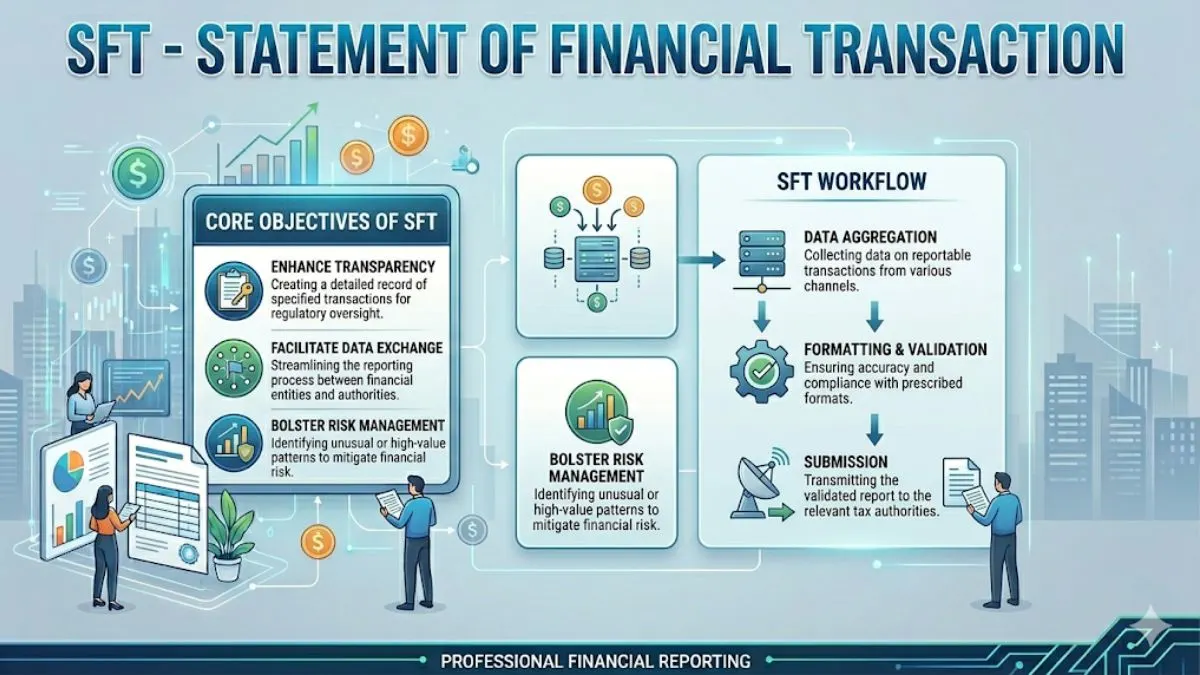
The Statement of Financial Transaction (SFT) is a report submitted by institutions to the tax department.
It includes:
- Details of the transaction
- PAN of the individual involved
- Nature and value of transaction
This is submitted using:
Form 61A
And the deadline is usually:
May 31st every year
Procedure for Registration and Submission of SFT
Now let’s talk about how reporting actually happens.
Step 1: Registration
Reporting entities must register on the income tax reporting portal.
Step 2: Data Collection
They collect transaction data that crosses specified thresholds.
Step 3: Report Preparation
Details are compiled in the required format (Form 61A).
Step 4: Submission
The report is submitted online before the due date.
Step 5: Verification
Authorities use this data for cross-checking with tax returns.
How Section 285BA Impacts You
Even though you don’t file SFT yourself, it still affects you.
Here’s how:
- Your transactions are being reported
- Your income is matched with your financial activity
- Any mismatch may trigger notices
Example:
If you deposit a large amount in your bank account but your income does not justify it, it may raise questions.
What Happens If Reporting is Not Done?
For reporting entities, non-compliance can lead to:
- Penalties
- Legal consequences
- Increased scrutiny
For individuals:
- Mismatch alerts
- Notices from tax department
- Further investigation
So even if you are not directly responsible, accurate financial reporting matters.
Common Mistakes People Make
Most issues happen because of small mistakes.
- Not linking PAN with transactions
- Ignoring large cash deposits
- Underreporting income
- Assuming “no one will notice”
But with Section 285BA, the system is already watching.
How to Stay Safe and Compliant
You don’t need to panic.
Just stay clear and consistent.
- Always report correct income
- Avoid unexplained cash transactions
- Keep proper documentation
- Match your transactions with your tax returns
Section 285BA vs Other Compliance Rules
This section works alongside other reporting mechanisms.
It doesn’t replace them.
Instead, it strengthens the system by creating a data network that tracks financial activity.
Key Takeaway
Section 285BA of the Income Tax Act is not about targeting individuals.
It is about building transparency.
- It ensures large transactions are reported
- It helps authorities verify income accuracy
- It reduces tax evasion
For you, it simply means:
Be honest and consistent with your financial records
FAQs on Section 285BA of the Income Tax Act
1. Do individuals need to file SFT?
No. Only specified reporting entities are required to file it.
2. What is the due date for SFT filing?
Usually May 31st every year.
3. What happens if my transaction is reported?
Nothing, as long as it matches your declared income.
4. Can I avoid reporting by splitting transactions?
Not effectively. Systems are designed to detect such patterns.
5. Is SFT the same as AIR?
SFT replaced AIR, but both serve similar purposes.
6. Will I get a notice if my transaction is reported?
Only if there is a mismatch or inconsistency.
7. Is PAN mandatory for these transactions?
Yes, PAN linkage is crucial for tracking.
Final Thought
The financial system today is more connected than ever.
With tools like Statement of Financial Transaction (SFT) under Section 285BA, transparency is no longer optional.
But that’s not a bad thing.
If your records are clean, this system actually protects you.
Want expert help in handling high-value transaction reporting, tax notices, or compliance issues? Get professional assistance from Callmyca.com and manage your taxes the smart way.