Can we pay the advance tax after 15th June?
yes, you can, but you might end up paying interest. The advance tax system in India works on a "pay-as-you-earn" basis, with specific advance tax dates throughout the year. The first instalment is due by 15 March 2026. Wait, let me clarify – the financial year runs from April to March, so the first instalment is due by 15 June. March 15 is the last date to pay the advance tax for the final instalment. So if you miss the 15th June deadline, you haven't lost everything – but you'll need to catch up quickly to avoid extra charges. Let me answer all your questions.
1. Who is not eligible to pay advance tax?
Quite a few people, actually. Under the Income Tax Act in India, one does not have to pay advance tax in case his/her total tax liability during the fiscal year is below ₹10,000. Another exception to paying advance tax includes a resident senior citizen aged 60 years or more, & whose income is not from a business or profession. However, any assessee whose estimated tax liability for the financial year exceeds Rs 10,000 is liable for payment of advance tax. One more exception – senior citizens (60 years or above) without business income are exempt. Taxpayers who opt for the presumptive taxation scheme u/s 44AD also have different, simpler rules."
2. Do salaried people have to pay advance tax?
Mostly no, but there are exceptions. Salaried employees rarely pay advance tax because employers deduct Tax Deducted at Source (TDS). So generally, salaried people need to pay advance tax only in special cases. However, if your net tax liability exceeds ₹10,000 in a financial year, you must pay it in ad-hoc circumstances (e.g., job changes, rental income, or capital gains). So to answer "Is Advance Tax Payment Mandatory for Salaried Employees" – it's not mandatory through advance tax forms, but Salaried individuals can pay advance tax voluntarily if they have extra income. Advance Tax for Salaried Individuals is rare, but Salaried individuals should still check if they have to pay Advance Tax based on their total income."
3. Who has to pay advance taxes?
The rule is simple & applies to almost everyone. In India, anyone whose estimated tax liability exceeds ₹10,000 for the financial year (after deducting TDS & TCS) must pay advance tax. This rule "Pay-As-You-Earn" applies to everyone – salaried individuals, freelancers, businesses, and corporations. So whether you're a Self-employed professional or a company, you're covered. For tax purposes, advance tax is for taxpayers across the board. All types of assessees are liable to pay advance tax if their liability crosses that ₹10,000 mark."
4. What will happen if I don't pay advance tax?
Honestly, it's not a penalty – it's interest, but it adds up. If your total tax liability is ₹10,000 or more & you fail to pay advance tax, you will face penal interest charges under the Income Tax Act. That said, there is no penalty for non-payment of advance tax – only interest. Specifically, an interest of 1% will be charged per month or part of a month. So you will be liable to pay interest on the shortfall. To avoid unnecessary penalties and interest charges, it's best to stay on top of payment of advance tax. If you delay, you'll be charged 1% interest on the outstanding amount. Late payment may result in interest charges under sections 234B & 234C."
5. Is today the last date for advance tax?
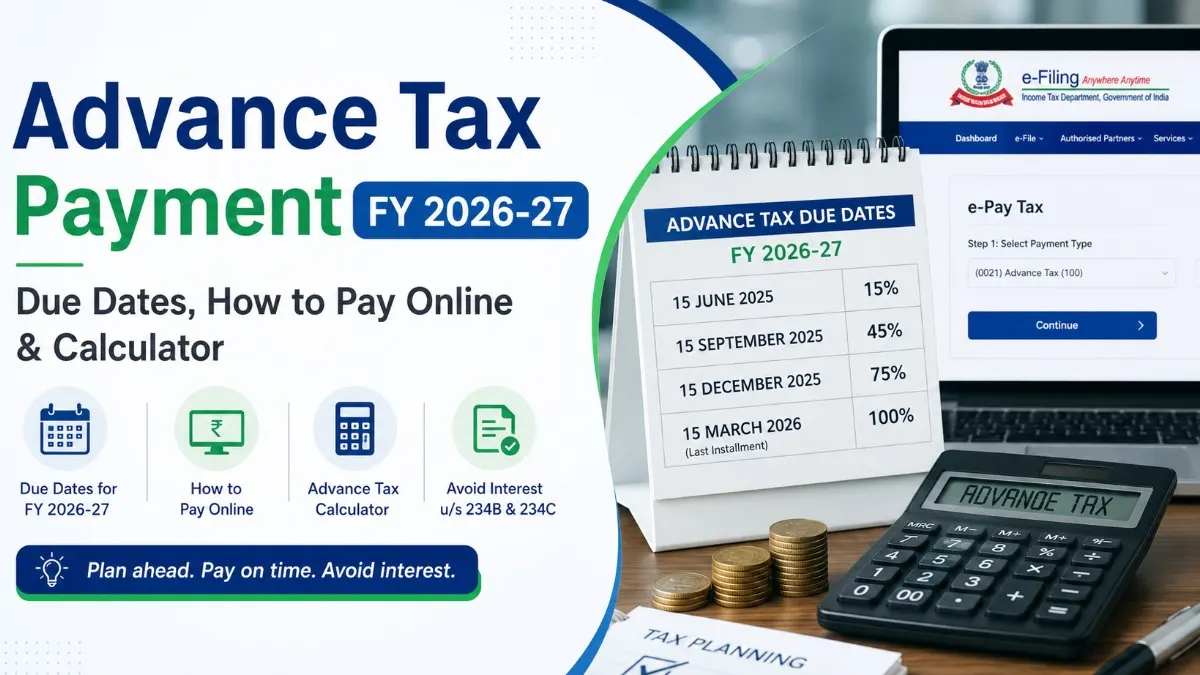
No, today is not the last date for advance tax. The primary advance tax installments are spread throughout the financial year on fixed dates. The upcoming deadlines are as follows – let me list them clearly. For FY 2025-26, the first installment is due by 15 March 2026? No – that's the final one. Let me correct: June, 2026 is the first installment? Actually, the financial year starts April 1. The first advance tax dates are: On or before June 15, 15% of your tax liability. Then September 15 (45%), December 15 (75%), and finally 15 March is the last date to pay advance tax (100%). So if you're reading this near June 15 – yes, that deadline is coming. But March 15 is the last date to pay advance tax for the full year. The due date is 30th April? No, that's for filing returns. Just remember: June 15, 2026 is the first cutoff.
6. How to avoid 234B & 234C?
It's actually very simple. Sections 234B and 234C of the Indian Income Tax Act are penal interest charges levied when a taxpayer's tax liability exceeds ₹10,000 for the financial year and they fail to pay or underpay their advance tax. To avoid them, you can avoid additional interest liability u/s 234B or 234C by just paying on time. Make sure to pay the advance tax in full and on time. Also, file returns on time and meet the specified deadlines. The golden rule – paying advance tax on time helps you avoid paying extra under Sections 234B and 234C. Pay advance tax in full according to the schedule. 234B and 234C only trigger when you're late. How to avoid interest u/s 234B and 234C is simple – follow the dates. Proper planning and quarterly payments help avoid penalties, so make sure you file advance tax correctly. And remember, pay advance tax on time as per the scheduled dates.
7. What if I pay extra advance tax in India?
Don't worry – you get it back. If you pay more advance tax than your actual final tax liability, the excess amount is simply refunded to you by the Income Tax Department once your filed return is processed. So that excess advance tax isn't lost. The excess amount will be refunded by the Income Tax Department after you file your ITR. In short, you can get any excess tax paid back as a refund. So even if you pay more advance tax than needed, the government returns the difference. No harm done, just a small delay.
8. What is the difference between 234B and 234C?
This confuses a lot of people, so let me break it down clearly with a chart.
Under the Indian Income Tax Act, 234B and 234C are penalty interest charges for failing to pay advance tax. 234B applies if you completely fail to pay advance tax, or if the advance tax you paid is less than 90% of your total assessed tax liability. 234C applies if you miss the due dates for quarterly installments of advance tax during the financial year.
Here's the difference at a glance:
|
Feature |
Section 234B |
Section 234C |
|
What it covers |
Section 234B imposes interest on taxpayers who fail to pay advance tax altogether OR pay less than 90% of total assessed tax |
Applies when you miss specific quarterly installment due dates |
|
When it applies |
At the end of the financial year, if 90% of tax isn't paid |
During the year, for each missed quarterly deadline |
|
Interest rate |
1% per month or part of a month |
1% per month on the shortfall for that quarter |
|
Main trigger |
Section 234B interest is imposed for non-payment or underpayment of advance tax overall |
Missing individual due dates (June 15, Sept 15, Dec 15, March 15) |
|
Purpose |
Penalizes not paying enough by year-end |
Penalizes not paying on time during the year |
So in simple terms – 234B & 234C both charge interest, but What is the difference between them is timing. 234B looks at your total year. 234C looks at each quarter. The difference between them matters because you could face one, the other, or both depending on your payment pattern.
9. How to calculate and pay advance tax?
It's easier than you think. You are required to pay Advance Tax if your total estimated tax liability for the financial year exceeds ₹10,000. Calculate it by estimating your total income across all sources, deducting eligible tax exemptions and deductions, computing your tax slab liability, and subtracting any prepaid taxes (TDS/TCS). To learn How to calculate Advance Tax, you first Compute your GTI (Gross Total Income). Remember, advance tax is the income tax paid in advance in installments. Step 1: Go to the e-Filing portal homepage, then calculate gross income from all sources for the financial year. For the December 15 deadline, you'll be calculating 75% of the total tax liability minus any tax paid before December 15th. Then pay online through the portal. Simple.
10. Is the advance tax deadline extended?
As of now, no extension has been announced. The advance tax final installment is due by 15 March 2026. That's the extended date? Actually, no extension – March 15 is the standard deadline. The deadline for the final instalment of Advance Tax for FY 2025-26 is due by 15 March 2026. Mark your calendar – Sunday, March 15, 2026 is the last date to pay without incurring interest under 234B. Keep an eye on announcements, but don't assume an extension.
Start your journey of filing ITR throug- Callmyca.com click here