Form 16 Renamed Form 130: What Every Salaried Employee Needs to Know
The first time I got to hear that the Form 16 is getting replaced, I felt a little panic. After all, I have used the Form 16 for many years now. Each year, during tax season, I keep waiting for it. I need it. If not, the process of filing my returns becomes like working in the dark. Isn’t it?
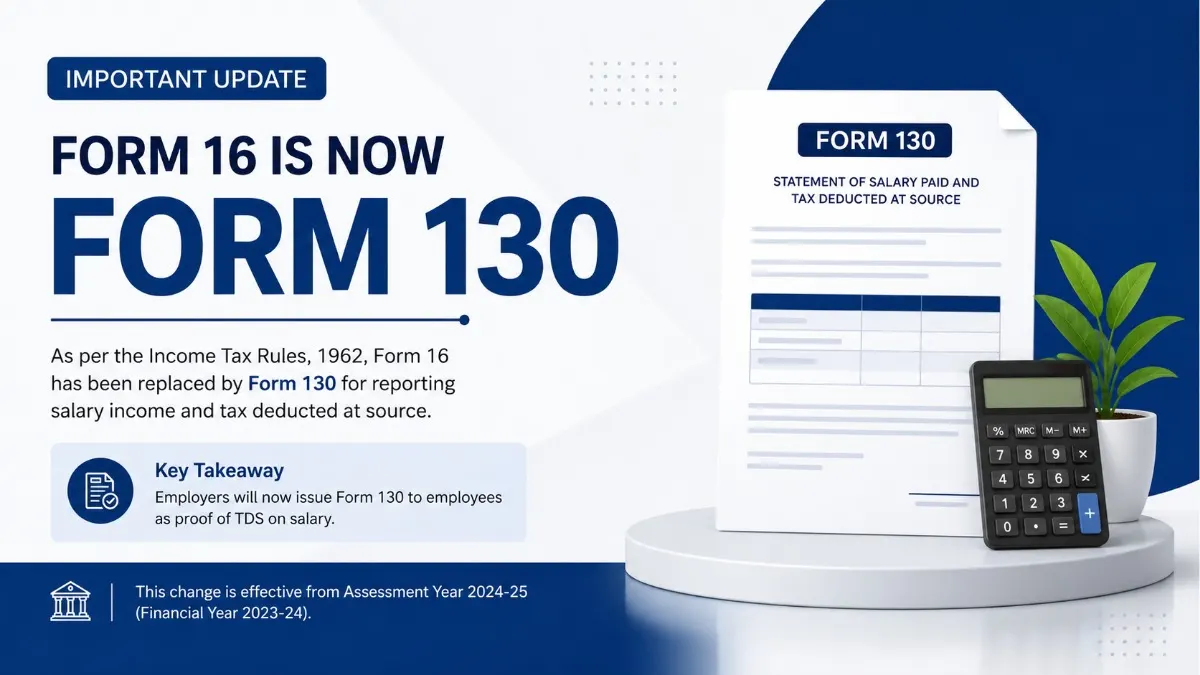
Well, here is the truth. Under the new Income Tax Rules, Form 16 has officially been replaced by Form 130.
That is correct. The long-standing tax deduction form used to be known as Form 16, but now it has another name. The old Form will be decommissioned after having served for several decades. It has now been renamed from Form 16 to Form 130, effective April 1, 2026.
But do not worry, your homework is done by me. I have read the new regulations, spoken to some CAs, and even referred to the notifications. Allow me to make things clear without using any tax language at all. I promise.
Why Did They Change the Name?
You might be thinking – why fix something that is not broken? Form 16 has been around forever. Our parents used it. We use it. Why change it now?
The answer is the new Income Tax Act, 2025. The government did not just make small changes this time. They rewrote the entire income tax law from scratch. Old section numbers are gone. New ones have arrived. And along with that, many old Form numbers have also been changed.
Form 16, 16A and 26AS are being renumbered from 1 April 2026.
So do not take it personally. It is not just Form 16 that is being targeted. The government is renumbering many forms to match the new law. Think of it like spring cleaning. Old things go out. New things come in.
Here is the important part for right now:
For the financial year 2025-26 (the return you will file in 2026), your employer will still give you the old Form 16. The change starts from the next financial year – which is April 1, 2026 onwards.
So if you are filing your return today, do not go looking for Form 130. You will not find it yet. You have one more year of the old Form 16. Use it well.
What Exactly Is Form 16?
Now let me revert to the basics for a while. Since not everyone knows what a Form 16 is. But that is alright.
Form 16 is a TDS certificate. But it is a technical term, which means nothing until you put it into context.
Suppose you earn a salary every month. The employer deducts some tax on your salary, which may be around ₹5,000 or ₹10,000.
They send that money to the government on your behalf. Form 16 is the receipt that proves your employer actually did this. It is like a "paid" stamp on your tax bill.
But it is much more than just a receipt.
It remains the standard TDS (Tax Deducted at Source) certificate issued by your employer to summarise your salary, deductions, and tax paid for the year.
Think of it as a one-page summary of your entire year's financial life. It tells you:
- How much you earned in total from your job
- Which parts of your salary were tax-free (like HRA, LTA, etc.)
- Which deductions you claimed (like 80C for LIC, PPF, or ELSS)
- How much tax was already deducted from your salary month by month
Without this single piece of paper, filing your income tax return is a headache. A big one. Trust me. I have tried filing without it once. I had to open 12 payslips, add everything manually, and pray I did not miss anything. Never again.
The Two Parts of Form 16 (Now Form 130)
One thing that is NOT changing is the structure. Form No. 130 replaces Form 16, but it still has two parts. Let me explain both in detail.
Part A – The "Proof of Payment" Part
This part comes directly from your employer. It is the official part. Think of it as the government's way of tracking that the money actually moved from your employer's pocket to the government's bank account.
Part A includes:
- Your employer's name, address, and TAN number (Tax Deduction Account Number)
- Your name and PAN
- How much TDS was deducted every three months (quarterly breakup)
- The dates when your employer sent that tax to the government
Why does Part A matter? Because if there is ever a dispute – say the government says you did not pay tax even though your salary was cut – Part A is your proof. It is your shield.
Part B – The "How They Calculated" Part
This is the part you will actually use while filing your return. This is where the real action happens.
Part B includes:
- Your full salary breakup – basic pay, dearness allowance, house rent allowance, special allowance, bonus, everything
- Which allowances were tax-free under Section 11 of the new Act (like HRA, LTA, children's education allowance)
- Which deductions you claimed under Chapter VIII of the new Act (this is the new name for Chapter VI-A, where 80C, 80D, etc. live)
- Your final taxable income after all these adjustments
- How much tax you should have paid, including surcharge and cess
Part B is your best friend during tax filing season. It does all the math for you. You do not need to calculate anything. Just copy the numbers from Part B into your ITR form. That is it.
What Details Will You Find in the New Form 130?
Let me make a simple table for you. This is exactly what you will see in the new Form when it starts coming in 2027 for FY 2026-27.
|
Part |
What You Will Find Inside |
|
Part A |
Employer name, address, and TAN |
|
Part A |
Your name and PAN (double-check this!) |
|
Part A |
Quarterly TDS deducted from your salary |
|
Part A |
Dates when TDS was deposited to the government |
|
Part B |
Your full gross salary – every single component |
|
Part B |
Exempt allowances under Section 11 (new Act) |
|
Part B |
Deductions under Chapter VIII (new Act) |
|
Part B |
Your total taxable income after all deductions |
|
Part B |
Tax, surcharge, cess, and any rebate under Section 87A |
Same information. Different section numbers. Do not let the new numbers scare you. It is like a friend changing their phone number – annoying at first, but once you update your contact list, it is fine.
How to Download Form 16 (And Eventually Form 130)
This is where many people get confused. I have seen friends waste hours trying to download Form 16 from the wrong place. Let me clear it up once and for all.
For Employers (The People Who Give You the Form)
If you are an employer or work in HR, here is how you download Form 16 from the TRACES portal (https://www.tdscpc.gov.in):
- Log in using the company's PAN as your User ID and your password
- Go to the 'Downloads' tab and select 'Form 16'
- Pick the correct financial year (do not pick the wrong year, or you will get old data)
- Verify all PAN and TDS details – one mistake here and everyone's forms will be wrong
- Enter the TDS receipt number and the tax amount
- Click submit and wait for processing
- Once processed, download the Form from the 'Downloads' section
For Employees (You and Me)
Here is something very important. And I cannot stress this enough.
Employees cannot download Form 16 on their own from any government website.
I repeat – you cannot log into the income tax portal (incometax.gov.in) and download your Form 16. That is not how it works. I have seen so many people try this and get frustrated.
Why? Because Form 16 is a certificate that your employer is legally required to give YOU. It is not a government document that you can generate yourself. Your employer creates it, certifies it, and gives it to you.
So how do you actually get it?
- Ask your HR department directly
- Check your company's employee portal (like SAP, Zoho, Keka, or any payroll app)
- Ask your payroll team – they usually have a schedule for releasing Form 16s
What if you changed jobs during the year?
You need Form 16 from BOTH employers. Contact your previous employer's HR. They still have your records. Most companies keep digital records for at least 6-7 years.
What if you lost your Form 16 from an old job?
Again, contact that company's HR. They can usually give you a copy. Some companies have alumni portals where you can download old documents. Check there first.
Form 16 Password: How to Open That Annoying PDF
I know this frustration. Trust me, I have been there.
You finally get the email. You download the PDF. You double-click it with excitement. And then – a password box appears. Your heart sinks. Why do they do this to us?
The answer is simple. It is for your security. The PDF contains your personal tax details – your PAN, your salary, your TDS. If it fell into the wrong hands, someone could misuse it.
Here are the most common passwords that actually work. Try them in this order:
Try these combinations:
- Your PAN in lowercase your date of birth in DDMMYYYY format
- Example: abcde1234f31121990
- This works for most companies
- Example: abcde1234f31121990
- Only your PAN in lowercase
- Example: abcde1234f
- Example: abcde1234f
- Only your PAN in uppercase
- Example: ABCDE1234F
- Example: ABCDE1234F
- Only your date of birth in DDMMYYYY format
- Example: 31121990
- Example: 31121990
- Your date of birth in DDMMYYYY format your PAN in lowercase
- Example: 31121990abcde1234f
- Example: 31121990abcde1234f
If none of these work, do not waste hours guessing. Just call your HR or payroll department and ask. Every company has its own format sometimes. Some companies use "password123" – yes, really. Some use the employee ID. Just ask.
Big Announcement: Forms 16, 16A & 26AS to Be Re-numbered
This is not an announcement limited to Form 16 alone. It involves a complete overhaul.
Forms 16, 16A & 26AS will be re-numbered from 1 April 2026.
Here is a quick reference for you to save.
|
Old Form Name |
What It Was For |
New Form Number (from April 1, 2026) |
|
TDS certificate for salary |
Form 130 |
|
|
Form 16A |
TDS certificate for non-salary income (interest, rent, commission) |
New number coming (not yet announced) |
|
Annual Information Statement – your complete tax statement |
New number coming (not yet announced) |
It therefore shouldn’t surprise you when you come across new form numbers in the next few months. The government is gradually adjusting all its forms according to the Income Tax Act, 2025. It is a gradual process that will be completed by the year 2027.
Difference between Form 16, Form 16A and Form 16B
There is no end to the questions that are raised on this topic. There are times when I have found people confusing the differences between these forms.
Think about three different income streams that an individual might have:
Form 16 (now Form 130) – Income from salary. Your employer gives it to you once a year, usually in May or June. It covers only the tax deducted from your salary.
Form 16A – This is for other income. Let us say you have a fixed deposit in a bank. The bank earns interest on that FD. They deduct TDS on that interest every three months. Then they give you Form 16A as proof. You also get Form 16A if you receive rent, commission, or professional fees.
Form 16B – This is for selling property. If you sell a house or land worth more than ₹50 lakh, the person buying your property has to deduct 1% TDS. They then give you Form 16B as proof.
|
Particular |
Form 16 (now Form 130) |
Form 16A |
Form 16B |
|
What is it for? |
Salary from your job |
Interest, rent, commission, professional fees |
Selling property (land or building) |
|
Who gives it to you? |
Your employer |
Banks, tenants, companies paying you |
The person buying your property |
|
How often do you get it? |
Once a year |
Every three months (quarterly) |
Every time you sell a property |
|
Minimum amount? |
Income above basic exemption limit |
Varies by section – for FD interest, it is ₹40,000 |
Property value above ₹50 lakh |
So if you have a salary, a fixed deposit, and you sold a house last year – you will get all three forms. Each one is different. Do not mix them up. And definitely do not throw away any of them.
Difference Between Form 16 and Form 26AS
Another common confusion. Let me clear it up with a simple comparison.
Form 16 is like a receipt from your employer. Form 26AS is like a master statement from the government.
|
Particular |
Form 16 (Form 130) |
Form 26AS |
|
What is it? |
TDS certificate from your employer |
Annual Information Statement from the Income Tax Department |
|
Who gives it to you? |
Your employer |
Income Tax Department (you download it yourself) |
|
What does it show? |
Only your salary and the TDS on that salary |
Everything – salary TDS, bank interest TDS, rent TDS, advance tax, self-assessment tax, high-value transactions like buying a car or property |
|
Can you download it yourself? |
No, your employer gives it to you |
Yes, from the income tax portal (incometax.gov.in) |
|
Found an error? |
Contact your employer |
Contact the person who deducted TDS (your bank, your tenant, etc.) |
Here is a pro tip that saves my skin every single year:
Always match your Form 16 with your Form 26AS. Open both. Put them side by side. The TDS amount in both should be exactly the same. Down to the last rupee.
If there is a difference – even ₹100 – something is wrong. Your employer might have used the wrong PAN. Or they might have deposited the TDS late. Or there could be a data entry error. Call your HR immediately. Do not file your return until it is fixed. I learned this the hard way.
Who Actually Gets Form 16? (And Who Does Not?)
Not every employee gets Form 16. Let me be very clear about this.
You Will Get Form 16 If:
- You are a salaried employee (not a business owner, not a freelancer, not a consultant)
- Your employer deducted TDS from your salary during the year
- Your total income is above the basic exemption limit (currently ₹2.5 lakh for people under 60, ₹3 lakh for 60-80, ₹5 lakh for above 80)
You Will NOT Get Form 16 If:
- Your income is below the taxable limit and no TDS was deducted from your salary
- You are self-employed or a freelancer (you get different forms like Form 16A from clients who deducted TDS)
But here is a small tip – many companies still issue Form 16 even if no TDS was deducted. It is a good practice. It gives you a clean record of your salary for loan applications. So do not be surprised if you get one even when you paid zero tax.
What If You Changed Jobs During the Year?
This happens to so many people. You switch jobs in May or October. Or maybe in March, just before the financial year ends. Now you have two employers in one financial year.
Here is what you need to do – and do not skip this step.
Collect Form 16 from BOTH employers.
Each employer will give you a separate Form 16 for the months you worked with them. The first employer covers April to your last month. The second employer covers your joining month to March.
When you file your ITR, you will:
- Add the income from both Forms carefully
- Add the TDS from both Forms – this is the total tax you already paid
- File a single return combining everything
Do not lose the Form 16 from your old employer. I cannot stress this enough. Without it, you will not know how much tax was already deducted from your salary before you joined the new company. Your new employer only knows about the salary they paid you. They have no idea what your old employer did.
If you have already left your old job and did not collect your Form 16, call their HR department. Most companies keep digital records for many years. They will help you. Be polite. Be patient. They get hundreds of such requests.
Why Is Form 16 (Now Form 130) So Important?
Let me give you three real, practical reasons why you should care about this piece of paper. Not theoretical reasons. Real ones.
1. It Proves You Paid Your Tax
Your salary comes to your bank account after your employer cuts TDS. But the government does not automatically know that. The government only knows what your employer tells them. Form 16 is the proof that your employer actually sent that tax to the government. Without it, if there is a mismatch in the government's records, you have no way to prove you paid.
2. You Cannot File Your ITR Properly Without It
When you file your income tax return, you need three things:
- Your exact salary amount for the full year
- The exact TDS amount that was deducted
- The deductions your employer already considered (like HRA, 80C, etc.)
All of this is in Form 16 – neatly organized, pre-calculated, and ready to copy. Without it, you will have to open 12 months of payslips and add everything manually. It is possible. I have done it once. But it took me 3 hours and I still made a mistake.
3. Banks Ask for It When You Take a Loan
Applying for a home loan? Car loan? Personal loan? Credit card with a high limit? Almost every bank will ask for your last 2-3 years of Form 16. It is their way of verifying your income. They do not trust your word. They do not trust your payslips (too easy to fake). They trust Form 16 because it comes from your employer and is also reported to the government.
So even if your income is below the tax limit, keep your Form 16 safe. You will need it for loans.
What to Check in Your Form 16 (Before You File Your Return)
Do not just save the PDF and forget about it. Take 10 minutes – that is all – to check these things. It could save you months of headache later.
1. Your Personal Details
- Is your name spelled exactly as it appears on your PAN card? One letter off and the tax department's computer will not match your return.
- Is your PAN correct? One wrong letter or number will cause a complete mismatch.
- Is your address correct? (This is less critical, but still check.)
2. The TDS Amount
- Does the TDS amount shown in Part A match what is shown in your Form 26AS?
- Does it match the year-end TDS number shown in your last payslip of the financial year?
3. Your Salary Breakup
- Is your basic salary correct?
- Are all allowances shown properly? (HRA, LTA, special allowance, etc.)
- Is HRA correctly calculated if you claimed it?
4. Your Deductions
- Did your employer include all the 80C deductions you told them about? (LIC, PPF, ELSS, etc.)
- Did they include your 80D medical insurance premium?
- If something is missing, you can still claim it in your ITR. But check anyway so you know what to add manually.
5. Your Final Taxable Income
- Does the final number look right to you?
- If your taxable income is ₹20 lakh but you only earn ₹12 lakh, something is clearly wrong. Do not file.
What If You Find an Error?
Do not ignore it. I made that mistake once. I thought "how bad can it be?" It was bad. I got a notice. I had to pay a penalty. I spent weeks talking to officers.
Call your HR or payroll department immediately. They can file a revised TDS return and give you a corrected Form 16. It takes time – sometimes 2-3 weeks. But it is worth it. Filing a wrong ITR can get you a notice, penalties, and endless stress.
Old vs New: A Simple Comparison Table
Since we are in the middle of this transition between the old and new tax laws, let me show you how section numbers have changed. This will help you when you see references in the new Form 130.
|
Topic |
Old Act (1961) |
New Act (2025) |
|
TDS certificate issuance by employer |
Section 203 |
Section 395(4) |
|
Exempt allowances (HRA, LTA, etc.) |
Section 10 |
Section 11 read with Schedule II to VII |
|
Deductions (80C, 80D, etc.) |
Chapter VI-A |
Chapter VIII (Section 122 onwards) |
|
Relief for salary arrears |
Section 89 |
Section 157 |
|
TDS on property purchase |
Section 194-IA |
Section 393(1) |
Do not panic when you see "Section 11" instead of "Section 10." It is the same thing. Same rules. Different numbers. It is like when your favorite restaurant moves to a new location – the food is the same, the address is just different.
My Personal Take (From One Taxpayer to Another)
I have been filing my own tax returns for over ten years. Every year, between May and July, I wait for that email from my HR – "Your Form 16 is ready." It is like a ritual now.
When I first heard that Form 16 has been renumbered as Form 130, my heart sank a little. I do not like change. Especially change related to taxes. It always feels complicated and scary.
But then I actually sat down and read the new rules. I called a CA friend. I checked the official notifications. And you know what I realized?
Nothing is really changing.
Form No. 130 replaces Form 16 – but it does the exact same job. It tells you your salary. It tells you your deductions. It tells you your TDS. It helps you file your return. It proves your income for loans.
Only the name on the paper is different. That is it.
So here is my advice to you. Do not stress about this. Do not lose sleep over it. Just remember one simple thing:
- For this year (FY 2025-26) – Ask your HR for Form 16
- From April 1, 2026 onwards (FY 2026-27) – Ask your HR for Form 130
That is the only change you need to remember. Everything else stays the same.
Summary: What You Actually Need to Remember
Let me end with a simple checklist. Save this somewhere. Bookmark this page. Share it with your colleagues who are also confused.
✅ For the current financial year (FY 2025-26):
- You will still get the good old Form 16 from your employer
- The old section numbers (Section 10, Section 80C, Chapter VI-A) still apply
- File your return as you always have – no change needed
✅ From April 1, 2026 (FY 2026-27 onwards):
- Under the new Income Tax Rules, Form 16 has officially been replaced by Form 130
- Ask your employer for Form 130, not Form 16
- The new section numbers apply (Section 11, Chapter VIII, etc.)
- Form 16, 16A and 26AS are being renumbered from 1 April 2026 – so expect more new numbers in the coming years
✅ Always, every year, no matter what:
- Check your Form for errors before you file your return
- Match it with your Form 26AS – the TDS amounts must be identical
- Keep it safely for at least 6 years (the government can reopen old cases)
- Use it to file your ITR correctly – do not guess, do not estimate
Need Help Filing Your ITR Using Form 16 or Form 130?
I get it. Tax filing is stressful. And now with Form 16 renamed as Form 130 and new section numbers everywhere, it is easy to make a mistake. One wrong entry in the wrong column and you could get a notice from the department. One missing deduction and you could pay more tax than you owe.
Do not take that risk. Your hard-earned money and your peace of mind are too valuable.
Visit Callmyca.com today and connect with a real Chartered Accountant who can help you file your return correctly using your Form 16 (or soon, Form 130). They will claim every deduction you are eligible for, double-check all your numbers, and keep you safe from scrutiny.