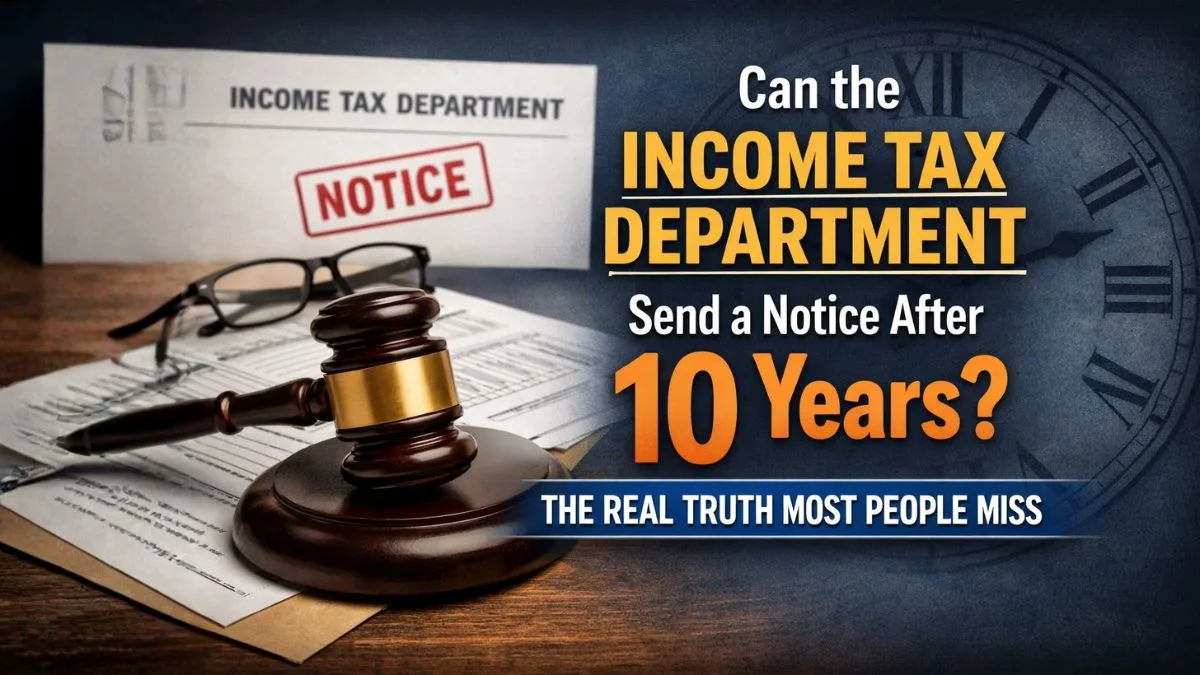
Can the Income Tax Department Send a Notice After 10 Years? The Real Truth Most People Miss
So… can they really send a notice after 10 years?
People usually think the tax department can suddenly wake up after a decade and question anything. That’s not exactly how it works. There are rules—very specific ones. And honestly, once you understand them, the fear reduces a lot.
Here’s the core idea you need to hold on to:
Yes, the Income Tax Department can send a notice after 10 years, but only in cases of significant tax evasion, typically involving untaxed income of ₹50 lakh or more, or involving undisclosed foreign assets. While normal reassessment has a 3-year limit, serious cases allow reopening up to 10 years.
The basic rule most people ignore"
For most taxpayers… nothing dramatic happens."
If you’ve filed your return properly, reported your income honestly, and there’s no major mismatch, the department usually has a limited window.
That’s where this comes in:
Notice to be issued within 3 or 10 years
This phrase sounds technical, but it’s actually simple:
- Up to 3 years → Regular cases"
- Up to 10 years → Only serious cases"
That’s it.
But here’s where things get interesting.
What happens in normal cases (the 3-year rule)
Most income tax notices fall under this category.
If there’s:
- Small mismatch in income
- Missed interest income
- Minor reporting error
- TDS mismatch
Then the department typically has 3 years to reopen your case.
After that?
They usually can’t touch it.
And honestly, this is where 90% of taxpayers fall. Nothing extreme. Just routine compliance.
Now think about this…
Why would the government need 10 years?
They wouldn’t… unless something serious is involved.
And that’s exactly the point.
When the 10-year rule actually applies
The extended timeline is not random. It kicks in only when there’s a big issue.
We’re talking about:
- Undisclosed income of ₹50 lakh or more
- Foreign assets not reported
- Income hidden through complex structures
- High-value transactions not explained
So yes, a Notice sent after many years is possible — but only when the stakes are high.
And here’s the important keyword again, clearly stated:
Yes, the Income Tax Department can send a notice after 10 years, but only in cases of significant tax evasion, typically involving untaxed income of ₹50 lakh or more, or involving undisclosed foreign assets. While normal reassessment has a 3-year limit, serious cases allow reopening cases up to 10 years.
If your case doesn’t fall into this… the 10-year fear is mostly irrelevant.
But can they go beyond 10 years?
Notices beyond 10 years cannot be issued.
That’s the outer boundary.
No matter how serious the case is, the department cannot legally go beyond this time limit.
So if someone tells you “they can reopen anything anytime”… that’s simply not true.
A confusing line people keep hearing
You might have seen something like this:
is legally allowed to send the taxpayers a notice in the next 8 years
Sounds odd, right?
Here’s what it actually refers to:
Earlier rules allowed reopening up to 6 years, then extended in certain cases. With new amendments, the framework now broadly sits between 3 &10 years.
So this “8 years” confusion comes from transitional interpretations or older provisions being discussed.
But today, practically speaking:
- Standard → 3 years
- Serious → 10 years
That’s the framework you should remember.
Real-life example
Let’s say:
Case 1: Normal salaried employee
Rahul earns ₹12 lakh per year. He forgets to report ₹40,000 interest income.
Worst case?
He may receive a notice within 3 years. After that, it’s mostly closed.
Case 2: High-value undisclosed income
Now imagine someone has:
- ₹80 lakh undisclosed capital gains
- Foreign bank account not reported
This is where things change.
The department can reopen the case even after several years — up to 10 years.
That’s when the extended rule applies.
Why the government keeps this long window
Big tax evasion cases are rarely simple.
They involve:
- Layered transactions
- Offshore accounts
- Delayed detection
- Data sharing between countries
So naturally, the department needs more time.
And that’s why income tax notices in such cases have a longer reach.
What if you receive a notice after many years?
First reaction? Panic.
But don’t.
Instead, do this step by step:
- Read the notice carefully
- Check the assessment year mentioned
- Identify the reason for reopening
- Compare with your filed return
- Gather supporting documents
And then… respond properly.
Silence is the worst mistake here.
Most people overlook this part
The notice itself doesn’t mean you’re guilty.
It just means:
“We want clarification.”
That’s it.
Many cases get resolved simply by:
- Providing bank statements
- Showing income proof
- Explaining transactions
So don’t assume the worst.
A small but important detail
Even within 10 years, the department cannot randomly reopen cases.
They need:
- Information suggesting income escaped assessment
- Proper approval from higher authorities
- Documented reasons
So there is a process. It’s not arbitrary.
Why this topic creates so much fear
Honestly?
Because people mix up:
- Old laws
- Half knowledge
- WhatsApp forwards
And suddenly it feels like the tax department has unlimited power.
They don’t.
They have structured timelines.
One more thing worth thinking about
If your financial life is clean & transparent, these long timelines shouldn’t bother you much.
But if there are:
- Large unexplained transactions
- Foreign dealings
- Cash-heavy activities
Then yes… you should be cautious.
Where most taxpayers go wrong
Not in evasion… but in ignorance.
They:
- Don’t keep records
- Ignore notices
- Delay responses
- Assume things will “go away”
They don’t.
Tax matters rarely disappear on their own.
A simple way to stay safe
You don’t need complicated strategies.
Just follow basics:
- File returns honestly
- Report all income sources
- Keep documentation for at least 8–10 years
- Reconcile AIS, TIS, & Form 26AS
- Respond to notices on time
That’s it.
Really.
Final thought
If you’re still wondering whether a notice after many years is something to worry about… take a breath.
Most people will never face the 10-year scenario.
And if they do, there’s always a reason behind it.
Still, tax notices can feel confusing. Sometimes unnecessarily technical. And that’s where having someone experienced makes things smoother.
If you ever find yourself dealing with income tax notices, especially a Notice sent after a long gap, getting proper guidance can save time, stress, & sometimes even money. Platforms like Callmyca.com can help you understand what’s actually happening—without overcomplicating it.
Because at the end of the day… clarity matters more than fear.