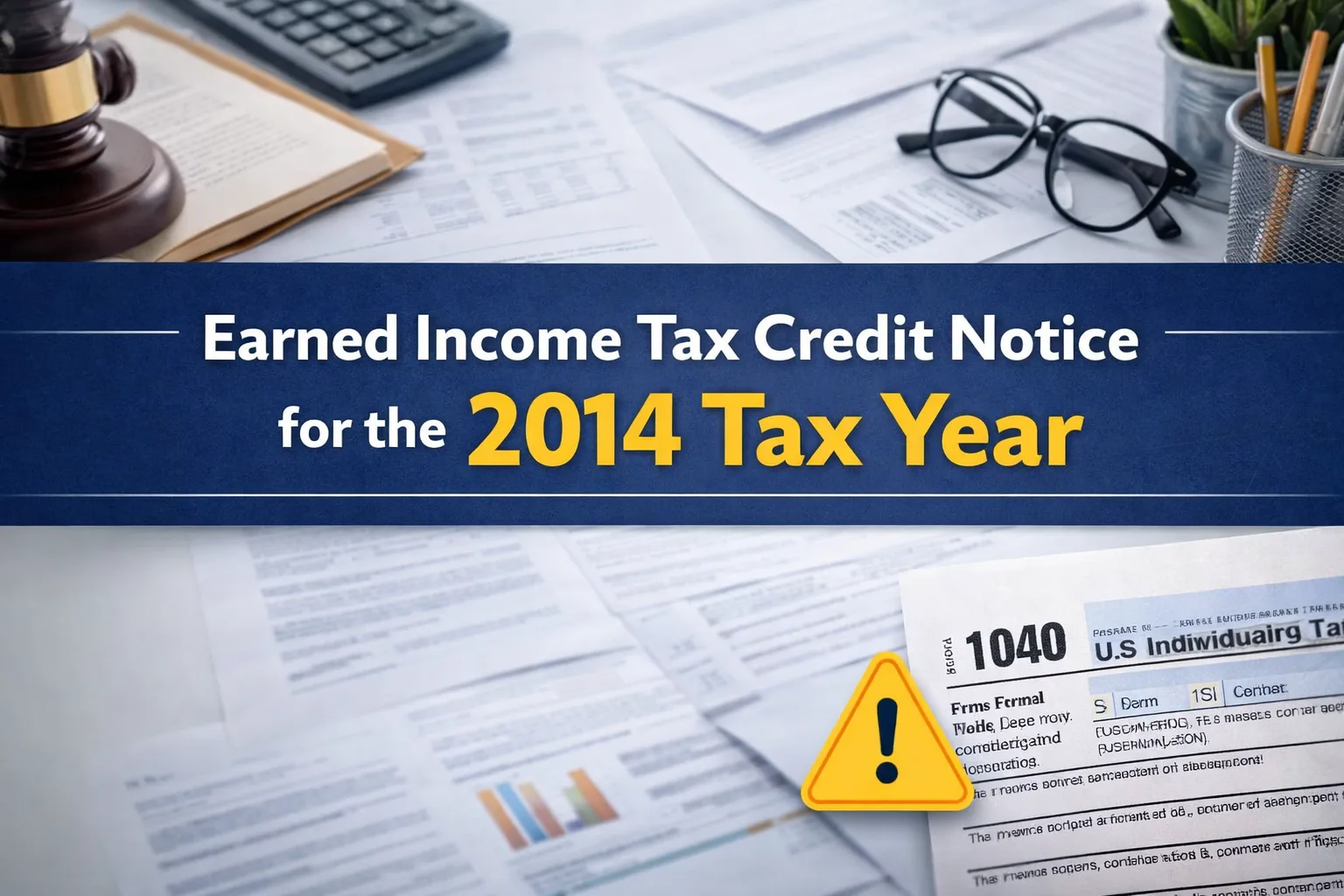
Earned Income Tax Credit Notice for the 2014 Tax Year
So… you received an earned income tax credit 2014 notice
Let’s be honest. Receiving a letter from the IRS, even if it's for something positive like a tax credit, can be a little unsettling.
You look at it for a moment. Then again.
And before you know it, a series of questions come to mind:
Did I do something wrong?
Am I being audited? or… is this actually good news?
Here’s the thing — an earned income tax credit 2014 notice isn’t always bad. In fact, sometimes it’s the IRS nudging you because you might be eligible for money you didn’t even claim.
What this notice actually means
Let’s pause for a second.
Most people assume any IRS notice = problem. That’s not entirely true here.
The keyword explanation says it clearly, and it’s important to understand it exactly:
A 2014 Earned Income Tax Credit (EITC) notice usually suggests that the IRS is checking or auditing a tax return filed for a given year. This could be due to a lack of income, incorrect child documentation, and filing errors. It requires a quick response to avoid any penalties. For the year 2014, the IRS may send CP09 or CP27 if you qualify but failed to claim it or Letter 5683 if adjustments are necessary.
Now think about that.
There are two sides to this:
- You missed claiming a benefit
- Or the IRS thinks something doesn’t match
Same notice category. Completely different implications.
The different types of 2014 EITC notices
1. CP09 Notice — “You might have missed your refund."
This is actually… good news.
It means:
- You filed your return
- You didn’t claim EITC
- But based on IRS data, you could have qualified
So the IRS is basically saying the following:
“Hey, you may be eligible. Want to claim it now?”
Simple enough.
2. CP27 Notice — “You didn’t file, but you should."
This one is slightly more serious.
It usually means:
- You didn’t file a return for 2014
- But your income suggests you qualify for EITC
So they’re encouraging you to file—because you could receive a refund.
3. Letter 5683 — “We need clarification”
Okay… now we’re entering audit territory.
This notice means:
- The IRS is reviewing your claim
- They need documents or an explanation.
- Something doesn’t match
Could be:
- Child eligibility issues
- Income discrepancies
- Filing errors
This one needs attention. Quickly.
Who was actually eligible for EITC in 2014?
Now let’s talk about eligibility. Because this is where many people get confused — or worse, assume things.
One key condition stands out:
Your 2014 earned income and adjusted gross income are both under $38,511
That’s a big deal.
If your income was above this threshold, chances are you didn’t qualify.
Other eligibility factors
Most people focus only on income. That’s not enough.
You also needed:
- Valid Social Security number
- Filing status (not “Married Filing Separately”)
- Qualifying child (in many cases)
- U.S. residency requirements
And here’s where people slip.
A small mistake in any of these — especially child-related claims — can trigger a notice years later.
How much was the EIC amount for 2014?
The EIC amount for 2014 depended on:
- Your income
- Number of qualifying children
Rough ranges looked like this:
- No children → up to around $496
- 1 child → up to around $3,305
- 2 children → up to around $5,460
- 3 children → up to around $6,143
Not small amounts.
Now imagine missing this entirely… or claiming it incorrectly.
That’s exactly why notices exist.
Why the IRS sends these notices years later
This part confuses people the most.
“Why now? It’s 2014!”
Fair question.
Here’s what happens behind the scenes:
- IRS data matching takes time
- Third-party reports (like employers) may come later
- Random audits are triggered
- Or system reviews identify missed credits
So even years later, they can:
- Offer refunds
- Or question your claim
It’s not random. Just… delayed.
What you should do after receiving the notice
Alright. Let’s get practical.
You’ve got the notice. Now what?
Don’t overthink it. Just follow this:
Step-by-step approach:
- Read the notice carefully
Sounds obvious, but most people skim and panic. - Identify the notice type
CP09? CP27? Letter 5683? - Check your 2014 return (if filed)
Compare what you filed vs. what the IRS says. - Gather the documents.
Especially if children or income is involved. - Respond within the deadline
This matters more than people think. - Avoid guessing
If unsure, pause and verify before replying.
Common mistakes people make
- Ignoring the notice completely
- Sending incomplete documents
- Claiming children without proper proof
- Not checking income mismatch
- Assuming it’s “just informational”
It’s not.
Even a small delay can turn a simple clarification into penalties.
What if you ignore the notice?
Short answer? Not a good idea.
Longer answer…
Ignoring an earned income tax credit 2014 notice can lead to the following:
- Loss of refund eligibility
- Additional scrutiny
- Future claim restrictions
- Penalties (in some cases)
Better to respond early than regret later.
Final thoughts
The key is understanding whether your notice is
- An opportunity
- Or a correction
And acting accordingly.
If you’re even slightly unsure — especially with documents, eligibility, or responses — it’s honestly smarter to get a second opinion. Platforms like Callmyca.com can help you review the notice properly and respond without unnecessary stress.