Introduction
Getting a notice from the income tax department is enough to make anyone nervous.
Most people immediately assume something is wrong with their tax return. Some panic. Others start searching online for answers.
But here’s the interesting part.
A message claiming to be from the Income Tax Department is left. Actually, such fake income tax notices are amongst the common scams and nothing less; scammers have become smart, as these days they purposely target taxpayers via e-mail/SMS & even WhatsApp messages.
These messages often look convincing. It can write formal logos, legalese, and even reference paragraphs of the Income Tax Act. Yet the entire message is fake.
So the real question is simple: how do you identify a fake notice from the Income Tax Department and make sure the notice you received is genuine?
Why Fake Income Tax Notices Are Increasing
In recent years, tax-related scams have grown rapidly.
Cybercriminals know that people fear government notices. When someone receives a message claiming to be from the Income Tax Department, their first reaction is anxiety. And scammers take advantage of that fear.
Here’s how most scams work.
A person receives an email or SMS saying they have an urgent notice regarding unpaid taxes, incorrect filing, or a pending penalty. The message then asks them to:
-
Click a link
-
Download a file
-
Pay a penalty immediately
-
Share bank details
This is where things become dangerous.
Because fake income tax notices are common scams, these messages are designed to push people into acting quickly without verifying the source.
But the truth is simple.
Real notices from the Income Tax Department follow a very specific process.
And once you know what to look for, identifying a fake Income Tax Department notice becomes much easier.
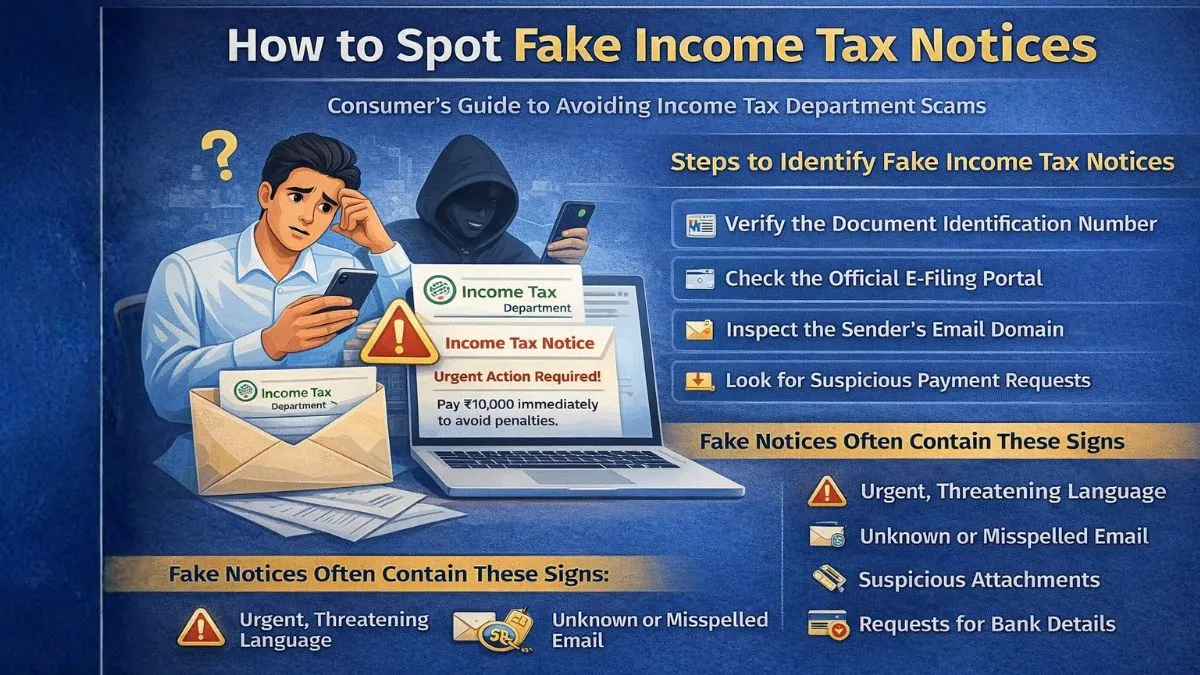
Step 1: Document Identification Number (DIN)
One of the key security features introduced by the government is the Document Identification Number (DIN).
A unique Document Identification Number (DIN) is prescribed in every official communication issued by the Income Tax Department.
This number allows taxpayers to confirm the communication is legitimate.
Most people don’t realize this, but the DIN is actually your strongest protection against fake tax notices.
Here’s what you should do:
-
Look for the Document Identification Number (DIN) on the notice.
-
Visit the official e-filing portal (incometax.gov.in).
-
Use the DIN verification feature available on the portal.
If the DIN does not exist in the system, the notice is very likely fake.
Always Check the official e-filing portal.
The e-filing portal (incometax. All official communications are archived on https://www.indiacode.nic.
Let’s understand how verification works.
How to check notice through online
Visit the e-filing portal (incometax.gov.in).
Simply log in using your PAN and password
Proceed to either e-Proceedings or Pending Actions
-
Check whether the Notice appears in your account
- If the notice appears in your portal dashboard, it is genuine.
- If it does not appear there, you should treat the communication as fake until proven otherwise.
This is the safest and most reliable method of verification.
Watch the Email Domain Carefully
Another simple but powerful verification method involves checking the sender’s email address.
Official emails from the Income Tax Department always come from domains such as
@incometax.gov.in
If an email claims to be from the tax department but comes from something like
Then it is almost certainly fake.
Government departments do not use Gmail, Yahoo, or other public email services.
So whenever you receive a suspicious message, take a moment to examine the email domain.
It tells you a lot.
Real Notices Never Ask for Payment Through Links
Here’s another critical point.
Real notices from the Income Tax Department never ask you to pay money through links sent in emails or SMS.
Let’s say you receive a message saying:
“Pay ₹10,000 immediately using this link to avoid legal action.”
That message is almost certainly fake.
The tax department does not collect payments that way.
Instead, tax payments are always made through the official portal or authorized banking channels.
So if a notice contains the following:
-
payment links
-
requests for bank details
-
requests for OTPs
-
requests for card numbers
You should assume it is a fake income tax department message.
And you should not click anything.
Signs That a Notice May Be Fake
Sometimes scammers try very hard to make their messages look real.
But even then, certain warning signs usually appear.
Watch out for these clues:
-
Urgent language demanding immediate payment
-
Spelling or grammar mistakes
-
Suspicious attachments
-
Unknown email domains
-
Requests for personal or banking information
Real communication from the Income Tax Department is usually formal, structured, and issued through official channels.
Scammers often rush the process.
That difference is not so apparent until you know what to look for.
What to Do If You Get a Suspicious Notice
It’s as easy as just a few steps.
Firstly, do not click on any links in the message.
To begin with, confirm the notice via the e-filing portal (incometax.gov.in).
Third, verify the Document Identification Number (DIN).
And if you still believe the notice is fraudulent, report it.
Suspicious emails can be reported to:
Reporting scams helps the Income Tax Department track fraudulent activities and warn other taxpayers.
So by reporting a fake Income Tax Department notice, you are actually helping protect others too.
Why Verification Is So Important
Tax scams are not just about misleading emails.
Sometimes scammers also create fake websites that look identical to government portals.
These sites try to steal login credentials or financial details.
That’s why experts always recommend one simple habit:
Always type the official website manually.
The correct website is:
e-filing portal (incometax.gov.in)
Never rely on links sent through unknown messages.
It takes only a few seconds to check the website address, but that small step can save you from serious financial fraud.
The Government’s Efforts to Prevent Fake Notices
To reduce scams, the government has introduced several safeguards.
Some of these include:
-
Mandatory Document Identification Number (DIN) for every notice
-
Digital records on the e-filing portal (incometax.gov.in)
-
Public awareness campaigns about fake tax messages
-
Official reporting channels for suspicious communication
These steps make it much harder for scammers to impersonate the Income Tax Department.
But awareness among taxpayers is still the most important defense.
The more people understand how verification works, the harder it becomes for fraudsters to succeed.
Final Thoughts
Receiving a Notice from the Income Tax Department can feel stressful at first.
But here’s the reassuring part.
Most genuine notices are simply requests for clarification or additional information. They are part of the normal tax administration process.
What you should really watch out for are fake notices designed to scare taxpayers into sharing money or personal data.
Remember these key rules:
-
Fake income tax notices are common scams
-
Always check the Document Identification Number (DIN)
-
Verify the notice on the e-filing portal (incometax.gov.in)
-
Trust emails only from @incometax.gov.in
-
Never share bank details through email or SMS
Once you follow these steps, identifying a fake Income Tax Department notice becomes straightforward.
And you can handle tax communications with much more confidence.
If you ever receive a confusing tax notice or need expert help responding to the Income Tax Department, professional guidance can make the process much easier. You can explore expert tax assistance and compliance support directly through CallmyCA.com, where specialists help taxpayers handle notices, filings, and tax issues smoothly.