
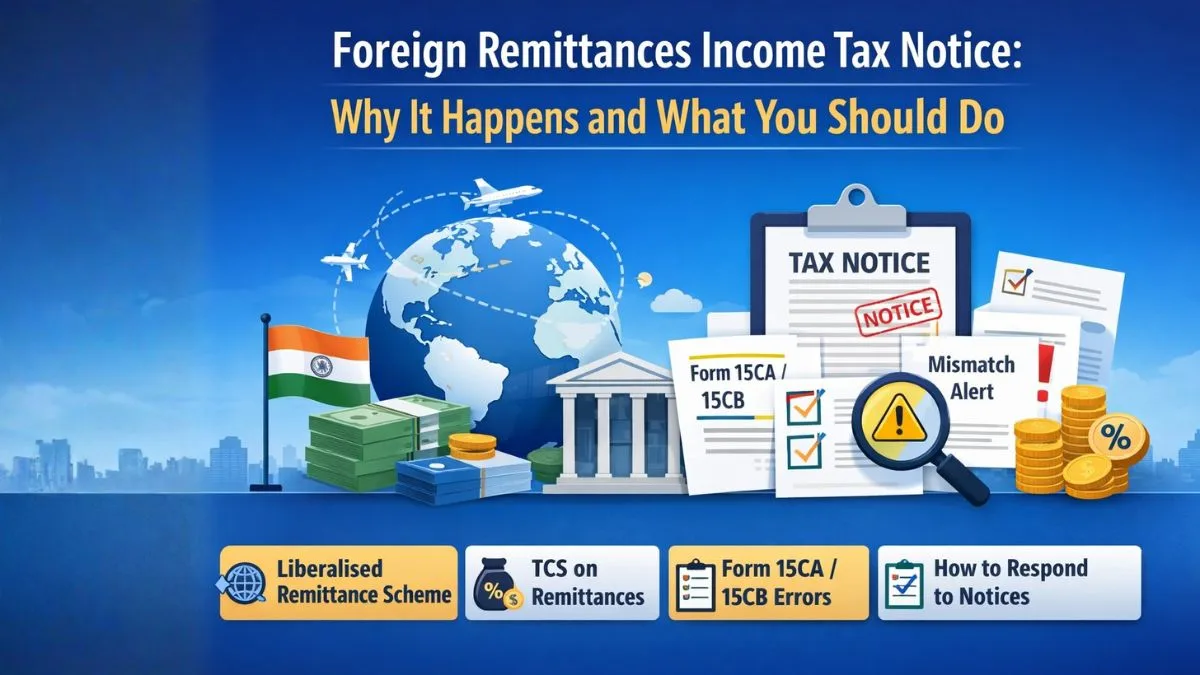
Foreign Remittances Income Tax Notice: Why It Happens and What You Should Do
Sending money abroad used to be a fairly quiet process. You walked into a bank, filled out a form, transferred the funds, and moved on with your day.
That was the earlier reality.
Today, things work differently.
Every remittance that leaves India leaves behind a digital trail. Banks report it. The system records it. And sometimes… the income tax department asks questions.
And that’s usually when people encounter something called a Foreign Remittances Income Tax Notice.
For many taxpayers, the notice arrives out of nowhere. Maybe months later. Sometimes even a year after the transaction.
Confusing? Yes.
But the reason behind it is usually simpler than people think.
Let’s walk through it slowly.
First, What Exactly Is a Foreign Remittance?
A remittance simply means sending money from one country to another.
Pretty straightforward.
If you transfer funds from India to a foreign account, that counts as foreign remittances.
People do this for all sorts of reasons:
- Paying for international education
- Sending money to children studying abroad
- Investing in global stocks
- Paying overseas vendors or freelancers
- Funding travel or medical treatment abroad
- Supporting family members living overseas
Nothing unusual about that.
But here’s the part many people overlook.
India regulates outward foreign transfers through something called the Liberalized Remittance Scheme.
And that’s where the tax angle quietly enters.
The Liberalised Remittance Scheme (LRS) and Tax Monitoring
Let’s pause for a second.
India allows residents to send money abroad under the LRS framework. Currently, individuals can remit up to USD 250,000 per financial year.
Sounds generous.
But the government also wants visibility over those flows. That’s why banks collect certain data whenever you make foreign remittances.
And since recent years, another mechanism has been introduced—TCS.
That’s where things start triggering notices.
Here’s the rule many people miss:
Foreign remittances from India exceeding ₹7 lakh (or ₹10 lakh from April 1, 2025) per financial year under the Liberalized Remittance Scheme (LRS) incur a 20% Tax Collected at Source (TCS) by banks, excluding specific education/medical cases. Failure to report these, or mismatches with Form 15CA/CB filings, triggers income tax notices.
Yes. That entire rule sits quietly in the background of international money transfers.
And sometimes taxpayers only learn about it after receiving a Foreign Remittances Income Tax Notice.
Why the Income Tax Department Sends a Notice
Now think about this.
Every bank reports LRS transactions to the tax department. These transactions also appear in systems connected to your PAN.
Meanwhile, when you file your income tax return, the department compares different datasets:
- Bank reports
- TCS records
- Form 26AS
- AIS (Annual Information Statement)
- Your reported income
If something doesn’t match, the system flags it.
And then… a notice may follow.
Common triggers include:
1. Remittance Reported by Bank But Not Reflected in ITR
This happens more often than people realize.
Someone sends ₹12 lakh abroad for investment, but their income tax return doesn’t clearly reflect the source of funds.
The system notices.
2. TCS Appears but Taxpayer Doesn’t Claim It
Banks collect TCS on eligible foreign remittances. That amount reflects in your tax records.
If your return ignores it completely, it creates a mismatch.
The department wonders why.
3. Form 15CA / 15CB Issues
These forms are used when making certain international transfers.
Most people never read them carefully. Banks usually help with filing.
But if documentation doesn’t align with the remittance amount or purpose, the system may raise questions.
4. Income Level Doesn’t Match Transfer Size
Let’s say a taxpayer reports annual income of ₹6 lakh but sends ₹20 lakh abroad.
That doesn’t automatically mean something is wrong.
But it definitely attracts attention.
What a Foreign Remittances Income Tax Notice Usually Looks Like
Most notices arrive through the e-filing portal.
You may see headings such as the following:
- Compliance Check Notice
- Information Mismatch Notice
- Explanation Required for Foreign Transaction
Sometimes the wording mentions foreign remittances directly.
Other times it simply asks you to explain the source of funds.
Short message. Big anxiety.
But here’s the thing.
A notice doesn’t automatically mean wrongdoing.
It usually means the department wants clarification.
Real-Life Situations Where Notices Often Appear
Let me share a few scenarios that come up quite frequently.
These aren’t unusual cases.
Just everyday financial decisions.
Scenario 1: Parents Paying for Overseas Education
Parents send ₹15 lakh to a university abroad.
The bank collects TCS.
But the taxpayer doesn’t reflect the transaction properly while filing taxes.
Result?
Mismatch in records.
Scenario 2: Global Stock Investing
More Indians are investing internationally now.
Money moves through brokers under LRS.
If the remittance details don’t align with the income declared, the department may ask questions.
Scenario 3: Family Transfers
Someone sends money to a relative living abroad.
Completely legal.
But if the taxpayer’s income profile appears inconsistent with the transfer amount, the system flags it.
What You Should Do If You Receive a Notice
First reaction for many people?
Panic.
Which honestly makes sense.
Anything from the income tax department tends to feel serious.
But responding calmly usually solves the issue.
Start with these steps.
1. Log into the income tax portal.
Check the notice carefully.
Look at:
- Financial year mentioned
- Transaction amount
- Type of query raised
Sometimes the notice simply asks for confirmation.
2. Review Your Remittance Records
Gather documents such as:
- Bank remittance receipts
- LRS declaration forms
- Form 15CA / 15CB
- TCS deduction records
Most people find everything in their bank statements.
3. Verify AIS and Form 26AS
Your AIS will often show reported foreign remittances.
Compare it with your income tax return.
If something is missing or mismatched, prepare an explanation.
4. Respond Through the Portal
Usually the department allows you to submit clarification online.
You may need to explain the following:
- Purpose of transfer
- Source of funds
- Supporting documentation
Clear explanation matters more than complicated language.
A Small Detail Most People Overlook
Here’s where things get interesting.
TCS on foreign remittances is not an additional tax in most cases.
It’s more like an advance collection.
Meaning you can claim it while filing your return.
If someone paid ₹2 lakh as TCS during the year but their actual tax liability is lower, they can adjust or claim a refund.
Yet many taxpayers don’t realize this.
So they ignore it completely.
And that’s when mismatches appear.
Practical Tips to Avoid Future Notices
Nobody enjoys dealing with compliance letters.
So prevention helps.
Here are a few simple habits that make a big difference.
- Keep records of every remittance transaction
- Download AIS before filing your tax return
- Ensure TCS entries appear correctly
- Maintain proof of income sources
- Verify Form 15CA / 15CB details when applicable
Nothing complicated.
Just consistent record-keeping.
The Bigger Picture Behind These Notices
Some people assume these notices mean the government is cracking down on overseas transfers.
That’s not entirely accurate.
India still allows substantial outward foreign transfers under LRS.
The goal is transparency.
When large sums leave the country, authorities want to ensure the following:
- Funds are legitimate
- Taxes are properly accounted for
- Financial reporting remains accurate
From a policy standpoint, it’s mostly about tracking.
A Quick Thought Before You Worry Too Much
Let’s pause again.
Receiving a foreign remittances income tax notice doesn’t automatically mean penalties or investigations.
Very often, it’s simply a data mismatch.
And mismatches happen easily when multiple reporting systems are involved.
Banks report one way.
Taxpayers file another.
Technology compares everything.
Questions appear.
That’s the process.
Final Thoughts
International transfers are becoming increasingly common. People study abroad, invest globally, run online businesses, and support family members overseas. Naturally, foreign remittances are part of modern financial life.
But with that convenience comes more visibility. Every remittance gets recorded somewhere in the tax ecosystem. If those records don’t line up with your reported income or documentation, a Foreign Remittances Income Tax Notice might appear.
Most of the time, resolving it is simply about explaining the transaction and ensuring your tax filings match the reported information.
Still, interpreting tax notices and compliance rules can feel overwhelming, especially when cross-border transactions are involved. When situations become unclear, discussing the matter with experienced professionals — like the experts at Callmyca.com — can help clarify the response process and ensure everything is handled properly.









