High-Value Transactions Income Tax Notice: What It Means and How to Respond
Understanding High-Value Transactions Income Tax Notice
If you’ve recently received a message or email regarding a high-value transaction income tax notice, you’re not alone. Many taxpayers in India receive these notices every year, and most of them feel confused or worried when they see it.
But here’s the important part—not every notice means you’ve done something wrong.
Sometimes it simply means the tax department wants clarification about certain financial activities that exceed specified thresholds. These transactions are automatically reported to the government through banking and financial systems.
Let’s understand this a little better.
Whenever large transactions happen in your bank account, investments, or property dealings, they get reported to the Income Tax Department through a system called the Statement of Financial Transactions (SFT). These transactions then appear in your tax records.
If there is a mismatch between your reported income and these high-value transactions, the system may automatically generate a notice asking you to explain the source of funds.
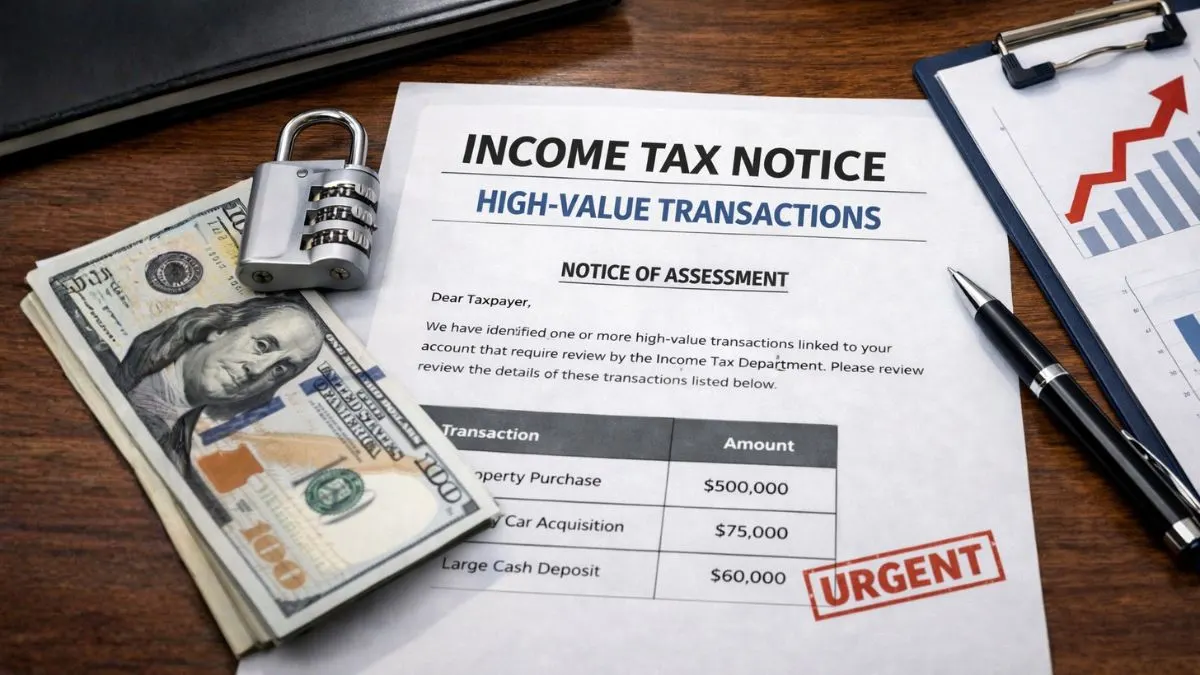
And that’s when taxpayers see a high-value transaction income tax notice.
Small pause here.
Most people panic immediately. But in many cases, it’s just a routine verification.
What Are High-Value Transactions?
The government closely monitors certain high-value transactions because they could indicate undisclosed income or tax evasion.
These are essentially financial activities that exceed specified thresholds and are automatically reported by banks, mutual funds, property registrars, and other financial institutions.
Here are some common examples:
-
Cash deposits of ₹10 lakh or more in a savings account in a financial year
-
Cash deposits of ₹50 lakh or more in current accounts
-
Credit card payments exceeding ₹1 lakh in cash or ₹10 lakh through other modes
-
Property purchase or sale above ₹30 lakh
-
Mutual fund investments exceeding ₹10 lakh
-
Fixed deposits totaling ₹10 lakh or more in a year
-
Foreign remittances under the Liberalised Remittance Scheme (LRS)
These high-value transactions are reported under SFT by financial institutions.
And here’s the interesting part.
You may not even realize that these transactions are being reported automatically.
Why Do Income Tax Notices for High-Value Transactions Get Triggered?
Let’s talk about the real reason behind income tax notices for high-value transactions.
The income tax department now uses advanced data analytics. Your financial activity is matched with your filed income tax return and your Annual Information Statement (AIS).
If something doesn’t add up, a notice may be generated.
Here are the most common triggers:
1. Income and Transactions Don’t Match
If your ITR shows an annual income of ₹5 lakh but your bank reports high-value transactions of ₹20 lakh, the system flags it.
Naturally, the department will ask for clarification.
2. Unreported Investments
Large investments in:
-
Mutual funds
-
Shares
-
Bonds
-
Fixed deposits
may trigger income tax notices for high-value transactions if they aren't reflected in your declared income.
3. Property Transactions
Property purchases or sales above ₹30 lakh are automatically reported.
If your income doesn’t justify such a transaction, you might receive a high-value transaction income tax notice.
4. Large Cash Deposits
Cash deposits during certain financial periods often trigger scrutiny.
This especially happened during the demonetization period and continues to be monitored closely.
Where Do These Transactions Appear?
Most people don’t realize this.
But every major financial activity is already recorded in your tax profile.
These transactions appear in:
-
Annual Information Statement (AIS)
-
Form 26AS
-
Taxpayer Information Summary (TIS)
These documents show all high-value transactions linked to your PAN.
So before filing your return, it’s always wise to check these statements.
Because if your ITR doesn’t match your financial activities that exceed specified thresholds, a notice can follow.
Received a Tax Notice? Don’t Panic
If you’ve received a tax notice from the income tax department on your high-value transactions, the first thing to do is stay calm.
Seriously.
Many of these notices are automated and meant for clarification.
Here’s what you should do:
Step 1: Verify the Notice
Log in to the income tax portal and check:
-
Document Identification Number (DIN)
-
Notice section
-
Due date for response
Always ensure the notice is genuine.
Step 2: Understand the Transaction
The notice will mention the specific high-value transactions that require explanation.
This could be:
-
Cash deposit
-
Property transaction
-
Investment
-
Credit card payment
Identify exactly what the department is asking about.
Step 3: Cross-Check AIS
Your Annual Information Statement (AIS) will show the transaction details reported by banks or institutions.
Compare this with your income tax return.
Documents You Should Keep Ready
Whenever there is a mismatch in high-value transactions, the department may ask for supporting documents.
So it’s important to stay prepared.
Just keep these documents ready when responding to a notice:
-
Bank statements
-
Income proof (salary slips, business income records)
-
Property sale or purchase agreements
-
Loan documents (if the transaction was funded by a loan)
-
Gift deeds (if funds were received as gifts)
-
Investment statements
-
Fixed deposit receipts
These documents help justify the source of funds behind high-value transactions.
And most of the time, providing proper documentation resolves the issue.
What Happens If You Ignore the Notice?
This is where things can get serious.
Ignoring a high-value transaction income tax notice can lead to deeper scrutiny.
Possible consequences include the following:
-
Income reassessment
-
Penalty notices
-
Additional tax demand
-
Interest on unpaid taxes
-
Detailed scrutiny assessments
If the department suspects undisclosed income linked to high-value transactions, penalties may apply.
In severe cases, it may even trigger investigation proceedings.
But again—this usually happens only when taxpayers ignore notices or fail to explain transactions.
How to Respond to High-Value Transaction Notices
Responding properly is important.
Here’s a simple approach:
-
Log in to the Income Tax portal
-
Go to “Compliance Portal."
-
Select the transaction mentioned in the notice
-
Choose the appropriate response option
-
Upload supporting documents if required
Possible responses include:
-
The transaction is correct and explained
-
The transaction relates to another PAN
-
The information is incorrect
-
The transaction is already included in income
Providing a proper explanation usually resolves income tax notices for high-value transactions quickly.
Common Mistakes Taxpayers Make
Let’s talk about something many people overlook.
When dealing with high-value transactions, taxpayers often make these mistakes:
-
Filing ITR without checking AIS
-
Ignoring mismatch notices
-
Assuming banks don’t report transactions
-
Not maintaining financial records
-
Responding late to notices
Most people don’t realize this: the tax department already has access to a large amount of financial data.
Which means transparency is more important than ever.
How to Avoid High-Value Transaction Notices
While you can’t completely avoid scrutiny, you can reduce the chances of receiving a high-value transaction income tax notice.
Here are some practical steps:
-
Always check your Annual Information Statement (AIS) before filing ITR
-
Report all major investments and property transactions
-
Maintain records of fund sources
-
Avoid unexplained cash deposits
-
Declare all income sources honestly
When your tax return matches your financial activities that exceed specified thresholds, notices are far less likely.
Simple.
Final Thoughts
Getting a high-value transaction income tax notice can feel stressful at first.
But in reality, many of these notices are simply requests for clarification. The tax department just wants to ensure that the high-value transactions reported by banks and financial institutions match the income you declared.
If you keep proper documentation, check your Annual Information Statement (AIS) regularly, and respond to notices on time, most cases get resolved smoothly.
The key is transparency and timely response.
And remember — the tax system today is highly data-driven. Your financial activities that exceed specified thresholds are already reported automatically.
So staying organized financially makes all the difference.
Need professional help responding to an income tax notice or handling compliance for high-value transactions?
You can explore expert tax assistance and compliance services directly on Callmyca.com, where professionals help simplify notices, filings, and tax complications for individuals and businesses.