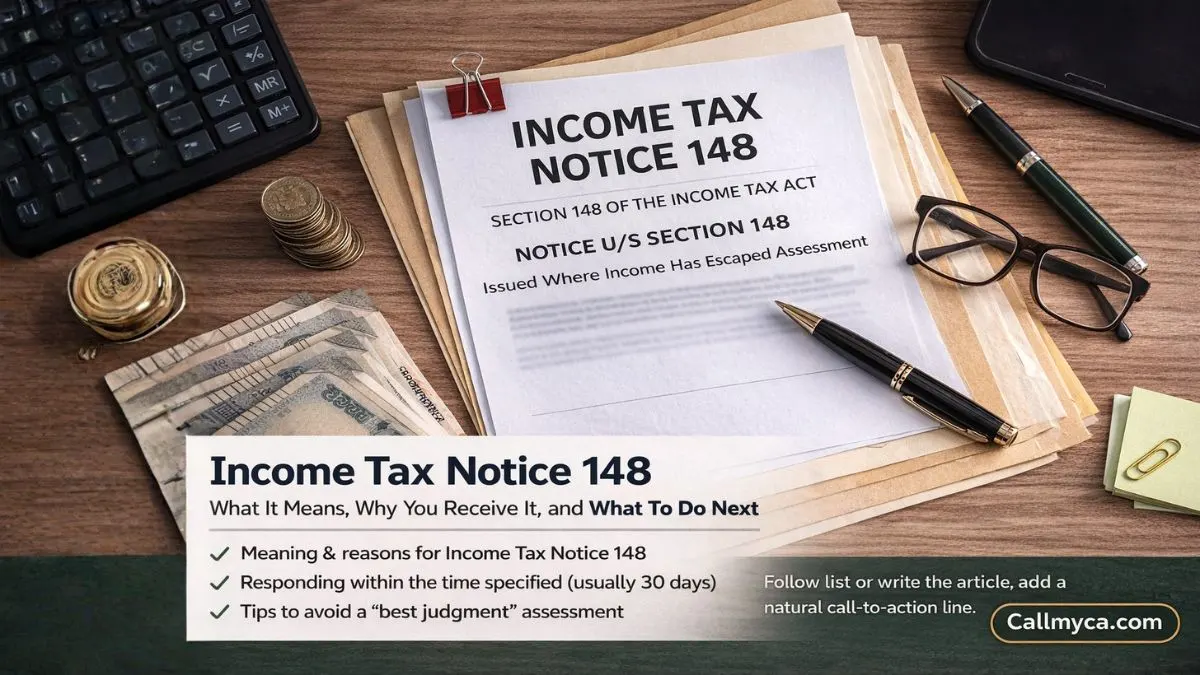
Income Tax Notice 148 – Meaning, Reasons, and What You Should Do
Imagine opening your email and seeing a message from the Income Tax Department.
Most people pause for a moment when that happens. Sometimes it’s just a regular update. But occasionally, it could be something more serious — like an income tax notice 148.
Now before panic sets in, let’s slow down and understand what this actually means.
An income tax notice 148 usually appears when the department believes that some income might not have been properly reported in your earlier tax return. In legal terms, the law calls this a situation where income has escaped assessment.
That phrase may sound complicated at first. But the idea behind it is quite straightforward. If the tax department receives information suggesting that a taxpayer’s income might be higher than what was declared, they can reopen the case and examine it again.
This is where Section 148 income tax notice comes into play.
What is Income Tax Notice 148?
At its core, an income tax notice 148 is a communication from the Income Tax Department asking you to revisit a previously filed tax return.
The law behind this notice is based on the principle of:
“Issue of notice where income has escaped assessment.”
In simple words, the department believes that some taxable income might not have been assessed correctly when the original return was filed.
This does not always mean intentional tax evasion. Sometimes it can happen because of:
-
mismatched financial records
-
incorrect reporting
-
missing information from third-party sources
Banks, employers, and financial institutions regularly submit transaction data to the tax department. If that data does not match the information in your tax return, it may trigger further review.
And when that happens, the department may issue an income tax notice 148.
Legal Authority Behind Section 148
The Income Tax Act provides clear authority to tax officers to investigate such situations.
According to the law, Section 148 gives authority to the Assessing Officer to send notice to a taxpayer when there is a reason to believe that income has not been assessed properly.
In other words, the officer must have some form of information indicating that income has escaped assessment before initiating reassessment.
This information can come from several sources, including:
• bank transaction reports
• property purchase records
• investment disclosures
• tax deducted at source (TDS) data
• financial intelligence reports
When such information indicates potential discrepancies, the officer may initiate reassessment proceedings by issuing an income tax notice 148.
Section 148A – A Step Before the Notice
Here’s something interesting that many taxpayers don’t realize.
Before issuing an income tax notice 148, the department must first follow a preliminary procedure under Section 148A.
The rule states that an inquiry under Section 148A is mandatory to provide an opportunity to be heard.
This means taxpayers now get a chance to explain their position before the reassessment notice is issued.
The process usually works like this:
-
The department receives information suggesting possible unreported income.
-
A notice under Section 148A is issued seeking clarification.
-
The taxpayer can respond and explain the situation.
-
After reviewing the explanation, the department decides whether to issue an income tax notice 148.
This step was introduced to make the process more transparent and fair.
Situations That Can Trigger Income Tax Notice 148
Many people assume only businesses receive tax notices. That’s not entirely true. Even salaried individuals can receive an income tax notice 148.
Some common triggers include:
• High-value bank deposits
• Property purchases not matching declared income
• Large investments in stocks or mutual funds
• Capital gains not reported in the return
• Credit card spending inconsistent with income
• Differences between AIS and filed tax return
When these mismatches appear, the department may conclude that income has escaped assessment, leading to the Issue of notice where income has escaped assessment.
But here’s the key thing to remember.
Receiving the notice does not mean the department has already decided that something is wrong. It simply means they want clarification.
Time Limit for Issuing Notice
One of the most important aspects of reassessment is the time limit.
The department cannot reopen tax cases indefinitely.
In most cases, Section 148 i is valid if it is issued within 3 years from the end of the relevant assessment year.
For example, if your tax return was filed for Assessment Year 2022–23, the department generally has three years to reopen the case if necessary.
In some exceptional situations involving significant undisclosed income, the time limit may extend further.
However, the standard rule still remains that Section 148 i is valid if it is issued within 3 years in most cases.
Understanding this timeline helps taxpayers determine whether a notice is legally valid.
What Should You Do After Receiving Notice 148?
The first reaction many people have when receiving an income tax notice 148 is panic.
But the best approach is simple: stay calm and respond properly.
Usually, the notice will ask the taxpayer to submit a fresh return or explanation within a specific time period.
As mentioned in the law, it requires filing a fresh return within the time specified (usually 30 days) to avoid a "best judgment" assessment.
Here’s a practical approach you can follow.
Step 1 – Read the notice carefully
Check the assessment year mentioned and understand what information the department is asking for.
Step 2 – Review your tax return
Compare your return with bank statements, AIS data, and Form 26AS.
Step 3 – Identify the discrepancy
Try to determine which transaction may have triggered the notice.
Step 4 – Prepare documents
Gather supporting records such as investment proofs, salary slips, or property purchase documents.
Step 5 – Submit your response online
The response can usually be submitted through the Income Tax e-Filing portal.
Most cases are resolved once the correct explanation and documents are provided.
What Happens If You Ignore the Notice?
Ignoring the notice is not a good strategy.
If the taxpayer fails to respond, the department may proceed with what is called best judgment assessment.
In this situation, the tax officer estimates the taxpayer’s income using available financial information.
This may include:
• bank transactions
• investment records
• property details
• TDS filings
Based on this information, the officer calculates tax liability and issues a demand.
Since deductions and exemptions may not be fully considered in such estimates, the tax amount can sometimes be higher than expected.
This is why responding to an income tax notice 148 within the specified time is extremely important.
Documents You May Need While Responding
When preparing a response to the notice, certain documents may be required.
These typically include:
• bank statements for the relevant year
• investment statements
• salary slips or income certificates
• property purchase or sale documents
• loan agreements
• TDS certificates
Having these records ready helps clarify the situation quickly.
Final Thoughts
Receiving an income tax notice 148 can feel intimidating at first. But once you understand the process behind it, the situation becomes much clearer.
The notice simply indicates that the department believes income has escaped assessment and wants to verify the financial information again.
Because of the procedural safeguard where an inquiry under Section 148A is mandatory to provide an opportunity to be heard, taxpayers now get a fair chance to explain their side before reassessment begins.
The key steps remain simple: review your records, respond within the deadline, and provide the required documents.
Most cases are resolved smoothly when handled properly.
Need Help Responding to an Income Tax Notice?
If you’ve received an income tax notice 148 and aren’t sure how to respond, professional guidance can make the process much easier. Experts at Callmyca.com help taxpayers understand notices, prepare proper responses, and resolve tax issues quickly so you can stay compliant without unnecessary stress.