
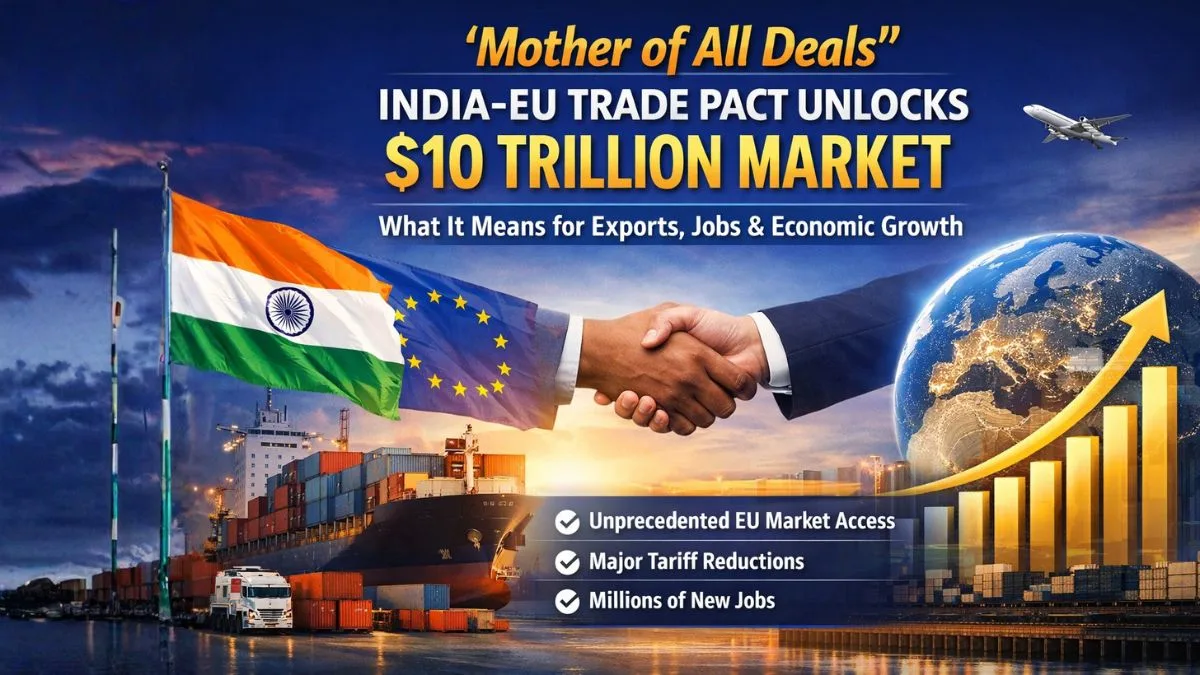
‘Mother of All Deals’: India-EU Trade Pact Unlocks $10 Trillion Market—What It Means for Exports, Jobs, and Economic Growth
When the news first came out that India and Europe had finally signed a massive trade deal, many people didn’t pay much attention.
It sounded like “just another agreement.”
But as details started coming in, people slowly realized—this was not ordinary.
This was something big.
In fact, many experts are now calling it the “mother of all deals,” and honestly, it makes sense. This is India's largest and most comprehensive trade agreement to date, and it has the potential to change how Indian businesses work with the global market.
Not overnight.
Not magically.
But steadily, over the next few years.
A Deal That Took Years (And Patience)
This agreement did not happen in a few months.
Talks between India and Europe have been going on for years. Sometimes things moved forward, sometimes they completely stopped. There were arguments over tariffs, data rules, farming products, and market access.
Many times, people thought the deal would never happen.
But finally, in 2026, India and the EU finalize a landmark free trade agreement after long negotiations.
This agreement now strengthens India's trade ties with 27 European countries, bringing India closer to one of the strongest economic blocs in the world.
For India, this is not just about trade. It’s also about global reputation and confidence.
Why Everyone Is Talking About the $10 Trillion Market
One reason this deal is getting so much attention is the size of the opportunity.
We are talking about a $10 trillion market.
The European Union buys everything—clothes, medicines, machines, jewelry, food, and services—in huge volumes.
Earlier, Indian companies could not fully tap into this market because of high duties and strict rules.
Now, things are changing.
With this agreement, India has secured unprecedented market access in the European Union. In simple words, Indian products will now get easier entry into Europe.
In fact, this deal offers unprecedented market access for more than. 99% of India's export value—something India has never received before.
That’s a big deal.
What’s Changing in Tariffs and Duties
This is where exporters really start paying attention.
Under the agreement:
The European Union has committed to eliminating duties on about 70.4% of tariff lines immediately, covering nearly 90.7% of India's export value, while another 20.3% of products will see phased tariff elimination over time.
Sounds complicated, right?
In simple language, it means:
Most Indian products will become cheaper in Europe.
And when products become cheaper, they sell more.
More sales = more production
More production = more jobs
More jobs = stronger economy
That’s how exports by trade actually help the country.
Which Sectors Will Benefit the Most?
Many industries are expected to gain from this agreement.
Some of the major ones are:
-
Textiles and garments
-
Leather goods
-
Gems and jewellery
-
Pharmaceuticals
-
Auto components
-
Engineering products
-
Agricultural and processed food
For many exporters in these sectors, this deal could be a turning point.
Some small exporters who never thought about Europe earlier may now seriously consider it.
How This Strengthens India’s Position in Europe
Earlier, Indian companies often felt disadvantaged in European markets.
Other countries already had trade deals. Their products were cheaper. Their paperwork was simpler.
India was behind.
Now, that gap is reducing.
This agreement improves trade relations and gives Indian companies a more equal chance.
At the same time, EU exports will also grow. European companies will find it easier to sell machinery, chemicals, vehicles, medical equipment, and services in India.
So yes, this is a balanced deal. Both sides benefit.
What This Means for Jobs and Economic Growth
This is probably the most important part.
Whenever exports increase, jobs follow.
If textile exports grow, there will be more factory workers
If pharma exports grow, more lab staff will be needed.
If engineering exports grow, more technicians will be needed.
If logistics grows, there will be more transport and warehouse jobs
This deal can create lakhs of jobs directly and indirectly.
More exports also bring more foreign money into India, which helps stabilize the economy and supports long-term growth.
That’s why economists are optimistic about this agreement.
A Big Shift in India’s Trade Policy
For many years, India was very cautious about free trade deals.
There was always a fear:
“What if cheap imports destroy local businesses?”
So India avoided many large agreements.
But this EU pact shows a new mindset.
India now believes its industries are strong enough to compete globally.
The EU-India Trade Deal 2026, explained in policy terms, shows India’s shift towards becoming a global manufacturing and export hub.
It reflects confidence.
What About MSMEs and Small Businesses?
This deal is not only for big corporate houses.
MSMEs and startups can also gain.
Earlier, exporting to Europe required huge money, contacts, and legal support. Now, things are becoming simpler.
With better access and government support, even mid-sized companies can try entering European markets.
For many small businesses, this could be their first international step.
Challenges Will Still Be There
Of course, everything will not become perfect overnight.
European countries have strict rules on:
-
Quality
-
Environment
-
Data protection
-
Labour standards
Many Indian companies will need to upgrade systems and training.
Some will struggle at first.
But in the long run, this will improve the global reputation of Indian products.
Final Thoughts
The “mother of all deals” between India and the European Union is not just about numbers.
It is about confidence.
It shows that India is ready to compete with the best in the world.
As India's largest and most comprehensive trade agreement, it opens doors to the $10 trillion market, strengthens partnerships, boosts exports by trade, supports EU exports, and creates real economic opportunities.
If implemented properly, this agreement can become one of the most important milestones in India’s economic journey.
If you want expert guidance on taxation, compliance, exports, or business growth, you can also explore trusted professional support at callmyca.com—where experienced CAs and advisors help you make smarter financial decisions.









