You got an audit notice. Now what?
The word "audit" alone is enough to make anyone uneasy.
You see an official letter, maybe from the Commonwealth of Massachusetts' Department of Revenue… and suddenly your mind jumps to worst-case scenarios.
But pause for a second.
Not every audit is a problem.
Sometimes, it’s just the system saying, “We need more clarity.”
What exactly is this notice trying to tell you?
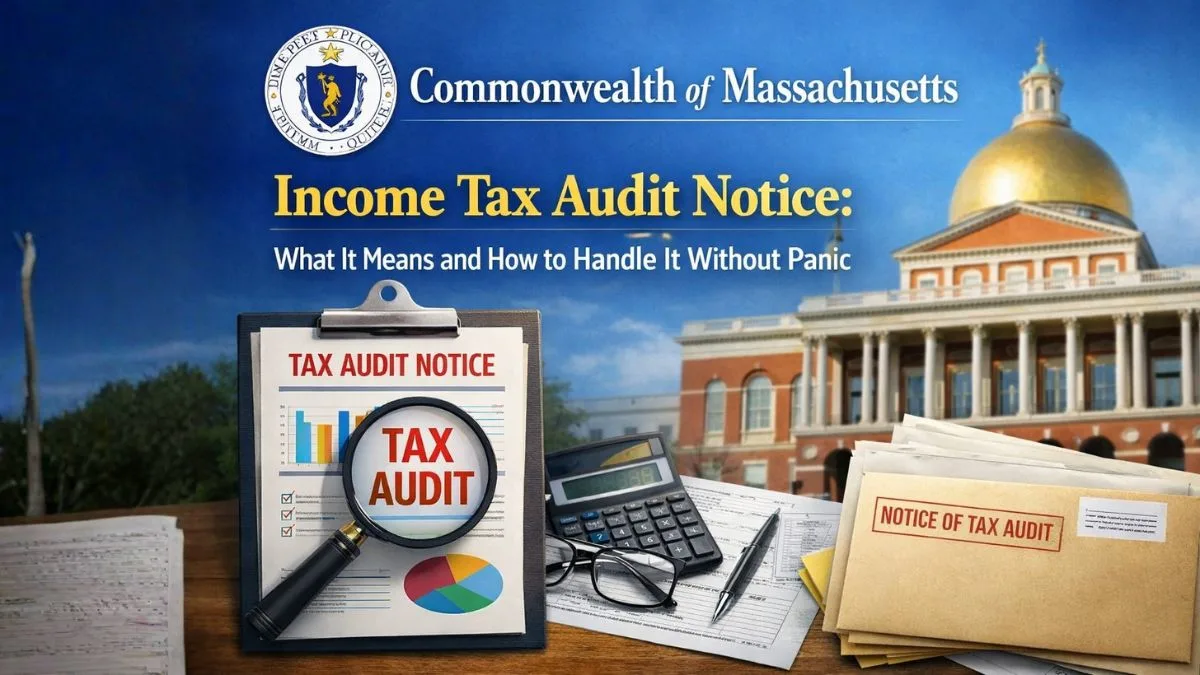
A Massachusetts income tax audit notice from the Department of Revenue (DOR) requires immediate attention to avoid penalties. Review the notice carefully for the specific tax year, issues in question, and response deadline. Use MassTaxConnect to securely view details, send messages, & submit requested documentation.
The department has questions."
About your return."
About certain numbers."
About something that didn’t quite match."
And they want you to explain it."
That’s your audit notice
What does “audit” actually mean here?
Let’s clear the confusion.
An audit doesn’t automatically mean you did something wrong.
It simply means your return has been selected for review.
That’s it.
And yes—audits are usually conducted for a 3-year period
So if you’ve received a notice, it’s likely related to a recent tax year within that window.
Why do people get audited?
Here’s where things get interesting.
There isn’t always a dramatic reason.
Sometimes it’s random.
Other times, there are patterns.
Common triggers:
- Income doesn’t match reported records
- Large deductions compared to income
- Missing or inconsistent data
- Unusual financial activity
- Prior compliance issues
Now think about this.
Even small inconsistencies can lead to a state tax audit.
Not because they’re serious… but because they’re unclear.
What should you do when you receive the notice?
Step-by-step approach:
- Read the letter carefully (don’t skim)
- Identify the tax year involved
- Understand what exactly is being questioned
- Check your filed return for that year
- Gather supporting documents
- Log in to MassTaxConnect
- Respond within the deadline
Deadlines are not flexible here.
Miss them… & things move forward without your input.
What kind of documents might be needed?
Depends on the case.
But typically:
- Income statements
- Bank records
- Investment proofs
- Expense receipts
- Prior filings
Basically, anything that explains your numbers.
What happens if you ignore the notice?
This is where things can go sideways.
Ignoring a notice can lead to the following:
- Adjusted tax liability
- Additional penalties
- Interest charges
- Final assessment without your input
And once that happens, reversing it becomes harder.
Common mistakes people make
Let’s be real here.
Ignoring the audit
Hoping it disappears. It won’t.
Sending incomplete documents
Half explanation = more questions.
Missing deadlines
This is the biggest one.
Overcomplicating responses
Simple & clear works better.
Can you challenge the findings?
Yes.
If you disagree with the outcome, you can:
- Provide additional documents
- Request reconsideration
- Appeal if necessary
But again, timing matters.
Final words
Receiving a Commonwealth of Massachusetts income tax audit notice can feel overwhelming at first.
But most audits are about clarification, not accusation.
Read the letter carefully.
Respond on time.
Support your data.
And if things feel complicated — especially with multiple years or large amounts — getting guidance from platforms like Callmyca.com can make the process smoother. Not because you can’t handle it… but because having clarity at the right time makes all the difference.