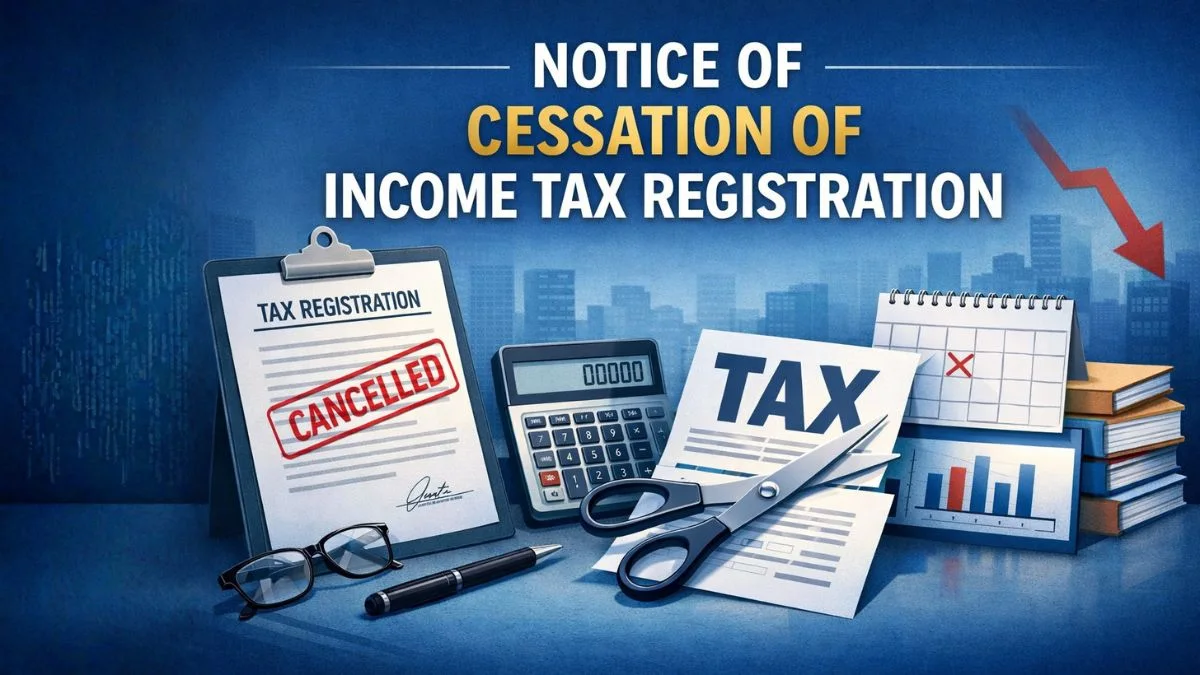
NOTICE OF CESSATION OF INCOME TAX REGISTRATION
So… what is this notice really about?
Let’s be honest.
Most people don’t even think about tax registration until something goes wrong.
And then suddenly, you see something like a Notice of Cessation of Income Tax Registration… and panic starts.
Now think about this.
You registered your business, maybe for freelancing, small trading, or even just testing something. But later, you stopped filing returns, or maybe you shut everything down quietly. No formal closure. No proper application. Just… stopped.
That’s where this notice comes in.
A Notice of Cessation of Income Tax Registration is basically an official communication from Revenue or the Income-tax department telling you that your tax registration is being cancelled, or asking you to explain why it shouldn’t be.
Simple language?
You’re either closing your registration… or they’re closing it for you.
The real meaning behind it.
A notice of cessation of income tax registration (or cancellation) is an official request or order to end a tax registration due to business closure, transfer, or non-compliance. Taxpayers must file for cancellation when business ceases, while authorities can issue a show-cause notice if tax returns remain unfiled for six months.
Now pause for a second.
Most people only focus on “closure”.
But the real trigger in many cases is non-compliance.
Meaning?
You didn’t file returns.
You ignored notices.
Or your registration just stayed inactive.
And the system doesn’t like inactive accounts.
Why do you receive this notice?
There isn’t just one reason. Actually, there are quite a few.
And sometimes, it’s not even your fault.
Common reasons include:
- Business has officially shut down
- No income activity reported for a long time
- Continuous failure to file Income-tax returns
- Incorrect or incomplete application details
- Transfer of business ownership
- Compliance issues flagged by Revenue
- Receiving a letter, Revenue asking for explanation but not responding
Here’s where things get interesting.
Sometimes, even if you think your business is inactive, the government system still considers your registration active — unless you formally cancel it.
That gap?
That’s exactly where notices start.
What does the notice usually contain?
The format can vary slightly, but most notices follow a pattern.
And once you’ve seen one, you’ll recognize it instantly.
A Notice of cessation of Income Tax Registration generally includes:
- Your registration details
- Reference number of the notice
- Reason for proposed cancellation
- Mention of non-compliance
- Deadline to respond
- Instructions to submit a reply or application
Sometimes it may also include references like:
- Notice of appointment or cessation of a receiver
- Compliance history
- Previous communication attempts by Revenue
And yes… deadlines are serious.
What should you do if you receive one?
Don’t ignore it.
Seriously.
Even if you feel like “it doesn’t matter anymore”, it does.
Here’s a practical approach:
Step-by-step action:
- Read the notice carefully (not just the heading)
- Identify the reason mentioned
- Check your past Income-tax filings
- Gather documents (returns, receipts, business closure proof)
- Log in to your tax portal
- Respond within the given timeline
- Submit required application if needed
What happens if you ignore the notice?
Let’s be real.
A lot of people ignore tax notices thinking nothing will happen.
But consequences do exist.
And they’re not always immediate.
Possible outcomes:
- Forced cancellation of your registration
- Penalties for non-compliance
- Issues in future business registrations
- Difficulty in getting loans or financial approvals
- Legal notices later
It’s like leaving something unfinished in the system.
Voluntary vs forced cancellation
This is important.
There are two ways your tax registration can end:
1. Voluntary cancellation
You submit an application yourself when:
- Business is closed
- Income activity has stopped
- You no longer need tax registration
This is clean. Organized. No issues.
2. Forced cancellation by Revenue
This happens when:
- You don’t file returns for months
- You ignore notices
- Your account shows no compliance
And usually, this starts with a Notice of cessation of Income Tax Registration
Which gives you one last chance to respond.
What documents might be required?
Depending on your case, you may need:
- Last filed Income-tax return
- Business closure proof
- Bank statements
- Identity proof
- Any previous Revenue communication
- Proof related to Notice of appointment or cessation of a receiver (if applicable)
Can you reopen your registration later?
Yes. But not always smoothly.
If your registration is cancelled properly, you can apply again.
But if it was cancelled due to non-compliance?
Then things get tricky.
You might need:
- Additional verification
- Clarifications
- Past compliance cleanup
So… better to handle it properly the first time.
Small but important mistakes people make
This part is often ignored.
But it matters.
- Assuming “no income = no responsibility”
- Ignoring letter, Revenue
- Not checking tax portal regularly
- Missing deadlines
- Not submitting closure application
Most people don’t intentionally make mistakes.
They just delay things.
And delays in tax matters?
They cost more later.
One thought before you move ahead
If you received a Notice of cessation of Income Tax Registration, it’s not necessarily a problem.
It’s a signal.
A chance to fix things.
Either close your registration properly…
Or correct your compliance.
That’s it.
No need to panic.
Final words (you should actually remember)
Handling tax notices isn’t about being perfect.
It’s about being responsive.
Even a simple reply, even a small correction — it goes a long way.
And if at any point, the process seems too confusing and technical, seeking guidance will make the process easier and quicker. For example, there are platforms like Callmyca.com that can assist in understanding what exactly needs to be done without overwhelming the process.