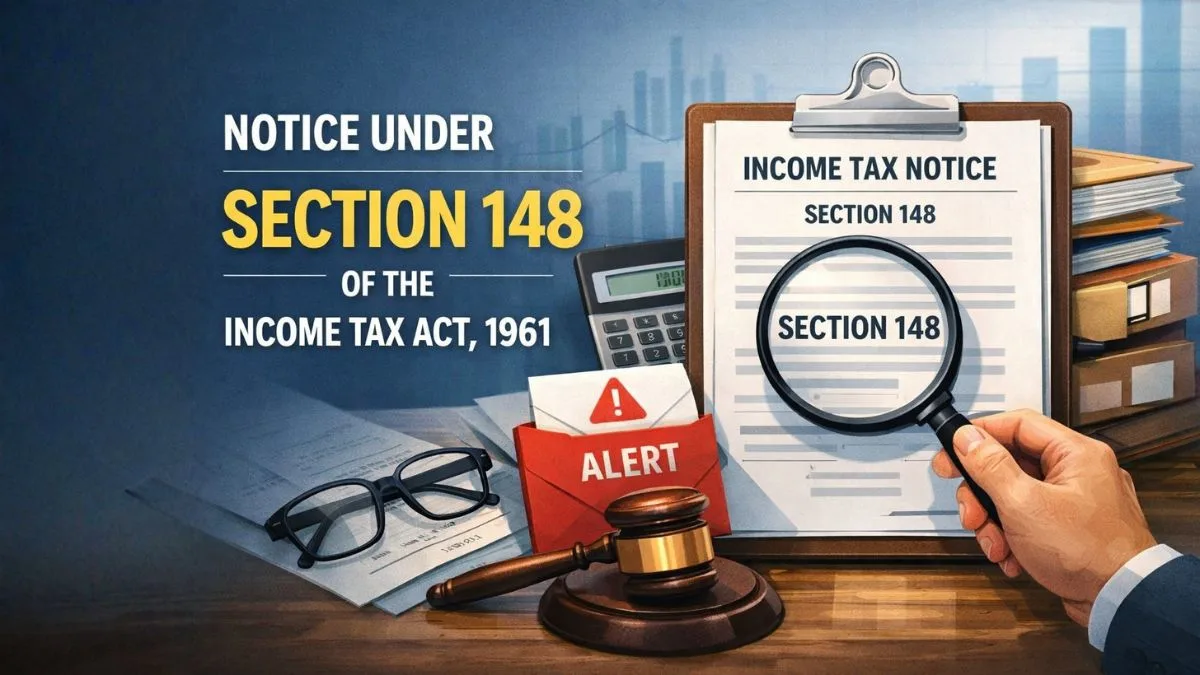
Notice Under Section 148 of the Income Tax Act 1961
What is a Section 148 notice, really?
When someone receives a notice under Section 148, the first instinct is usually confusion, sometimes even fear. It feels official, serious… and a little intimidating.
But pause for a second.
Not every notice is about wrongdoing. Sometimes, it’s just about a mismatch in records. Sometimes it’s missing information. & occasionally, yes, it can be something more serious.
The actual meaning behind Section 148
A notice under Section 148 of the Income Tax Act, 1961, is issued by an Assessing Officer (AO) when they have credible information that income chargeable to tax has escaped assessment. This initiates reassessment proceedings, requiring the taxpayer to file a return of income, often within 30 days.
Now let’s break that down in plain terms."
- The department thinks some income wasn’t reported"
- Or it wasn’t reported correctly
- Or their data doesn’t match what you filed
This is why it falls under the Issue of notice where income has escaped assessment.
And notice something important here.
It says “credible information,” not “final proof.”
Why do people usually receive this notice
Here’s where things get interesting."
Most people assume these notices are only for large-scale tax issues. That’s not entirely true.
Sometimes, very small discrepancies trigger the system.
For example:
- A bank deposit that doesn’t align with declared income
- Property transactions that don’t match reported values"
- High-value purchases
- Foreign transactions
- Missed or forgotten income sources"
Even something from older records, like an earned income tax credit 2014 notice type mismatch, can occasionally surface again.
And then…
issuance of notice
It often feels sudden. But in reality, it’s data-driven."
Let’s pause for a second
You might feel like everything was already filed correctly.
That’s a very common reaction.
But tax systems rely heavily on matching multiple data points — banks, registries, third-party reporting. If even one piece doesn’t align, it can trigger a notice under Section 148.
Most people overlook this part.
What does the notice actually contain?
It’s not just a vague message.
An income tax notice under Section 148 is a formal communication
It usually includes:
- The assessment year involved
- A reference to reassessment
- Instructions to file a return again
- A response deadline (often around 30 days)
And that deadline matters more than people realise.
Ignoring it doesn’t make it disappear.
The role of the Assessing Officer
Now think about this.
The Assessing Officer to issue a notice for reassessment must have some basis. They cannot send notices randomly.
However, the threshold is not extremely high.
They need a “reason to believe,” not absolute certainty.
That distinction matters.
Because it also means you have the right to question that belief.
Time limits — how far back can they go?
This is one of the most asked questions.
Nobody wants something from years ago coming back unexpectedly.
Typically:
- Notices are issued within 3 years of the relevant assessment year
- In certain situations, it can extend further — even up to 10 years
That’s where you hear about notices issued under section 148 of the Act beyond three years.
But there’s a condition.
The amount involved usually needs to be significant for extended timelines.
What should you do after receiving the notice?
First step.
Stay calm.
Second step.
Do not ignore it.
A simple approach works best:
Practical steps:
- Read the notice carefully
- Identify the assessment year
- Understand what is being questioned
- Log in to the income tax portal
- File the return as required
If something feels unclear… it probably is.
And that’s okay.
Common mistakes people make
This part is often underestimated.
- Ignoring the notice assuming it’s an error
- Responding without understanding the issue
- Missing deadlines
- Not seeking guidance when needed
Small missteps can complicate things.
And most of them are avoidable.
Can you challenge a Section 148 notice?
Yes, you can.
And sometimes, you should.
If you believe the notice is not justified:
- You can request the reasons recorded by the officer
- You can file objections
- You can challenge it legally if required
Because issuance of a notice when any income has escaped assessment is based on initial belief — not a final decision.
Something people don’t talk about enough
The mental side of it.
Receiving a notice like this can create stress. You start revisiting past decisions. You question whether something was missed.
But often, it’s just a mismatch that needs clarification.
Clarity reduces stress. Guesswork increases it.
Is every notice serious?
Not necessarily.
Some are routine checks.
Some are triggered by minor discrepancies.
And yes, some are serious.
But you won’t know which one it is until you understand it properly.
A small but powerful tip
Keep your records organized.
It sounds simple, but it makes a huge difference.
Things like:
- Bank statements
- Investment details
- Property documents
- Previous tax returns
When you need them, you don’t want to be searching for them.
Final thoughts
Receiving a notice under Section 148 doesn’t automatically mean trouble.
It means the department wants clarification.
That’s all.
Sometimes the situation is straightforward. Sometimes it’s not. And in those moments, having the right guidance can save both time & unnecessary stress. Platforms like Callmyca.com can be helpful when things feel unclear, especially if you want to be sure you’re responding the right way without overcomplicating things.