
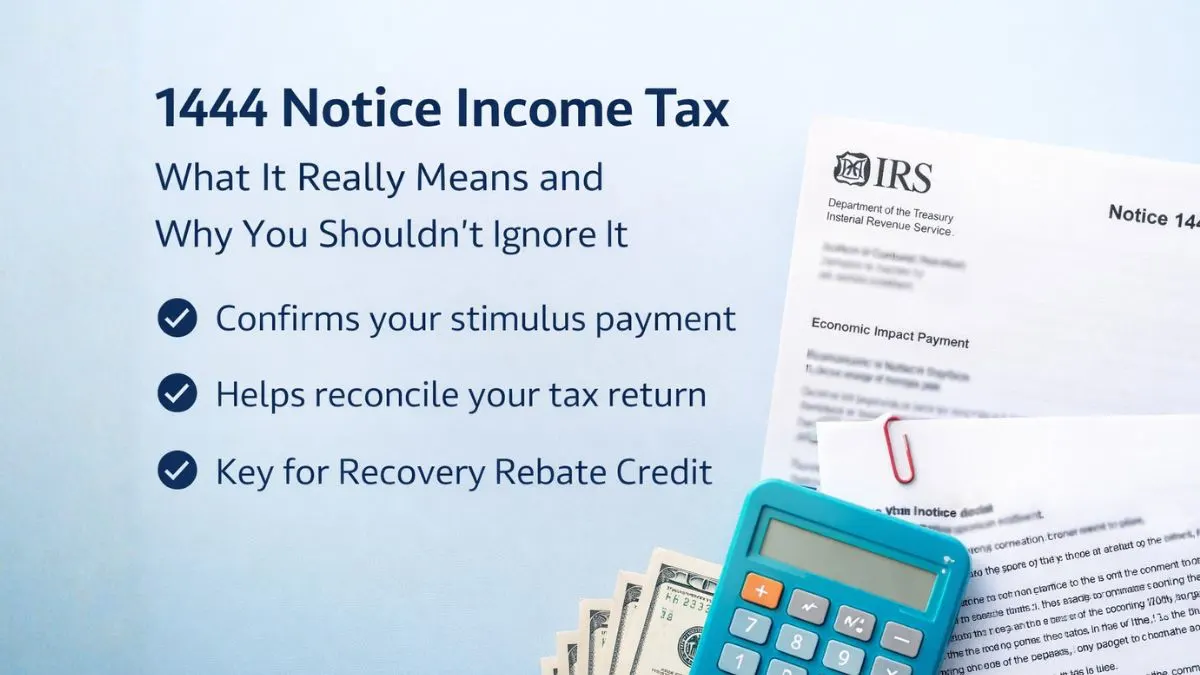
1444 Notice Income Tax: What It Really Means and Why You Shouldn’t Ignore It
You receive a letter. It looks official. Government seal, formal language, maybe a bit intimidating. And at the top, it says — Notice 1444.
Most people do one of two things.
Either they panic… or they ignore it.
Both are slightly wrong.
Let’s slow down for a second.
Because this notice isn’t actually something to fear. But yes, it is something you should understand.
So, what exactly is Notice 1444?
In very plain terms, Notice 1444 is a document sent by the IRS to inform you about the stimulus payment (Economic Impact Payment) you received."
That’s it.
But also… not just that."
The official explanation says:
“Notice 1444 is an important IRS document sent to taxpayers documenting the amount of their first Economic Impact Payment (stimulus check) in 2020. It serves as an official record for tax filing, specifically to reconcile payments with the 2020 Recovery Rebate Credit, & should be kept with tax records.”
Now think about this.
If the government is sending you proof of money they gave you… that’s not random."
There’s a purpose behind it."
Why this notice actually matters
At first glance, it feels like just another informational letter."
But here’s where things get interesting.
This notice becomes important when you file your income tax return.
Because during your tax return filing, you may need to:
-
Confirm how much stimulus you already received"
-
Check if you are eligible for additional credit"
-
Avoid claiming the same amount twice
And if your records don’t match what the IRS has?
That’s where problems begin.
Let’s pause for a second.
Imagine this situation.
You forgot how much stimulus you received. Or maybe you never even checked properly. Then while filing your income tax return, you accidentally claim the full credit again.
What happens?
The IRS already has the record.
Because they issued Notice 1444.
So your return gets adjusted. Delays happen. Refunds get stuck.
Annoying, right?
What information does Notice 1444 contain?
It’s actually quite straightforward. Nothing overly complicated.
Here’s what you’ll usually find:
-
The total amount of stimulus payment issued
-
The method of payment (direct deposit or check)
-
Basic taxpayer identification details
-
Instructions related to your tax return
That’s it.
No scary legal warnings. No penalties mentioned.
Just… information.
But useful information.
Most people overlook this part
And this is important.
People assume that once the stimulus money is received, the job is done.
But that’s not how taxation works.
Your income tax return is where everything gets finalized. That’s where:
-
Payments are verified
-
Credits are adjusted
-
Final tax liability is calculated
And Notice 1444 acts like a reference point in this entire process.
Without it, you’re basically guessing.
Do you really need to keep Notice 1444?
Short answer: Yes.
Long answer: Definitely yes.
You should keep Notice 1444 along with your other tax documents because:
-
It helps during future tax return filings
-
It avoids confusion about stimulus payments
-
It acts as proof in case of discrepancies
-
It supports claims related to Recovery Rebate Credit
Think of it like a receipt.
You may not need it every day… but when you do, it becomes extremely important.
What if you lost your Notice 1444?
Relax. It happens.
You’re not the only one.
Here’s what you can do instead:
-
Check your bank statements (for payment amount)
-
Log into your IRS account
-
Refer to your previous income tax return
-
Contact a tax professional for accurate records
Because ultimately, what matters is the amount, not the paper itself.
Still… having the original notice makes life easier.
Common mistakes people make
Here are some common mistakes:
-
Ignoring Notice 1444 completely
-
Entering incorrect stimulus amount in tax return
-
Claiming full credit despite already receiving payment
-
Not keeping records for future reference
And the result?
-
Delayed refunds
-
Adjusted returns
-
Confusion & stress
Avoidable problems, honestly.
Another small thing people don’t realize
Even if you received partial payment, this notice matters.
Because you might still be eligible for:
Additional Recovery Rebate Credit
But how will you know how much you already got?
Exactly.
From Notice 1444.
How to use Notice 1444 while filing your tax return
When you sit down to file your tax return, keep this notice nearby.
Then:
-
Compare the amount mentioned in Notice 1444
-
Enter the correct stimulus amount
-
Check eligibility for additional credit
-
Avoid double claims
Simple steps. But they make a big difference.
“Do I need this every year?”
Not really.
This notice is specifically related to stimulus payments.
So you won’t receive Notice 1444 every year.
But whenever you do receive such official communication… don’t ignore it.
Because tax-related documents often connect to something bigger.
A quick reality check
Most people don’t read tax notices properly.
They skim. Or they avoid.
But taxation doesn’t work on guesswork.
Even a small document like Notice 1444 can affect your entire income tax return outcome.
So taking a few minutes to understand it?
Totally worth it.
Final thought
Tax stuff can feel confusing sometimes. Even when it’s actually simple.
And notices like Notice 1444 fall into that category — simple, but easily misunderstood.
If you’re ever unsure while filing your tax return, especially about stimulus credits or mismatched amounts, it’s okay to ask for help. A quick consultation with a professional (platforms like Callmyca.com, for example) can save you from unnecessary delays or mistakes.









