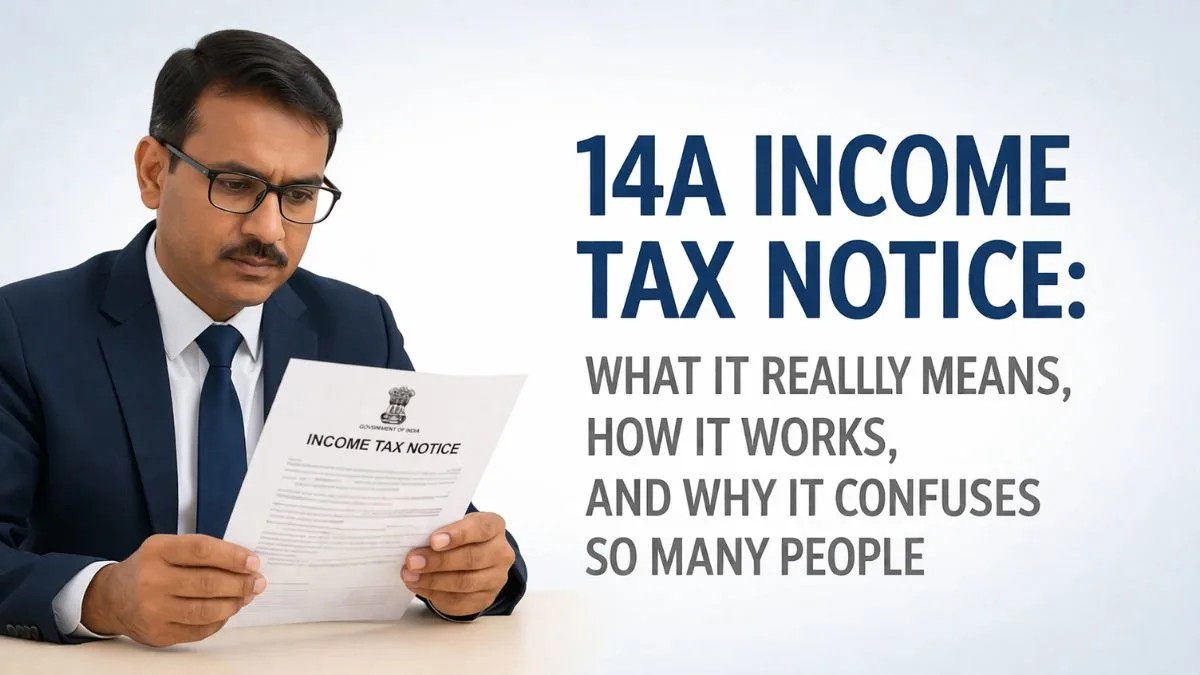
14A Income Tax Notice: What It Really Means, How It Works, and Why It Confuses So Many People
Let’s be honest for a second.
The moment you hear “Section 14A” or a 14A income tax notice… it already sounds complicated."
Numbers. Sections. Rules."
And somehow, all of it connects to your income tax".
But here’s the thing — once you actually understand the logic behind it, it’s not that scary".
Just misunderstood.
What is Section 14A?
Section 14A basically says this:
If you earn income that is not taxable, then you cannot claim expenses related to earning that income as deductions.
That’s it.
Now think about this.
If the government is not taxing a certain income, why should it allow you to reduce your taxable income tax by claiming expenses for it?
Makes sense, right?
That’s exactly what Section 14A is trying to control.
Where does a 14A income tax notice come from?
A 14A income tax notice usually comes when the tax department feels:
-
You have claimed expenses
-
Those expenses are linked to exempt income"
-
But you still reduced your taxable income tax"
So they step in & say:
“Wait… this deduction is not allowed.”
And that’s when the notice is issued.
Let’s pause for a second.
Most people don’t even realize they’ve made this mistake.
Because they don’t track which expense is linked to which income.
They just claim everything.
And honestly… it feels logical at that moment.
But tax laws don’t always follow our logic.
What kind of income is considered “exempt”?
Good question.
Because everything revolves around this.
Examples of exempt income:
-
Dividend income
-
Agricultural income
-
Certain tax-free investments
-
Income from mutual funds
Now here’s where things get interesting.
Even though this income is not taxed… any expense used to earn it becomes questionable under Section 14A.
A very real-life example
Let’s make this practical.
Suppose:
-
You invest in shares
-
You earn dividend income (tax-free in some scenarios)You took a loan to invest
-
You pay interest on that loan
Now, can you claim that interest as a deduction in your income tax?
Under Section 14A — No.
Because that expense is linked to exempt income.
Most people overlook this part
Expenses are not always obvious.
Sometimes they are indirect.
Like:
-
Portfolio management fees
-
Interest expenses
-
Administrative costs
And that’s where Section 14A becomes tricky.
Because it doesn’t just look at direct expenses.
It looks at the connection.
What is Rule 8D?
Now let’s talk about something people fear — calculation.
Rule 8D comes into play when:
-
You haven’t properly calculated disallowance
-
Or the Assessing Officer is not satisfied
So they calculate it themselves using Rule 8D.
It usually includes:
-
Direct expenses related to exempt income
-
Interest expenses (proportionate)
-
A fixed percentage of investment value
And suddenly… your deductions increase. Your taxable income tax goes up.
Here’s where things get slightly frustrating
Because even if you think you didn’t use any expense for that income…
The department may still apply Rule 8D.
Why?
Because they assume there is some indirect cost involved.
Fair? Debatable.
But it happens.
Common mistakes that trigger a 14A income tax notice
Let’s talk reality again.
Here’s what usually leads to trouble:
-
Claiming full interest deduction without checking its use
-
Ignoring exempt income completely
-
Not separating taxable & non-taxable income
-
Assuming “small amount hai, chalta hai”
And then comes the 14A income tax notice.
Unexpected.
“But I didn’t know…”
That’s the most common reaction.
And honestly, it’s valid.
Tax rules like Section 14A are not very intuitive.
You don’t naturally think like:
“Oh this expense is linked to exempt income, so I shouldn’t claim it.”
You just claim expenses.
That’s how normal thinking works.
How to respond if you receive a 14A income tax notice
Don’t panic.
Seriously.
Just follow a structured approach:
-
Review your income tax return carefully
-
Identify exempt income sources
-
Check which expenses were claimed
-
Match expenses with income types
-
Recalculate disallowance if needed
And then:
-
Respond with explanation
-
Provide documents if required
Simple steps. But they need clarity.
A small but important tip
Always maintain clarity between:
-
Taxable income
-
Exempt income
If you mix them up… Section 14A will catch you.
Eventually.
Another thing people rarely think about
Even if your exempt income is small…
The disallowance can still happen.
Because it’s not about the size.
It’s about the principle.
That’s how tax laws operate.
Practical way to avoid Section 14A issues
Let’s make it super usable.
Here’s what you can do:
-
Keep separate records of investments
-
Track source of funds (loan vs own money)
-
Avoid claiming blanket deductions
-
Be cautious with interest expenses
-
Review before filing income tax
Basically, don’t rush your return.
That’s where most mistakes happen.
Final thought
If you’ve received a 14A income tax notice, it doesn’t mean you’ve done something “wrong” intentionally.
It usually means something wasn’t calculated properly.
And that’s fixable.
If things feel confusing — especially with calculations, Rule 8D, or linking expenses to income — it’s okay to get help. Platforms like Callmyca.com can guide you through it in a practical way, without making it sound like a legal lecture.