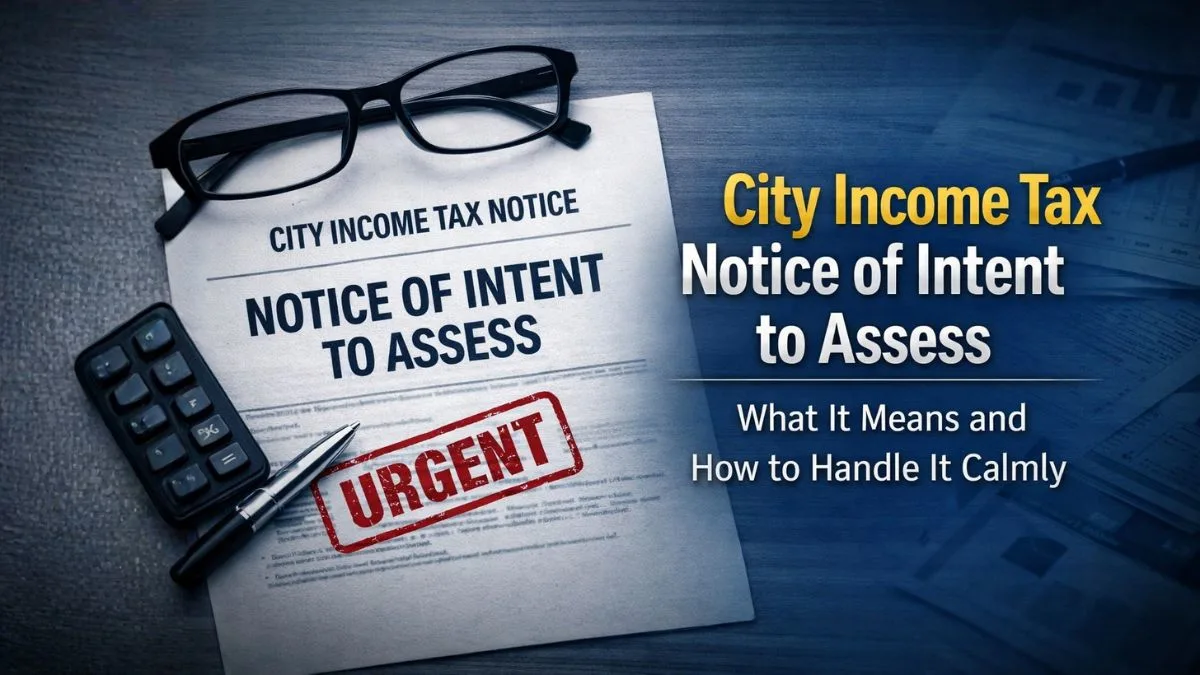
City Income Tax Notice of Intent to Assess: What It Means and How to Handle It Calmly
You saw the notice… and paused, right?
That phrase—"Intent to Assess”—sounds serious.
Almost like something final.
But let’s slow down for a second.
A city income tax notice of intent to assess is not the final demand. It’s more like… a warning before the actual bill arrives. The department is basically saying the following:
“Based on what we see, you might owe taxes. Please check and respond.”
That’s it.
Not a penalty yet. Not enforcement. Just a formal heads-up.
What does this notice actually mean?
A "Notice of Intent to Assess" from a city income tax department is a formal notification that the city intends to charge you for unpaid taxes, penalties, or interest based on a preliminary determination of tax liability. This typically occurs if a return was not filed, or if the city found discrepancies between your submitted information and their records
The city believes:
- You didn’t file properly
- OR
- Your details don’t match their records
And based on that, they’ve made an initial calculation — what you might owe.
That’s what we call DOR's determination of additional taxes you might owe
Important thing most people misunderstand
Let’s pause here.
This is not final.
Read that again.
A notice of intent to assess is not a confirmed demand. It’s an intention. Which means you still have time to:
- Correct things
- Explain your situation
- Dispute incorrect data
This window is where everything matters.
Why did you receive this notice?
There’s always a trigger.
Sometimes obvious. Sometimes not.
1. You didn’t file a city tax return
Even if you filed at the central level, city-level taxes can be separate.
People miss this more often than you’d expect.
2. Mismatch in income records
Your employer reported something.
Your filing says something else.
System flags it.
3. Missing or incomplete information
You filed… But maybe:
- Missed a source of income
- Entered incorrect figures
- Skipped a section
4. Data received from third parties
Authorities get data from:
- Employers
- Financial institutions
- Other tax departments
If that data doesn’t match your return, the notice is triggered.
So what is “Intent to Assess” exactly?
Think of it like this.
It’s a draft calculation.
The department has:
- Looked at your data
- Compared it with their records
- Estimated what you might owe
And now they’re telling you:
"This is what we think. Do you agree?”
That’s the essence of Intent to assess.
What should you do when you receive it?
This is where people either fix everything… or make it worse.
No panic. Just process.
Step-by-step:
- Read the notice carefully
- Identify the tax year involved
- Understand the calculation made
- Compare it with your own records
- Gather documents (salary slips, returns, bank data)
- Respond within the given time
Deadlines matter here.
Miss them, and the “intent” becomes an actual assessment.
How to authenticate your income tax status
Now this part is important — and often ignored.
If you’re unsure whether the notice is correct, you need to verify your records properly.
Here’s how to authenticate your income tax status:
- Check your filed returns (city and central).
- Review Form 16 or equivalent documents
- Match reported income with actual earnings
- Verify tax credits or payments made
- Look at any notices or prior communications
Take your time here.
Rushing leads to wrong responses.
What happens if you ignore it?
This is where things change.
Ignoring a notice of intent to assess leads to:
- Final assessment order
- Tax demand
- Penalties and interest
- Possible enforcement actions
Common mistakes
Ignoring the notice
Hoping it goes away — it won’t.
Assuming the department is wrong
Sometimes they are. But you still need proof.
Missing the deadline
This is where most trouble starts.
Sending incomplete replies
Half-information leads to more notices.
Here’s where things get interesting
Many people think this is about unpaid tax.
But often, it’s about miscommunication.
Data mismatch.
Wrong reporting.
Or simply missing filings.
That’s why the solution is usually not complicated — just detailed.
Can you challenge the assessment?
Yes.
You can:
- Disagree with the calculation
- Provide supporting documents
- Request correction
But you need to respond within the timeline mentioned in the notice
Final words
A city income tax notice of intent to assess might feel intimidating at first glance.
But in reality, it’s just a stage before final action.
A chance.
To explain. To correct. To align your records.
Take it seriously, but not emotionally.
And if the calculations, documents, or timelines feel overwhelming, getting help from platforms like Callmyca.com can make the process smoother. Not because it’s impossible to do alone, but because clarity and accuracy matter more than speed in situations like this.