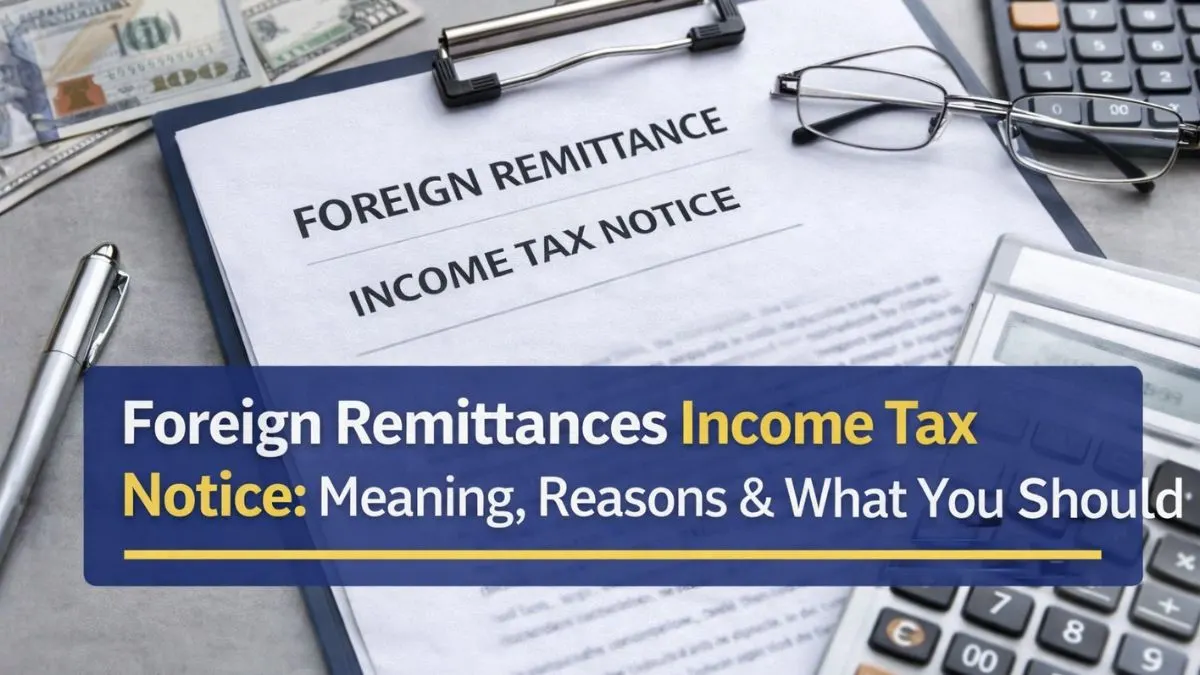
Foreign Remittances Income Tax Notice: Meaning, Reasons & What You Should Do
Introduction
Sending money abroad has become fairly common today.
People transfer funds overseas for education, investments, travel, family support, or business payments. These transactions are called foreign remittances.
But here’s something many taxpayers don’t realize.
Large remittance transactions are closely monitored by the Income Tax Department. Banks report these transfers under the Liberalised Remittance Scheme (LRS), and if the information reported by banks does not match the details in your income tax return, the department may issue a Foreign Remittances Income Tax Notice.
The notice does not necessarily mean you did something wrong.
Sometimes it’s simply a mismatch in reporting, a missing disclosure, or incorrect documentation such as Form 15CA/CB.
Still, it’s important to understand how these foreign remittances are taxed and why the Income Tax Department may send a notice.
Once you know the rules, responding to such notices becomes much easier.
What is a Foreign Remittances Income Tax Notice?
A Foreign Remittances Income Tax Notice is an official communication sent by the Income Tax Department when they detect discrepancies related to foreign remittances made by a taxpayer.
This usually happens when:
-
Large remittance transactions are reported by banks
-
The taxpayer fails to disclose them correctly in their tax return
-
There is a mismatch with Form 15CA/CB filings
In simple terms, the department wants clarification.
They want to know:
-
Why the foreign remittance was made
-
Whether the source of funds was properly taxed
-
Whether the correct taxes were paid
The notice generally asks taxpayers to explain the transaction or submit supporting documents.
Liberalised Remittance Scheme (LRS) –
To understand why a Foreign Remittances Income Tax Notice may appear, you first need to understand the Liberalised Remittance Scheme (LRS).
The LRS is a rule that allows Indian residents to send money abroad legally.
Under this scheme, individuals can send money overseas for various purposes such as:
• Foreign education
• Travel expenses
• Investments abroad
• Property purchase
• Supporting family members
However, these foreign remittances are subject to certain limits and tax rules.
Tax Rules for Foreign Remittances
Currently, when you send money abroad under LRS, banks may collect Tax Collected at Source (TCS).
Here’s how it generally works.
Current Rule
If foreign remittances exceed ₹7 lakh per financial year, banks may collect 20% TCS.
New Rule (From April 1, 2025)
The threshold increases to ₹10 lakh per financial year.
This means:
-
If total remittance exceeds ₹10 lakh
-
The bank collects TCS on foreign remittances
This tax is not an extra tax.
Instead, it works like an advance tax credit which can later be adjusted when you file your return.
Situations Where Lower TCS Applies
Certain foreign remittances are treated differently.
For example:
Education Loans
If the remittance is made for education through a loan from a financial institution, the TCS rate may be lower.
Medical Treatment Abroad
Payments for medical treatment or hospitalization abroad also receive relaxed rules.
However, documentation is important.
Failure to provide correct documentation can still lead to an Income Tax Notice.
Why You Might Receive a Foreign Remittances Income Tax Notice
There are several reasons why the Income Tax Department may issue a Foreign Remittances Income Tax Notice.
Let’s look at the most common ones.
1. Mismatch with Form 15CA/CB
When making a foreign remittance, taxpayers often need to submit Form 15CA or Form 15CB.
These forms confirm:
-
The nature of the payment
-
Whether the payment is taxable
-
Whether the correct taxes were deducted
If the information in these forms does not match the bank records, it may trigger a notice.
2. Undisclosed Source of Funds
The department may question the source of funds used for the remittance.
For example:
-
Large foreign remittances from low reported income
-
Transfers inconsistent with declared income
This mismatch can trigger scrutiny.
3. Incorrect Reporting in Income Tax Return
Sometimes taxpayers forget to mention foreign remittance transactions in their tax return.
Since banks report these transactions separately, the Income Tax Department detects the difference.
4. High-Value Foreign Transactions
Large remittance transactions automatically attract attention.
If the total foreign remittances exceed the reporting threshold, the department may issue a notice asking for clarification.
How the Income Tax Department Tracks Foreign Remittances
Many taxpayers wonder how the government even knows about their overseas transfers.
The answer is simple.
Banks and financial institutions report these transactions directly to the Income Tax Department.
They provide details such as:
-
Amount of remittance
-
Purpose of transfer
-
PAN of the taxpayer
-
Country of destination
-
TCS collected
These reports are matched with your tax return.
If something doesn’t match, a Foreign Remittances Income Tax Notice may be issued.
What to Do If You Receive a Foreign Remittances Income Tax Notice
Receiving such a notice can feel stressful.
But the solution is usually straightforward.
Here’s what you should do.
Step 1: Read the Notice Carefully
First, carefully review the Foreign Remittances Income Tax Notice.
Check:
-
Assessment year
-
Amount of remittance
-
Reason for the notice
Step 2: Gather Supporting Documents
Prepare documents related to your foreign remittance.
These may include:
• Bank remittance receipts
• Form 15CA / Form 15CB
• TCS certificate
• Purpose of transfer documentation
These documents help clarify the transaction.
Step 3: Verify Tax Reporting
Make sure the foreign remittance was correctly reported in your income tax return.
Also confirm whether the TCS credit was properly claimed.
Step 4: Respond Through the e-Filing Portal
Most notices can be responded to through the Income Tax e-Filing portal.
Upload explanations and supporting documents.
If everything is correct, the notice is usually closed without penalties.
What Happens If You Ignore the Notice
Ignoring a Foreign Remittances Income Tax Notice can create complications.
Possible consequences include:
• Penalties
• Interest charges
• Further scrutiny by the Income Tax Department
• Additional tax assessment
This is why responding promptly is always recommended.
Tips to Avoid Foreign Remittance Notices
The best strategy is prevention.
Follow these simple tips when making foreign remittances.
Before sending money abroad
• Ensure correct Form 15CA/CB filings
• Confirm the correct purpose code
• Maintain bank documentation
While filing your tax return
• Report all foreign remittance transactions
• Claim TCS credit correctly
• Ensure income sources match remittance amounts
After filing
• Keep transaction records safely
• Verify your Form 26AS for TCS entries
Following these steps significantly reduces the chances of receiving an Income Tax Notice.
Final Thoughts
International money transfers are completely legal under the Liberalised Remittance Scheme.
But because large foreign remittances involve cross-border taxes, the Income Tax Department monitors them carefully.
If the department detects mismatches between bank records, Form 15CA/CB, and your tax return, they may issue a Foreign Remittances Income Tax Notice.
In most cases, these notices are simply requests for clarification.
Once you provide the correct documents and explanation, the matter is usually resolved.
So if you ever receive such a notice, don’t panic.
Just verify the details, gather the necessary documents, and respond properly.
💡 Received a Foreign Remittances Income Tax Notice and unsure how to respond?
Tax experts at Callmyca.com help taxpayers verify foreign remittance transactions, handle Income Tax Department notices, and ensure correct compliance with LRS rules and taxes — so you can resolve issues quickly and avoid penalties.