High Value Transactions Income Tax Notice: Meaning, Reasons & What You Should Do
Introduction
Imagine this.
You open your email or log into the tax portal and see a message from the Income Tax Department.
It says you have received a high value transactions income tax notice.
Naturally, your first thought might be:
“Did I do something wrong?”
In most cases, the answer is no.
A tax notice for high-value transactions usually means the department has detected certain financial activities that exceed specified thresholds and wants clarification.
These transactions could include:
-
Large cash deposits
-
Property purchases or sales
-
High credit card spending
-
Big investments in mutual funds or shares
Banks and financial institutions report these high-value transactions to the government under a system called the Statement of Financial Transactions (SFT).
If the value of these transactions does not match your reported income in the Annual Information Statement (AIS) or Income Tax Return (ITR), the Income Tax Department may send a high value transactions income tax notice asking for an explanation.
The notice is not necessarily a penalty.
But it is definitely something you should respond to carefully.
What is a High Value Transactions Income Tax Notice?
A high value transactions income tax notice is an official communication sent by the Income Tax Department when they detect large financial transactions that appear inconsistent with a taxpayer’s declared income.
These notices are triggered when certain high-value transactions are reported by banks or financial institutions.
For example:
-
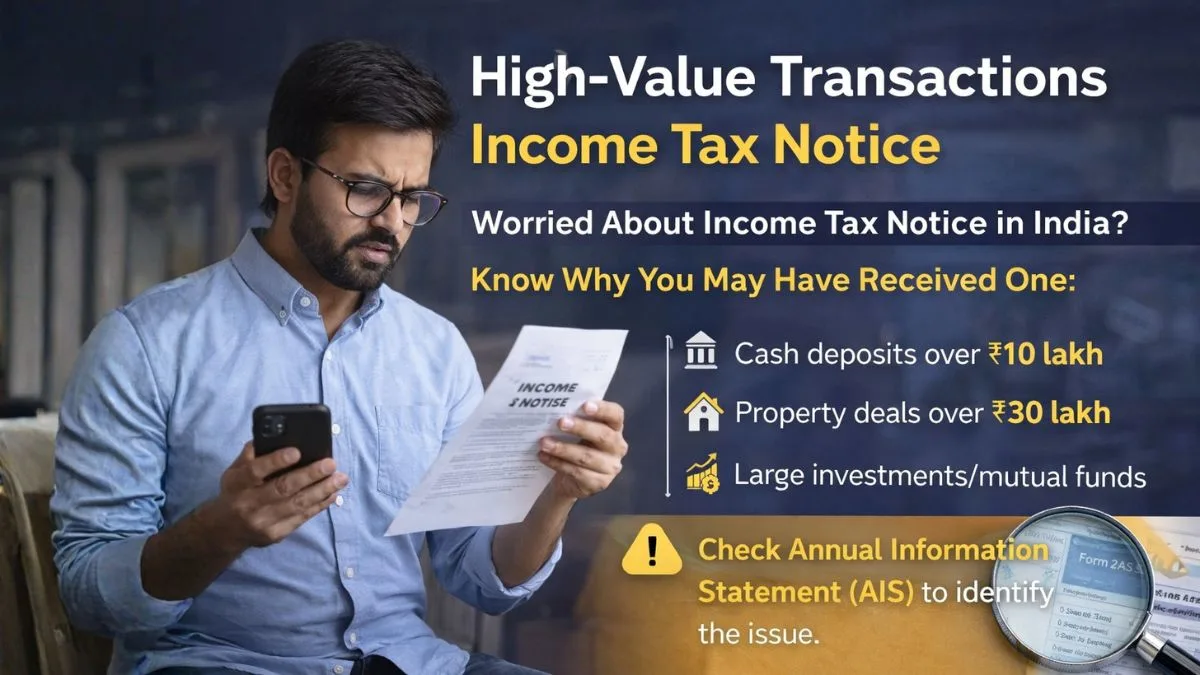
Cash deposits exceeding ₹10 lakh in a financial year
-
Property transactions exceeding ₹30 lakh
-
Large investments in stocks or mutual funds
-
High-value credit card payments
If these financial activities that exceed specified thresholds do not match the income declared in your ITR, the department may ask you to explain the source of funds.
This is why taxpayers sometimes receive a tax notice from the Income Tax department on your high-value transactions.
How the Income Tax Department Tracks High-Value Transactions
Many people wonder how the government even knows about their spending.
The answer lies in a reporting system called Statement of Financial Transactions (SFT).
Under SFT rules, banks and financial institutions must report certain high-value transactions to the Income Tax Department.
These reports are automatically linked to your PAN.
The information is then displayed in your Annual Information Statement (AIS).
The department compares:
-
Your reported income
-
Your financial activities that exceed specified thresholds
If the numbers don’t match, a high value transactions income tax notice may be issued.
Common High-Value Transactions That Trigger Income Tax Notices
Certain transactions automatically attract attention.
Here are the most common high-value transactions that can trigger a tax notice.
1. Large Cash Deposits
Cash deposits exceeding ₹10 lakh in savings accounts during a financial year are reported.
If your income does not justify such deposits, the department may issue a notice.
2. Property Transactions
Buying or selling property worth more than ₹30 lakh is reported to the Income Tax Department.
If the source of funds is unclear, a high value transactions income tax notice may follow.
3. High Credit Card Payments
Credit card payments exceeding ₹1 lakh in cash or ₹10 lakh through other modes may also be reported.
4. Large Investments
Investments such as:
-
Mutual funds
-
Bonds
-
Shares
above specified limits may be considered high-value transactions.
5. Foreign Travel Expenses
Large expenses on foreign travel can also be flagged if they appear inconsistent with declared income.
Why You Received a Tax Notice for High-Value Transactions
There are several reasons why taxpayers receive a high value transactions income tax notice.
The most common reasons include:
1. Mismatch with AIS
If your Annual Information Statement (AIS) shows high-value transactions that were not disclosed in your ITR, the system may generate a notice.
2. Income Does Not Match Spending
If your reported income appears too low compared to your spending, the department may seek clarification.
3. Unreported Transactions
Sometimes taxpayers simply forget to report certain financial activities that exceed specified thresholds.
This can trigger scrutiny.
4. Suspicious Cash Activity
Large or frequent cash deposits can also raise red flags.
What to Do If You Receive a High Value Transactions Income Tax Notice
Receiving a tax notice from the Income Tax department on your high-value transactions can feel stressful.
But in many cases, the issue can be resolved easily if you respond correctly.
Here’s what you should do.
Step 1: Read the Notice Carefully
First, understand the details mentioned in the notice.
Check:
-
Assessment year
-
Transaction details
-
Amount reported
Step 2: Verify AIS and ITR
Compare the transaction details in your Annual Information Statement (AIS) with your Income Tax Return (ITR).
Look for mismatches.
Step 3: Prepare Supporting Documents
The department may ask you to explain the source of funds.
So just keep these documents ready:
• Bank statements
• Investment records
• Property documents
• Loan agreements
• Gift deeds (if applicable)
These documents help prove that your high-value transactions were legitimate.
Step 4: Respond Through the Tax Portal
Most Income Tax notices can be answered through the Income Tax e-filing portal.
Upload your explanation and supporting documents.
In many cases, once the clarification is accepted, the notice is closed.
What Happens If You Ignore the Notice?
Ignoring a high value transactions income tax notice is not a good idea.
If you fail to respond, the Income Tax Department may take further action.
Possible consequences include:
• Additional tax demand
• Penalties
• Detailed scrutiny
• Investigation by the assessing officer
That’s why responding promptly is extremely important.
Tips to Avoid High-Value Transaction Notices
The best way to handle high-value transactions is to ensure proper reporting.
Here are some simple tips.
Before Filing Your Return
• Check AIS and Form 26AS
• Review reported transactions carefully
While Filing Your Return
• Declare all income sources
• Ensure investments match your income
After Filing
• Keep records of all financial activities that exceed specified thresholds
• Maintain supporting documentation
These steps help prevent unnecessary tax notices.
Final Thoughts
Large financial transactions are not illegal.
But when high-value transactions appear inconsistent with your declared income, the Income Tax Department may issue a high value transactions income tax notice to seek clarification.
In most cases, the notice simply asks you to explain the source of funds behind certain financial activities that exceed specified thresholds.
Once you provide proper documents and justification, the issue is usually resolved.
So if you ever receive a tax notice from the Income Tax department on your high-value transactions, don’t panic.
Review the notice carefully, prepare your documents, and respond on time.
💡 Received a high value transactions income tax notice and not sure how to reply?
Experts at Callmyca.com help taxpayers analyse high-value transactions, verify AIS data, prepare documentation, and respond correctly to Income Tax Department notices to avoid penalties and scrutiny.