
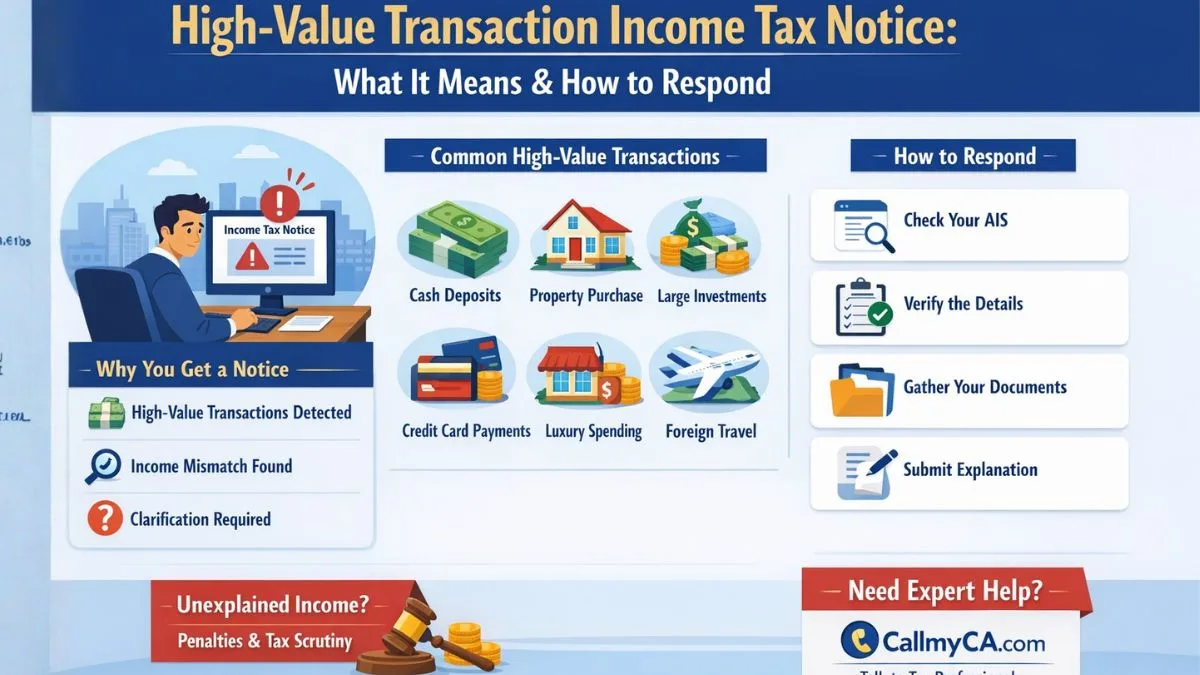
Understanding High-Value Transactions Income Tax Notice
If you’ve recently received a message or email from the Income Tax Department, don’t panic. Many taxpayers get worried the moment they see a notice. But here’s the interesting part—most of these notices are simply requests for clarification.
A high-value transaction income tax notice usually appears when the department detects certain high-value transactions in your financial records. These are transactions that stand out because they are bigger than normal spending patterns.
In simple terms, the government monitors certain financial activities that exceed specified thresholds. When these activities are reported by banks, financial institutions, or registrars, they are matched with the income declared in your tax return.
If everything matches, nothing happens.
But if there is a mismatch between your declared income and the transaction value, the department may ask questions.
That’s when a notice arrives.
Why the Income Tax Department Tracks High-Value Transactions
India’s tax system relies heavily on financial reporting. Banks, mutual fund houses, property registrars, and even credit card companies regularly submit data to the Income Tax Department.
These reports are called Statements of Financial Transactions (SFT).
Here’s the important part.
Income tax notices for high-value transactions are triggered when financial activities, such as cash deposits over ₹10 lakh, property sales exceeding ₹30 lakh, or large investments, mismatch reported income in the Annual Information Statement (AIS) or ITR. Banks report these under the Statement of Financial Transactions (SFT) to the Income Tax Department, and failure to justify the source of funds can lead to penalties and scrutiny.
This system helps authorities detect undeclared income or tax evasion.
Most people don’t realize this, but almost every major financial transaction today is automatically reported.
And yes, the department already knows more than most taxpayers think.
Common High-Value Transactions That Can Trigger a Notice
Now let’s talk about the specific high-value transactions that are commonly reported.
Certain transactions automatically fall under monitoring. These are typically financial activities that exceed specified thresholds.
Here are some examples:
-
Cash deposits above ₹10 lakh in a savings account in a year
-
Cash deposits above ₹50 lakh in a current account
-
Property purchase or sale above ₹30 lakh
-
Credit card payments exceeding ₹10 lakh in cash
-
Large mutual fund investments
-
Large fixed deposit investments
-
High-value share transactions
-
Foreign travel expenses above ₹2 lakh
These are classic examples of high-value transactions.
And again, reporting these doesn’t mean you did something wrong.
It just means the transaction is recorded.
What Happens When a Mismatch Is Detected
Sometimes the department finds a difference between your reported income and your spending or investments.
For example:
-
Someone reports income of ₹5 lakh
-
But buys property worth ₹80 lakh
Naturally, this raises questions.
At that point, the system flags the transaction as a high-value transaction requiring verification.
You might then receive a message or email saying the following:
Received a tax notice from the Income Tax department on your high-value transactions
Sounds scary, right?
But most notices are simply asking for clarification.
You are usually asked to confirm one of the following:
-
Whether the transaction belongs to you
-
The source of funds used
-
Whether it was already reported in your ITR
And that’s it.
Where These Transactions Appear (AIS and Form 26AS)
If you want to check what the government knows about your transactions, the best place to look is your AIS.
AIS stands for Annual Information Statement.
This statement includes almost every high-value transaction linked to your PAN.
It shows:
-
Bank deposits
-
Property transactions
-
Stock market investments
-
Interest income
-
Foreign remittances
-
Mutual fund purchases
These are automatically collected from financial institutions.
So before filing your tax return, it’s always a good idea to review AIS carefully.
Because if AIS shows something that your ITR doesn’t… the system notices.
Immediately.
What To Do If You Receive a High-Value Transaction Notice
Let’s understand the practical part.
If you received a tax notice from the income tax department on your high-value transactions, follow these steps calmly.
First, don’t ignore the notice.
Second, check the notice details on the income tax portal.
Third, verify the transaction mentioned.
Usually the portal will ask you to choose from options like the following:
-
The information is correct
-
The information is partially correct
-
The information is incorrect
-
Information relates to another PAN
Once you select the correct option, you may need to submit a supporting explanation.
This is where documentation becomes important.
Documents You Should Keep Ready
When explaining high-value transactions, documentation is everything.
So if the department asks for clarification, just keep these documents ready:
-
Bank statements
-
Property purchase or sale agreement
-
Loan sanction documents
-
Gift deed (if money was gifted)
-
Income proof
-
Investment statements
-
Mutual fund transaction reports
-
Capital gains reports
These documents help prove the source of funds.
And most of the time, once you provide them, the issue gets resolved quickly.
Possible Penalties for Unexplained High-Value Transactions
Now here’s something many taxpayers overlook.
If someone cannot explain their high-value transactions, the department may treat the amount as unexplained income.
And that’s where penalties may apply.
Under Indian tax laws, unexplained income can be taxed heavily.
Possible consequences include the following:
-
Tax on unexplained income
-
Additional penalty
-
Interest on unpaid tax
-
Further scrutiny or investigation
This doesn’t happen in most cases.
But if transactions truly don’t match declared income, the department may investigate further.
That’s why proper documentation matters.
A lot.
How to Avoid High-Value Transaction Notices in the Future
Here’s a simple rule many experts follow.
Always report what the government already knows.
Before filing your ITR, compare:
-
AIS
-
Form 26AS
-
Bank statements
-
Investment records
If something appears in AIS, mention it in your return.
Even if the income is exempt.
This simple step prevents many high-value transaction notices.
Another useful habit is maintaining a financial paper trail.
Whenever large transactions happen, keep supporting documents safely.
Because months or even years later, the department may ask questions.
And you’ll need answers.
Final Thoughts
Receiving a high-value transaction income tax notice can feel intimidating at first.
But in reality, it’s often just part of the government’s data verification process.
The key thing to remember is this: high-value transactions are not illegal.
They simply need proper explanation.
If your income sources are legitimate and documented, responding to such notices is usually straightforward.
The smartest approach is simple:
-
Check your AIS regularly
-
Report income accurately
-
Maintain documentation
-
Respond to notices promptly
Follow these steps, and most high-value transaction queries become routine compliance rather than a stressful experience.
Need Help Handling a High-Value Transaction Notice?
If you’ve received a tax notice from the income tax department on your high-value transactions and aren’t sure how to respond, getting expert help can save time and stress.
You can connect with experienced tax professionals at Callmyca.com, where experts assist with tax notices, compliance, and proper response strategies so you can resolve issues quickly and confidently.









