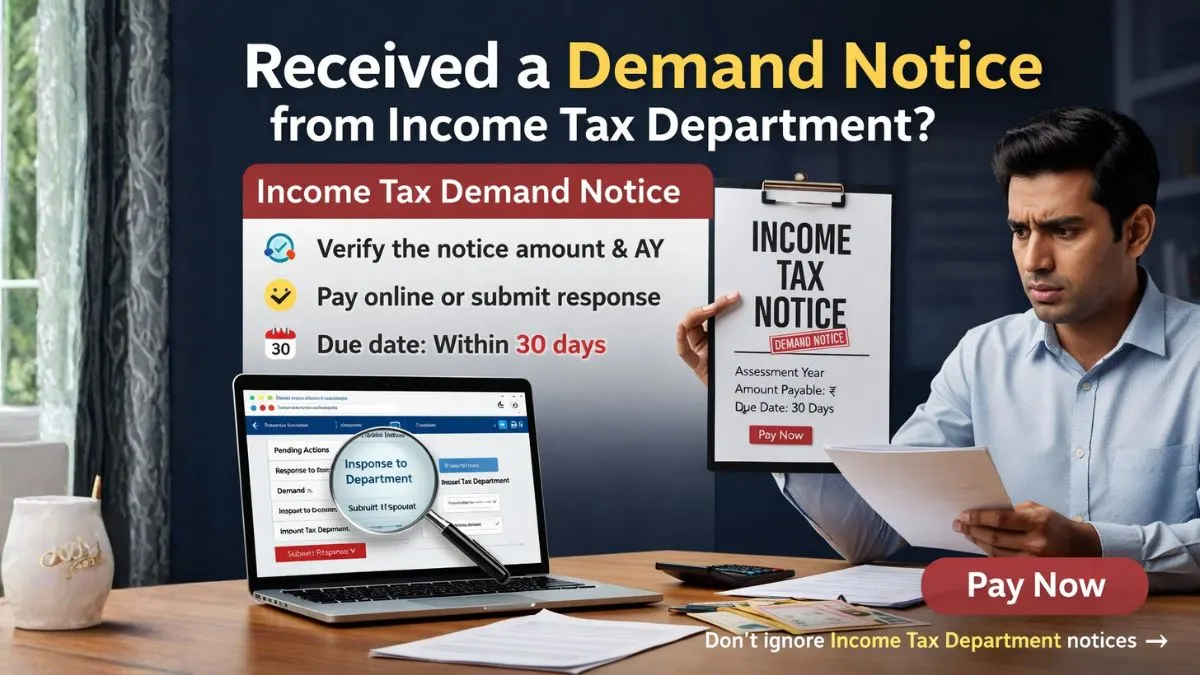
Demand Notice from Income Tax Department: Meaning, Reasons & What You Should Do
Introduction
Imagine this for a second.
You log into the tax portal just to quickly check your income tax return status. Maybe you’re expecting a refund. Maybe you’re just making sure everything is fine.
And then suddenly you see a demand notice.
Your first reaction?
“Wait… what is this?”
That moment of confusion is completely normal. Many taxpayers feel the same way when they see a demand notice from the income tax department for the first time.
But here’s something important to understand.
A notice is a demand. It simply means the Income Tax Department believes that there is some tax amount that may still need clarification or payment.
It does not automatically mean you made a serious mistake.
Sometimes the issue is just a mismatch in data. Sometimes it’s a small tax calculation difference. And sometimes the system simply picks up an entry that needs verification.
Still, ignoring a demand notice is never a good idea.
The best thing to do is review the Income Tax Demand Notice, verify the details carefully, and respond through the e-Filing portal under “Pending Actions.”
Once you understand how these notices work, they become far less intimidating.
What is an Income Tax Demand Notice?
An Income Tax Demand Notice is an official communication sent by the Income Tax Department informing a taxpayer that a certain tax amount appears to be unpaid or needs clarification.
Most commonly, this type of demand notice is issued under Section 156 of the Income Tax Act.
Let’s simplify it.
The process usually looks like this:
-
You file your income tax return.
-
The Income Tax Department reviews it.
-
They detect a mismatch or shortfall.
-
They issue a demand notice.
So when people say “notice is a demand,” they simply mean that the department is asking you to either pay the amount or explain why the demand might be incorrect.
A typical Income Tax Demand Notice includes:
-
Assessment year
-
Amount of tax demand
-
Reason for the notice
-
Instructions for payment or response
-
Deadline for action
Usually, taxpayers get 30 days to respond.
But remember — receiving a notice does not always mean you must immediately pay. First, you verify whether the demand is correct.
Why the Income Tax Department Sends a Demand Notice
Many people are surprised when they receive a demand notice from the income tax department. They often think their return was filed correctly.
In many cases, they’re right.
But the Income Tax Department works through automated systems that compare your return with multiple financial records.
Even a small mismatch can trigger a demand notice.
Let’s look at the most common reasons.
1. TDS Mismatch
One of the biggest causes of an Income Tax Demand Notice is a mismatch in TDS data.
For example:
-
Your employer reported a different TDS figure.
-
Bank interest income was not included.
-
TDS claimed in return doesn’t match Form 26AS
When the system notices this difference, it may generate a demand notice automatically.
2. Incorrect Tax Calculation
Tax calculations sometimes go wrong during filing.
Even a small mathematical difference can trigger an Income Tax Demand Notice.
3. Self-Assessment Tax Not Paid
Sometimes taxpayers file their return before paying the full self-assessment tax.
When that happens, the system raises a demand notice from the income tax department asking for payment.
4. Adjustment of Previous Demand
If there was an unpaid demand from a previous year, the Income Tax Department may adjust it against your refund.
A demand notice may then be issued to explain the adjustment.
5. Simple Filing Errors
Sometimes it’s nothing more than a small data entry mistake.
Entering the wrong figure or missing a detail can trigger a demand notice.
That’s why it’s always important to review your return carefully before submitting it.
Section 156 – Legal Basis of the Demand Notice
Most Income Tax Demand Notices are issued under Section 156 of the Income Tax Act.
This section gives the Income Tax Department the authority to officially notify taxpayers about unpaid taxes.
A Section 156 demand notice usually includes:
-
Amount of demand
-
Assessment year
-
Reason for demand
-
Payment instructions
-
Response deadline
In most situations, taxpayers must respond within 30 days.
But again, that response doesn’t necessarily mean payment. The first step is always verification.
How to Check Demand Notice Online
If you receive a demand notice from the income tax department, the easiest way to verify it is through the official tax portal.
Here’s the process.
Steps to Check the Notice
-
Log in to the Income Tax e-Filing portal.
-
Go to Pending Actions
-
Click Response to Outstanding Demand
-
Open the Income Tax Demand Notice
Inside the portal, you will see details such as:
-
Amount of demand
-
Assessment year
-
Reason for the demand notice
Sometimes the amount may be extremely small. It could be ₹200 or ₹500, caused by rounding differences.
So always check carefully before reacting.
How to Respond to an Income Tax Demand Notice
Once you review the Income Tax Demand Notice, you usually have three response options.
1. Agree with the Demand
If the demand notice is correct, you can accept it and pay the tax amount through the portal.
Once payment is completed, the Income Tax Department updates the demand status.
2. Disagree with the Demand
If you believe the demand notice from the income tax department is incorrect, you can dispute it.
You may need to submit supporting documents such as:
-
Tax payment challans
-
TDS certificates
-
Previous return details
The department will review your explanation before making a decision.
3. Partially Agree with the Demand
Sometimes taxpayers accept part of the demand but dispute the remaining amount.
In such cases, the e-Filing portal allows partial response submission.
What Happens If You Ignore the Notice
Ignoring a demand notice from the income tax department can create problems later.
Possible consequences include:
-
Adjustment of future refunds
-
Interest on unpaid tax
-
Additional penalties
-
Further scrutiny by tax officers
That’s why responding within the 30-day deadline is extremely important.
Even if the notice is a demand based on incorrect information, responding keeps your records clean.
Tips to Avoid Income Tax Demand Notices
Nobody likes receiving a demand notice.
Fortunately, many notices can be avoided with careful filing.
Here are some practical habits.
Before Filing Return
-
Check Form 26AS carefully.
-
Verify the AIS statement.
-
Confirm TDS entries
While Filing Return
-
Double-check tax calculations
-
Ensure deductions are valid.
-
Pay self-assessment tax before submission.
After Filing
-
Track return status
-
Keep tax documents safely.
-
Monitor any Income Tax Department notices.
These simple steps significantly reduce the chances of receiving an Income Tax Demand Notice.
Final Thoughts
Getting a demand notice from the income tax department can feel stressful at first.
But in most cases, it’s simply a communication asking for clarification.
Remember this key idea:
A notice is a demand — not always a penalty.
The Income Tax Department sends such notices when its system detects a difference between records and your tax return.
The best approach is simple:
-
Review the Income Tax Demand Notice
-
Verify the information
-
Respond through the e-Filing portal under “Pending Actions.”
In many cases, once the correct explanation or documents are submitted, the issue gets resolved quickly.
💡 Received a demand notice from the income tax department and unsure how to respond?
Experts at Callmyca.com help taxpayers review Income Tax Demand Notices, verify tax records, and respond correctly to the Income Tax Department, helping you resolve the issue quickly and avoid unnecessary penalties.