Picture the scene a few years back — some stores accepted wallets, some didn’t, and others still insisted on cash only. It created confusion & made it hard to track genuine sales.
To fix that, the government rolled out Section 269SU in the Income Tax Act, 1961.
The idea was simple: if a business is big enough (annual turnover above ₹ 50 crore), it must make digital payments possible for its customers. No excuses, no extra charges, just a clear path toward a cash-free marketplace.
What Exactly Does Section 269SU Say?
The section states that every person carrying on business shall provide facility for accepting payment through certain prescribed modes if their turnover in the previous financial year exceeded ₹ 50 crore."
In plain language, if your business crossed that threshold, you are required to provide electronic mode of payment facility to all customers — whether you run a restaurant, a car showroom or a retail chain.
Which Electronic Modes Count?
The CBDT (Central Board of Direct Taxes) notified three specific electronic modes for payment acceptance:
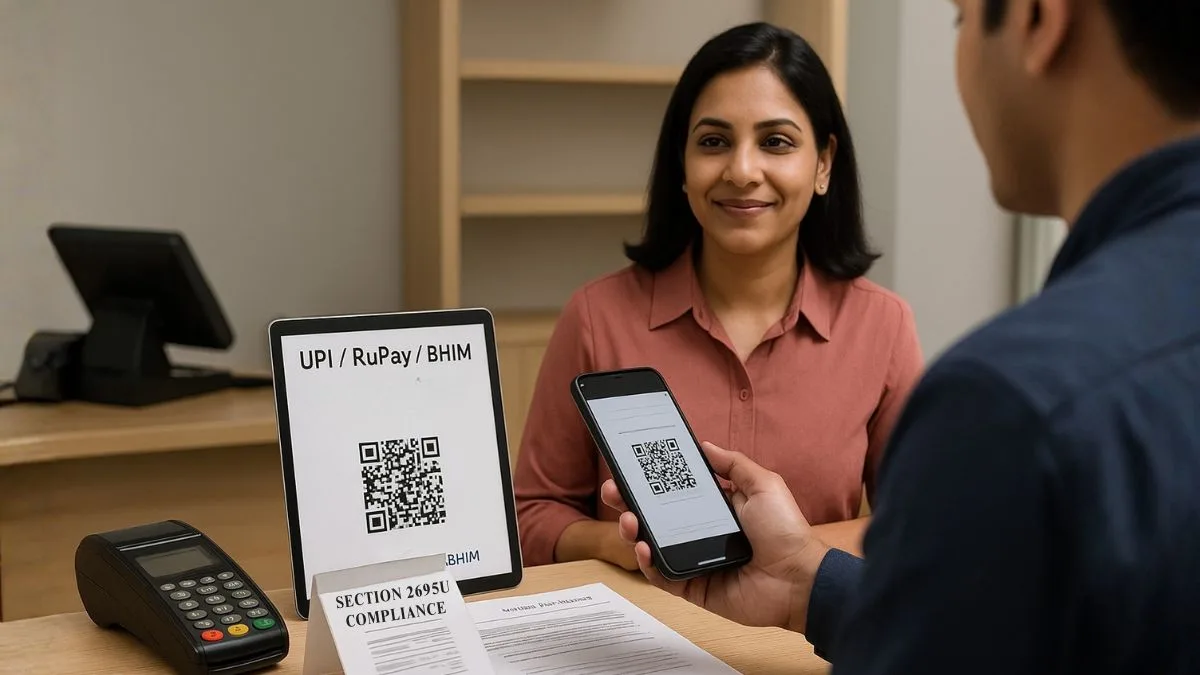
- BHIM UPI and UPI QR codes
- UPI payment apps supported by banks & NPCI
- Rupay Debit Card transactions
These are free to use — no Merchant Discount Rate (MDR), no hidden fee, no fine print. The goal is to make digital payments as normal as handing over cash.
Also Read: Cash Limit for Loans, Deposits & Specified Sums
Who Has to Follow It?
Section 269SU applies to:
- Private & public limited companies
- LLPs and partnership firms
- Sole proprietors running large businesses
If your sales in the preceding financial year were ₹ 50 crore or more, you must offer these digital modes at every branch or outlet. Even online portals fall under its umbrella if they meet the turnover mark.
Why This Matters for the Economy
The real purpose behind Section 269SU is not just convenience — it’s accountability. When payments move digitally, transactions leave a clear trail. This helps the government tackle tax evasion & black money, while making life simpler for customers and businesses alike."
It’s a nudge toward a future where “Cash Only” boards slowly disappear.
Penalty for Ignoring It — Section 271DB
Non-compliance can get expensive fast. Under Section 271DB, if a business fails to install or offer the required digital modes, the Income Tax Department can levy a penalty of ₹ 5,000 for each day of default.
The clock starts ticking from the day you’re supposed to be compliant until you actually are. The only way to avoid it is to show a “reasonable cause” under Section 273B — for example, a temporary technical issue or bank integration delay.
Example to Understand Better
Let’s say a supermarket chain reported ₹ 70 crore in sales last year. By law, it must provide BHIM UPI & Rupay payment options at each branch. If the chain ignores this requirement for ten days after the notification, that’s ₹ 50,000 in penalties right there.
Clearly, compliance is cheaper than carelessness.
Also Read: Section 269ST – A Bold Move to Curb Black Money
How to Stay Compliant
- Check eligibility. Did your turnover exceed ₹ 50 crore last year? If yes, the rule applies to you.
- Set up the infrastructure. Add a UPI QR code & Rupay POS machine at every counter or payment page.
- Inform customers. Display a notice clearly stating that electronic payments are accepted and free of charge.
- Maintain records. Keep transaction reports handy for any audit or inspection.
Most banks & payment aggregators will set this up for you at no cost.
No Extra Charges — CBDT Clarification
To protect consumers, the CBDT has explicitly barred merchants from charging additional fees for digital payments. So if a customer pays via UPI or Rupay, you can’t add a “digital convenience fee.” Banks too are not allowed to deduct MDR for these specific transactions.
This creates a win-win: customers save money & businesses earn trust.
Small Businesses and Future Impact
Although the law currently targets businesses with turnover above ₹ 50 crore, digital adoption is spreading down the ladder. Even mid-size & small enterprises are realizing that cashless operations make bookkeeping simpler and audits cleaner.
For the customer, it means speed, safety & instant proof of payment. For the nation, it’s a step toward complete financial transparency.
Quick Snapshot
|
Parameter |
Details |
|
Law Section |
269SU of Income Tax Act, 1961 |
|
Who Must Comply |
Businesses with turnover > ₹ 50 crore |
|
What To Do |
Provide facility for accepting payment through specified electronic modes |
|
Accepted Modes |
BHIM UPI, UPI QR Code, Rupay Debit Card |
|
Penalty for Default |
₹ 5,000 per day under Section 271DB |
|
Relief Clause |
Section 273B – Reasonable cause can avoid penalty |
|
Transaction Fee |
No MDR or service charge allowed |
Also Read: Penalty for Contravention of Section 269T
Why It’s Good for Business
Complying with Section 269SU is more than just avoiding penalties. It makes your brand look modern & trustworthy. Digital records reduce errors and help in faster reconciliation of sales. Most importantly, customers love the convenience of scanning a QR code and getting an instant receipt.
Final Word
The government’s push for digital payments through Section 269SU of the Income Tax Act is a clear sign that cash-based business models are fading away. If your turnover has crossed ₹ 50 crore, it’s time to act — set up the digital channels now & save yourself from daily penalties later.
Need help figuring out whether your business meets the criteria or how to install UPI and Rupay systems the right way? Visit Callmyca.com — our CA team will handle compliance, documentation & digital integration so you can focus on growth.