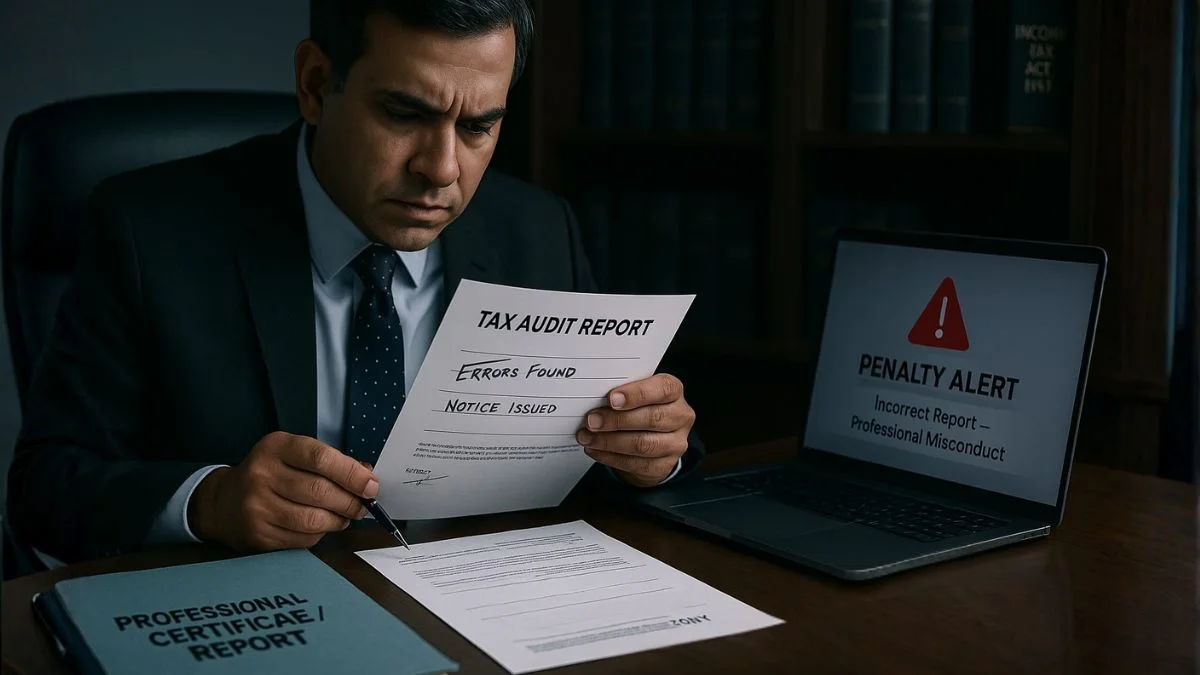
The Income Tax Act places a huge amount of trust in professionals. Whether it’s a tax audit, valuation report, transfer pricing documentation, or any certificate submitted to the tax department, the entire system depends on the accuracy of the information presented by experts. When a professional signs a certificate, the tax department assumes it has been checked properly, verified, and issued after exercising due care.
But what happens when a professional issues a wrong or misleading report?
To deal with that exact issue, Section 271J of the Income-tax Act, 1961 was introduced.
In simple words, Section 271J imposes a penalty on professionals for furnishing incorrect information in any report or certificate required under the Income Tax Act. This includes the work of:
- Chartered Accountants
- Merchant Bankers
- Registered Valuers
These individuals often certify data or reports that influence assessments, refunds, deductions, & even major financial decisions. When they make mistakes—whether intentional or due to negligence—the consequences can be serious.
Why Does Section 271J Exist?
Before Section 271J was introduced, the law had limited ways to hold professionals accountable for wrong certifications. If a CA, merchant banker, or valuer issued a wrong report, the only consequence was ethical action by the professional body. The Income Tax Department had no direct mechanism to impose a penalty on the professionals themselves.
The government noticed a spike in cases where incorrect reports led to:
- inflated deduction claims"
- undervaluation of assets
- wrong audit statements
- incorrect transfer pricing documentation
Each of these issues could cause sizable losses to the government. Section 271J was introduced as a safeguard—to ensure that professionals remain diligent & responsible.
Also Read: Penalty for Late Filing You Can’t Ignore
What Does Section 271J Say in Simple Terms?
Let’s break down the technical language into something easy to follow.
✔️ 1. Penalty for Incorrect Reports
Section 271J of the Income-tax Act, 1961, allows for a penalty to be imposed on professionals who provide incorrect information in reports or certificates.
✔️ 2. Who Can Be Penalized?
Penalties are imposed on:
- a chartered accountant
- a merchant banker
- a registered valuer
These are the professionals who commonly submit statutory reports under the Act.
✔️ 3. What Kind of Incorrect Information?
Any inaccurate, misleading, unverified, or false information in:
- audit reports
- valuation papers
- certificates issued for deductions
- compliance documents
- transfer pricing certification
- Form 15CB
- FMV valuation for shares
If the department identifies incorrect data, Section 271J may apply.
✔️ 4. Who Can Impose the Penalty?
The Assessing Officer has the authority to penalize the accountant, merchant banker, or valuer.
✔️ 5. What Is the Penalty Amount?
The Income Tax Act imposes a penalty of ₹10,000 for each incorrect report.
Not per financial year — per incorrect certificate.
So five wrong certificates = ₹50,000 penalty.
Is Intent Required? Does the Officer Need to Prove Misconduct?
This is one of the most important things to understand.
No intent is required to impose the penalty.
A professional may be penalized even if the mistake was unintentional.
The section does not require the tax department to prove:
- fraud
- malicious intent
- deliberate misreporting
- collusion with the taxpayer
If the issued report contains incorrect information, the penalty may still be levied."
This is why Section 271J has increased the seriousness with which professionals certify information.
Also Read: Penalty for Concealment or Misreporting
Why Professionals Must Take Section 271J Seriously
Chartered accountants, merchant bankers, & valuers play crucial roles in taxation. Their certificates determine eligibility for:
- deductions
- exemptions
- tax holidays
- depreciation claims
- transfer pricing adjustments
- valuation under capital gains
- FMV-based transactions under Section 56
- share valuation under Rule 11UA
If these certificates contain wrong numbers or unverifiable statements, the tax department faces incorrect assessments.
Section 271J ensures that professionals cannot simply sign documents without proper verification.
Real-Life Example That Explains Section 271J Perfectly
Imagine a CA issuing a certificate under Section 80JJAA for deduction on employment of new workmen. The company submits wrong payroll details, & the CA signs the certificate without cross-checking.
During assessment, the AO discovers the mistake. What happens?
- Deduction claimed by the company is disallowed
- Additional tax demand is raised
- And the CA receives a ₹10,000 penalty under Section 271J
This penalty is separate from the adjustments made in the taxpayer’s case.
The professional becomes directly accountable for poor verification.
What Types of Reports Often Attract Section 271J?
Some areas where Section 271J is commonly triggered include:
✔️ Tax Audit Reports under Section 44AB
✔️ Certificates under Chapter VI-A deductions
✔️ Valuation reports for shares under Section 56(2)(viib)
✔️ CA certificates for foreign remittances (Form 15CB)
✔️ Transfer pricing documentation
✔️ FMV valuation reports by registered valuers
✔️ Certifications filed during appeals or assessments
Any inaccuracy in these reports can invite penalties.
Does Section 271J Replace Ethical Actions by ICAI or Other Bodies?
No.
It works in addition to professional disciplinary actions.
For example, if a CA issues a fraudulent certificate, then:
- ICAI may take disciplinary action, and
- the Income Tax Department may impose a penalty under Section 271J
Both can happen independently.
How Professionals Can Protect Themselves From Section 271J Penalties
A few practical steps every CA, merchant banker, & valuer should follow:
✔️ Verify before signing: Never rely only on client declarations. Check documents.
✔️ Maintain working papers: This protects professionals in case the AO questions their certificate later."
✔️ Avoid last-minute certification: Most penalties arise from rushed, unverified work.
✔️ Use checklists: Standard checklists ensure nothing is missed.
✔️ Understand the law clearly: Wrong interpretation can lead to wrong certification.
Following these steps reduces risk significantly.
Does This Section Help Taxpayers Too?
Yes, absolutely.
When professionals are held accountable, taxpayers get:
- more accurate reports
- smoother assessments
- fewer disputes
- higher quality documentation
This helps in avoiding unnecessary penalties & notices for taxpayers.
Also Read: Penalty for Failure to File TDS/TCS Returns
Final Thoughts
Section 271J is a powerful reminder that professional certifications must be issued with care and integrity. The section ensures that professionals—especially chartered accountants, merchant bankers, & registered valuers—take full responsibility for the accuracy of the certificates they issue. With a clearly defined ₹10,000 penalty per incorrect report, this provision helps maintain trust, transparency, and accountability in the tax ecosystem.
📌 Want 100% accurate tax reports, valuations, or certificates? Visit Callmyca.com — Get your own expert CA who ensures flawless compliance every single time!