Notice of Assessment for Income Tax: What It Means & What You Should Do
Getting a notice of assessment for income tax can make anyone nervous.
You might immediately think, “Why me?” or “Did I do something wrong?”
But here’s something most people don’t realize—not every notice means trouble. In fact, many notices are just part of the regular assessment process in income tax, where the department verifies the details you’ve already submitted.
The Income Tax Department uses this process to check whether your return is accurate, complete, and consistent with the information they already have. If something doesn’t match, they simply ask for clarification.
So instead of panicking, the smarter approach is to understand what the notice actually means and what action is required.
What is a Notice of Assessment?
A Notice of Assessment for income tax is an official communication sent by the department after reviewing your return.
In simple words, it means your return is being checked—either automatically or manually.
This notice may ask you to:
- Confirm details already submitted
- Provide missing documents
- Explain certain transactions
- Accept or dispute tax calculations
The purpose is not always to penalize you. Often, it is just to inquire about the details of the assessee and ensure everything is correctly reported.
These notices are available to both registered and unregistered users, especially when the department detects financial activity linked to your PAN.
1. Section 143(1) – Summary Assessment
This is the most common type.
A summary assessment in income tax is completely automated. The system checks your return against available data like TDS, AIS, and Form 26AS.
You may receive:
- Intimation of no demand
- Refund confirmation
- Or a small tax demand
This is usually not serious and does not require detailed verification.
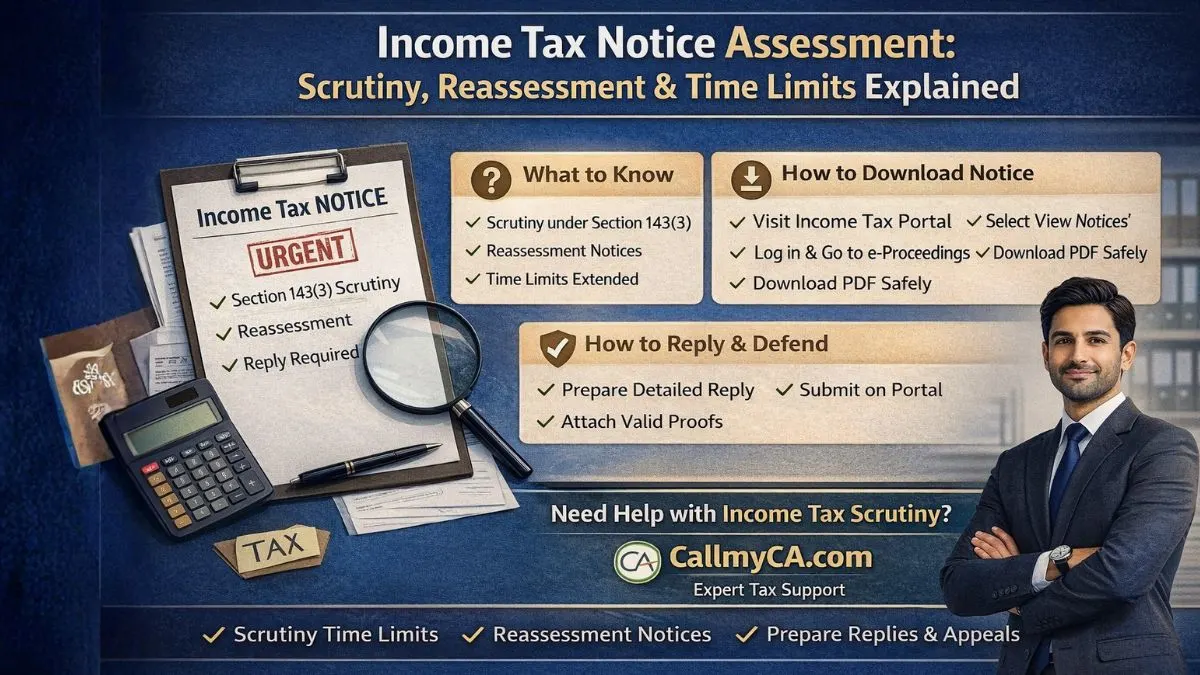
2. Section 143(2) – Scrutiny Assessment
This is where things get serious.
A scrutiny assessment in income tax means your return has been selected for detailed examination.
Under scrutiny assessment under income tax section 143(3), the department may ask for:
- Income proof
- Investment details
- Bank statements
- Expense justifications
The goal is to ensure that your declared income is accurate.
3. Section 142(1) – Inquiry Notice
This notice is issued when the department needs additional information.
It may ask you to:
- File your return (if not filed)
- Submit documents
- Clarify specific entries
Again, this is mainly to inquire about the details of the assessee.
4. Section 148 – Reassessment Notice
This is issued when income has escaped assessment.
In simple words, if the department believes you have not reported some income, they may initiate reassessment of income tax.
This notice requires careful handling, as it involves reopening your past returns.
Income Tax Scrutiny Time Limit
One of the most searched topics is the income tax scrutiny time limit.
The department cannot issue scrutiny notices anytime they want. There are specific timelines.
👉 A scrutiny notice under Section 143(2) must generally be served within three months from the end of the financial year in which the return is filed.
Sometimes, the government announces updates like the income tax scrutiny notice time limit being extended. So it’s important to stay updated with the latest rules.
If the notice is issued after the allowed time, it may be invalid.
Procedure for Assessment in Income Tax
Now let’s understand the procedure for assessment of income tax in a simple way.
The process usually follows these steps:
- Return Filing
You file your income tax return. - Initial Processing
The system checks your return (summary assessment). - Notice Issue (if required)
If discrepancies are found, a notice is issued. - Response Submission
You submit documents or explanations. - Final Order
The department accepts your response or raises demand.
This entire flow is part of the assessment procedure of the income tax notes PDF that many taxpayers search for.
How to Respond to a Notice of Assessment
Once you receive a notice, don’t delay.
Here’s what you should do:
Step 1: Read Carefully
Understand the section and reason for the notice.
Step 2: Check Deadline
Every notice has a response time. Missing it can create problems.
Step 3: Gather Documents
Keep all supporting documents ready.
Step 4: Reply Online
Submit your response through the income tax portal.
Step 5: Track Status
Keep checking updates after submission.
Responding correctly and on time can close the matter smoothly.
Common Mistakes to Avoid
Many taxpayers make simple mistakes that turn small issues into big problems.
Avoid these:
- Ignoring the notice
- Responding late
- Submitting incorrect documents
- Not understanding the section
- Giving incomplete answers
These mistakes can lead to penalties or further scrutiny.
What Happens If You Ignore the Notice?
Ignoring a Notice of Assessment for income tax is risky.
Here’s what may happen:
- Additional tax demand
- Penalties
- Best judgment assessment
- Legal consequences
The department assumes you are not cooperating.
So always respond, even if you believe the notice is incorrect.
Why You May Receive a Scrutiny Notice
A scrutiny assessment in income tax is usually triggered due to:
- High-value transactions
- Mismatch in income
- Large deductions
- Cash deposits
- Suspicious financial activity
Sometimes, cases are also selected randomly.
So receiving a notice does not always mean you did something wrong.
Documents Required for Assessment
Depending on your case, you may need:
- Salary slips or Form 16
- Bank statements
- Investment proofs
- Capital gain reports
- Business income records
Keep everything organized. It makes responding easier.
Final Thoughts
A Notice of Assessment for income tax is not something to fear—it’s part of the normal tax system.
The goal of the department is to ensure accuracy, not to trouble taxpayers unnecessarily.
If you understand the procedure for assessment in income tax, follow deadlines, and provide correct information, most issues can be resolved easily.
The key is simple:
👉 Stay calm
👉 Read the notice
👉 Respond on time
Don’t Risk Penalties—Get Expert Help
Received an income tax notice and not sure how to handle it? Don’t guess your way through it. Let professionals take care of your case—visit Callmyca.com and get your notice resolved quickly, accurately, and stress-free.