Income Tax Notice for Cash Transaction: Limits, Rules & How to Respond Safely
Have you recently received an income tax notice for a cash transaction and felt confused or worried? That reaction is completely normal. Most people panic the moment they see a notice from the Income Tax Department, especially when it’s related to cash transactions.
But here’s the truth—not every notice means you’ve done something wrong.
In many cases, it simply means that your financial transaction details need clarification. The income tax system tracks high-value cash activities very closely. If your cash transactions don’t match your reported income tax return, the system may automatically generate a notice.
So instead of panicking, the smart approach is to understand the rules, verify your details, and respond properly.
Why You Receive an Income Tax Notice for Cash Transaction
Today, the government is actively trying to restrict cash transactions to bring more transparency into the system. Because of this, banks and financial institutions regularly report large cash activities to the Income Tax Department.
If your cash usage seems unusual compared to your declared income, you may receive an income tax notice for cash transactions.
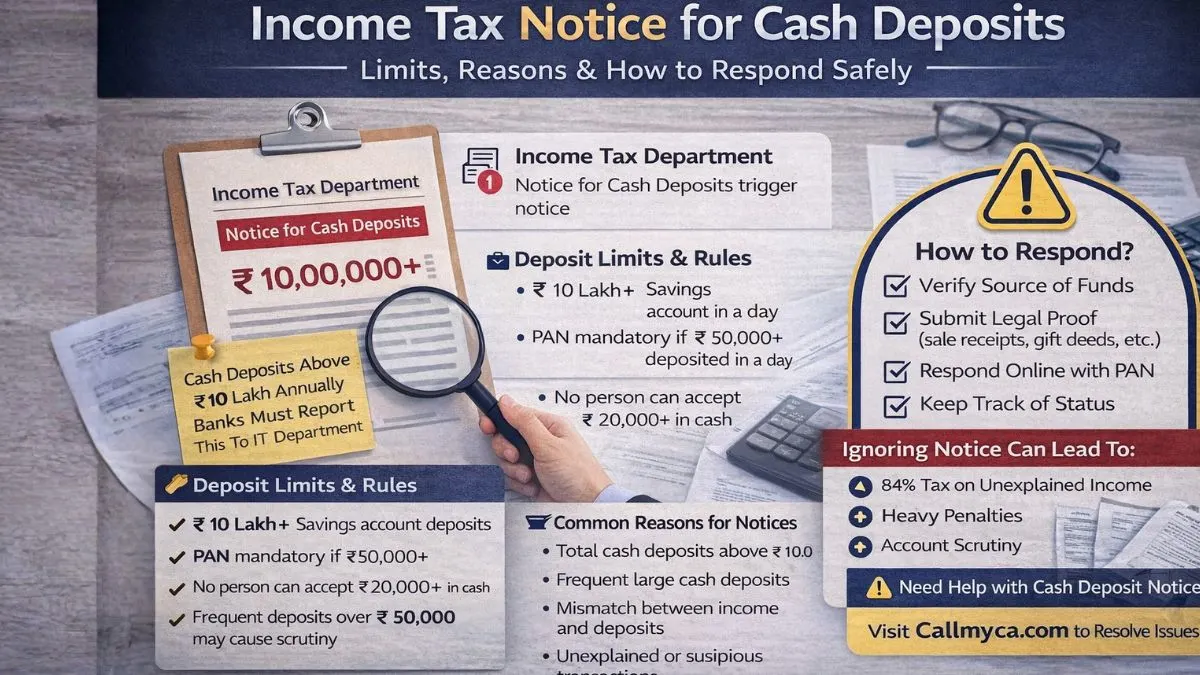
Common reasons include:
-
Large cash deposits or withdrawals
-
Frequent high-value cash transactions
-
Mismatch between your bank activity and your income tax return
-
Cash payments beyond permitted limits
-
Suspicious or unexplained financial activity
The important thing to remember is that most notices are triggered by data mismatch, not wrongdoing.
Cash Transaction Limit as per Income Tax
Many taxpayers are unaware of the cash transaction limit as per income tax, which often leads to unnecessary notices.
There is no complete ban on cash, but there are clear limits you must follow.
Important limits to keep in mind:
-
Cash receipts above ₹200,000 are restricted
-
Business expenses above ₹10,000 in cash are not allowed
-
Loans above ₹20,000 cannot be accepted in cash
These limits exist to monitor unaccounted money and ensure proper reporting.
Cash Transaction Limit in India as per Income Tax
To fully understand the rules, you need to know the cash transaction limit in India as per income tax.
Different sections of the Income-tax Act apply depending on the type of transaction.
Section 269ST
This section states that you cannot receive ₹200,000 or more in cash:
-
From a single person in a day
-
In a single transaction
-
For a single event
Section 40A(3)
Businesses cannot claim expenses above ₹10,000 paid in cash.
Section 269SS / 269T
Loans or deposits above ₹20,000 cannot be accepted or repaid in cash.
These rules are designed to restrict cash transactions and promote transparency.
Cash Payment Limit: ₹20,000 Effective Date
A very common query is about the cash payment limit of 20,000 and the effective date.
The rule under Sections 269SS and 269T has been in force for several years. It clearly states that:
-
You cannot accept a loan above ₹20,000 in cash
-
You cannot repay a loan above ₹20,000 in cash
If you violate this rule, the penalty can be equal to the amount involved, which makes it very important to follow.
Cash Transaction Limit per Day as per Income Tax Act
When it comes to daily transactions, understanding the cash transaction limit per day as per the Income Tax Act is crucial.
There isn’t a strict limit on deposits, but restrictions apply to receipts and reporting.
Key points:
-
Cash receipts above ₹200,000 are not allowed
-
PAN is required for transactions above ₹50,000
-
Frequent large transactions may attract scrutiny
Even if your transactions are genuine, they should always be properly documented.
Cash Transaction Limit per Day: ₹10,000
Another important rule is the cash transaction limit of 10,000 per day, especially for businesses.
-
If a business pays more than ₹10,000 in cash for expenses, it cannot claim that expense as a deduction
-
This increases taxable income
So even if the transaction is genuine, using cash can reduce tax benefits.
Cash Transaction Limit in a Year
Many people search for the cash transaction limit in a year, expecting a fixed number.
But the reality is—there is no fixed yearly limit.
However:
-
Banks report high-value transactions
-
All major activities are tracked
-
Data is reflected in AIS
If your annual cash transactions are not in line with your declared income, you may receive an income tax notice for cash transactions.
Exemption from Cash Transaction Limit
There are some cases where the law provides an exemption from the prohibition of cash transactions exceeding Rs. 2 lakh.
Examples include:
-
Government-related transactions
-
Banking institutions
-
Certain notified entities
However, these exemptions are limited and should not be assumed without proper understanding.
Income Tax Notice for Cash Transaction PDF
When you receive a notice, it is usually available online as an income tax notice for a cash transaction PDF.
You can check it by:
-
Logging into the Income Tax portal
-
Going to “e-Proceedings”
-
Downloading the notice
-
Verifying all details
Always read the notice carefully before taking any action.
Cash Deposit Notice Income Tax Reply Format
If you receive a notice, you must respond correctly. Knowing the cash deposit notice income tax reply format can make this process much easier.
Sample reply:
Subject: Response to Income Tax Notice for Cash Transaction
Dear Sir/Madam,
This is in response to the notice regarding cash transactions in my account for the financial year [Year].
The source of these transactions is explained below:
[Provide clear explanation]
Supporting documents are attached for verification.
Kindly consider the same.
Regards,
[Your Name]
Keep your reply simple, honest, and supported with documents.
Documents Required to Explain Cash Transactions
To avoid any issues, documentation is your strongest support.
Keep these ready:
-
Bank statements
-
Income proof
-
Business records
-
Sale invoices
-
Loan agreements
If your records are clear, responding becomes much easier.
Consequences of Violating Cash Transaction Rules
Ignoring the rules or failing to explain your transactions can lead to serious consequences.
-
Heavy penalties
-
Tax on unexplained income
-
Disallowed expenses
-
Legal action
That’s why it’s always better to stay compliant.
How to Avoid Income Tax Notice for Cash Transaction
The best way to handle notices is to avoid them in the first place.
Simple tips:
-
File accurate income tax return
-
Avoid unnecessary cash usage
-
Use digital payment methods
-
Maintain proper records
-
Ensure transactions match your income
Being transparent is the safest approach.
Final Thoughts
Receiving an income tax notice for a cash transaction may feel stressful at first, but it is usually manageable.
Most notices are triggered due to mismatches, not because of fraud.
If you understand the cash transaction limit as per income tax, follow the rules, maintain records, and respond properly, you can handle the situation without any trouble.
Need Help With Your Income Tax Notice?
Still unsure how to reply or worried about your notice?
👉 Don’t take risks with your income tax matters—visit Callmyca.com and get expert assistance to handle your income tax notice quickly, correctly, and without stress.