You Got a Federal Earned Income Tax Credit Notice… Is It Good or Bad?
When people hear the word “IRS,” they immediately think something is wrong.
Audit. Penalty. Problem.
But a federal earned income tax credit notice is different.
It’s not a warning. It’s not a fine. It’s actually a reminder that you might be entitled to money back.
Yes, money back.
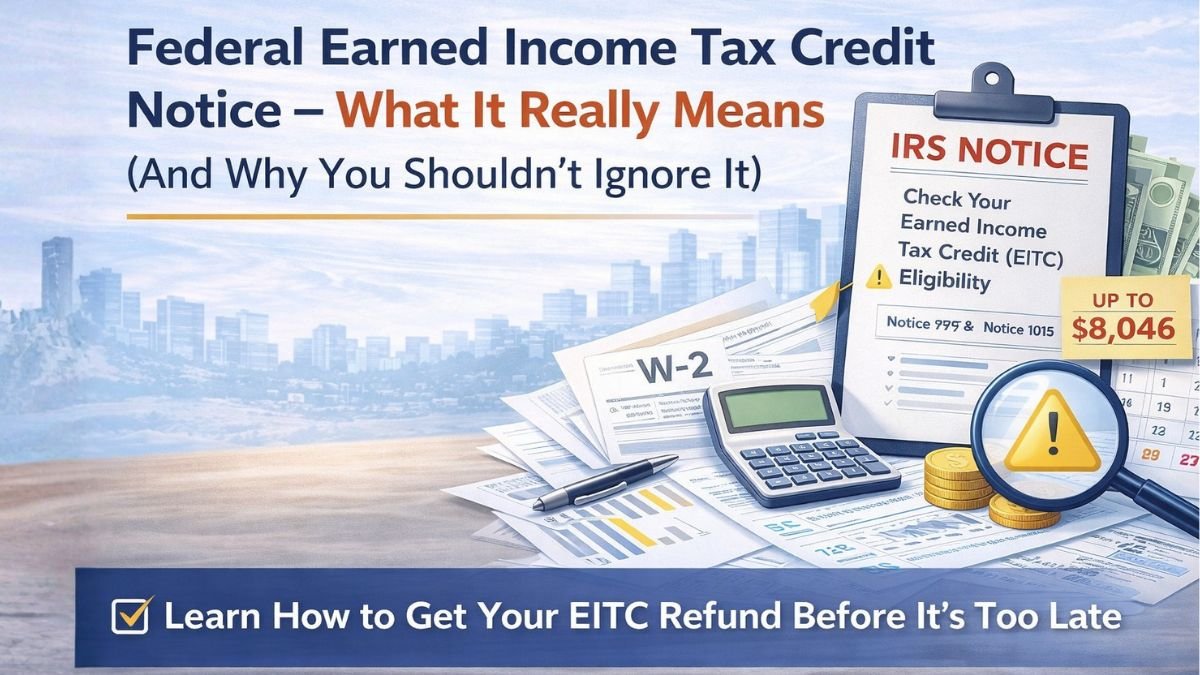
The IRS requires employers to notify employees about the Earned Income Tax Credit (EITC) through documents like IRS Notice 797 and Notice 1015. These notices tell workers they may qualify for a refund—even if no federal tax was withheld from their paycheck.
And here’s the part that surprises most people:
For 2025, the maximum federal EIC can go up to $8,046.
That’s not a small refund.
What Is the Federal Earned Income Tax Credit?
The federal earned income tax credit is a refundable tax credit created to support low-to-moderate-income workers.
Let’s simplify that.
It’s an Income Tax Credit (EITC) that can reduce your tax bill—and if the credit is bigger than your tax, the IRS sends you the difference as a refund.
Even if you owe zero tax.
That’s what “refundable” means.
The Earned Income Tax Credit is designed to reward work. If you earned income—from wages or self-employment—you may qualify.
And many people who qualify don’t even realize it.
What Is IRS Notice 797?
IRS Notice 797 is not a penalty notice.
It’s a required communication that employers must provide to employees, informing them about potential eligibility for the federal EIC.
Sometimes it’s included with Form W-2. Sometimes it’s displayed as an IRS Notice 797 poster in the workplace.
If no W-2 is required for an employee, employers must still notify employees by February 9, 2026.
The purpose is simple: awareness.
Because the IRS knows that many eligible workers never claim the credit simply because they don’t know they qualify.
What About Notice 1015?
Notice 1015 works alongside IRS Notice 797.
It gives employees more details about how to determine eligibility for the EIC and explains income thresholds.
Together, these notices are meant to protect workers.
They are informational. Not threatening.
If you received one, it doesn’t mean something is wrong.
It means you may be eligible for something good.
How Much Is the Credit in 2025?
For tax year 2025, the earned income tax credit table shows maximum credits up to:
-
$8,046 for three or more qualifying children
-
Lower amounts for one or two children
-
Smaller credits for workers without children
Yes, even if you don’t have children, you may qualify for a federal EIC.
That’s one of the biggest misconceptions.
People think EITC is only for families with kids. It’s not.
The credit amount depends on:
-
Your income
-
Filing status
-
Number of qualifying children
-
Adjusted gross income
And income limits adjust slightly each year.
What Disqualifies You From Earned Income Credit?
This is one of the most searched questions: what disqualifies you from the earned income credit?
Common reasons include:
-
Filing as married filing separately
-
Having investment income above the IRS limit
-
Not having earned income
-
Being claimed as a dependent
-
Invalid Social Security number
-
Not meeting residency rules
Sometimes people assume they’re disqualified when they’re not.
Other times, a small technical rule makes the difference.
That’s why checking carefully matters.
Should You Use an Earned Income Credit Calculator?
Yes—but with understanding.
An earned income credit calculator can give you a quick estimate based on your income, filing status, and number of children.
It’s helpful for planning.
But calculators don’t replace filing.
The final eligibility and refund amount are determined when you actually file your tax return.
If the calculator shows you might qualify, that’s your sign to take it seriously.
Why Filing Matters—Even If You Owe Nothing
Here’s something many people don’t realize.
Even if you’re not required to file a return because your income is low, you must file to claim the federal EIC.
No filing means no refund.
That’s why IRS Notice 797 exists. It reminds employees that filing can be beneficial.
Some workers skip filing because they think, “I didn’t have taxes withheld, so I won’t get anything back.”
That’s not always true.
With the Earned Income Tax Credit, you might still receive a refund.
What Is the IRS Notice of Withholding Earned Income Credit Poster?
The IRS notice of withholding earned income credit poster is something employers may display in workplaces.
It informs employees that even if little or no federal tax was withheld, they may still qualify for EITC.
It’s part of employer compliance.
But more importantly, it’s part of taxpayer protection.
It helps ensure workers don’t miss out on benefits they legally qualify for.
What About CA EITC Notice 2025?
If you live in California, you may see a CA EITC notice 2025.
California offers its own version of the earned income credit.
If you qualify for the federal EIC, there’s a good chance you may qualify for the California credit too—depending on income limits.
That means you could potentially receive:
-
Federal EIC refund
-
State EITC refund
Stacked together, refunds can become significant.
Why So Many People Miss This Credit
Despite IRS Notice 797, posters, and reminders, millions of eligible taxpayers don’t claim EITC.
Why?
Because they assume:
-
They earn too little.
-
They earn too much.
-
It’s complicated.
-
It’s not worth filing.
But when the maximum credit can reach $8,046, it’s absolutely worth checking.
The EITC exists to support working people.
It’s not charity. It’s part of the tax system.
Final Thoughts—Don’t Leave $8,046 Unclaimed
A federal earned income tax credit notice is not bad news.
It’s an opportunity.
Whether you saw IRS Notice 797, Notice 1015, an IRS Notice 797 poster, or searched for an earned income credit calculator, the message is clear:
You may qualify for a refund.
Understanding the earned income tax credit table, checking what disqualifies you from the earned income credit, and filing properly can make a real financial difference.
The Earned Income Tax Credit (EITC) is one of the most powerful refundable credits available.
And it starts with one simple step.
Filing your return.
If you received a federal earned income tax credit notice and want to calculate your federal EIC accurately, check eligibility, and maximize your refund without risking disqualification, the experts at Callmyca.com can help you claim every dollar you deserve—because missing an $8,046 refund is far worse than taking a few minutes to file correctly.