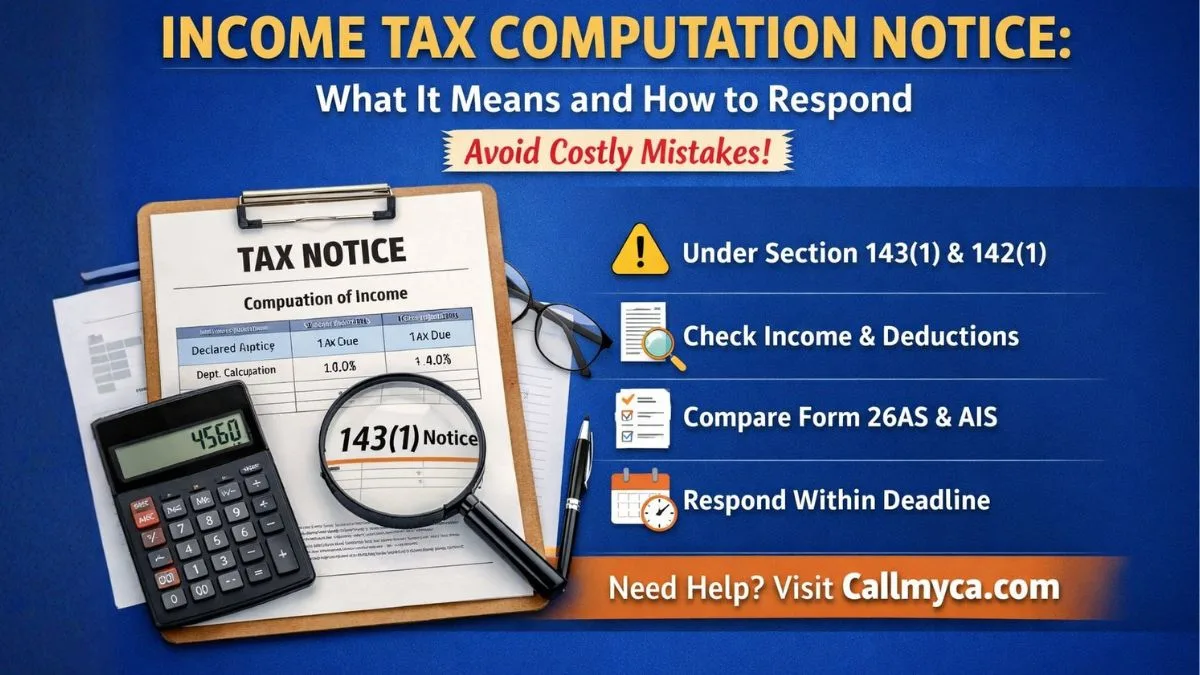
Income Tax Computation Notice: What It Means and How to Respond (Avoid Costly Mistakes!)
Have you recently received an income tax computation notice and felt confused or even worried? You’re not alone. Many taxpayers panic when they see an official message from the Income Tax Department. But here’s the truth—not every notice is bad. In many cases, it’s simply a routine communication related to the computation of income of your filed return.
Understanding the meaning of a computation notice, why it is issued, and how to respond correctly can save you from unnecessary stress, penalties, or even legal complications. In this guide, we’ll break down everything you need to know about income tax notices, especially notices under Section 143(1) and Section 142(1), in simple and practical language.
What is an Income Tax Computation Notice?
An income tax computation notice is a formal communication sent by the Income Tax Department after processing your Income Tax Return (ITR). It contains details about the computation of income, tax payable, refunds, or discrepancies found in your return.
The most common type of computation notice is an income tax notice under section 143(1). This is called an “intimation” and is generated automatically after your ITR is processed.
It compares:
-
Your declared income
-
Tax paid by you
-
Data available with the department
If there is any mismatch, the system recalculates your tax computation and informs you through a notice.
Types of Income Tax Notices You May Receive
Understanding different types of income tax notices is crucial to responding correctly. Here are the most common ones:
1. Income Tax Notice under Section 143(1)
This is the most common computation notice. It is not always negative.
It may show:
-
No demand and no refund
-
Refund due
-
Additional tax payable
It highlights differences in the computation of income of your return versus the department’s data.
2. Notice under Section 142(1)
This notice is issued when:
-
You have not filed your return
-
The department needs more information
It may ask for:
-
Documents
-
Proof of income
-
Clarification on deductions
3. Notice under Section 139(9)
Issued for defective returns where:
-
Incorrect details are filled
-
Mandatory information is missing
4. Notice under Section 148
This is a serious notice for reassessment of income, usually when income has escaped assessment.
Why Do You Receive an Income Tax Computation Notice?
Receiving an income tax computation notice does not mean you have done something wrong. It is often generated due to mismatches in data.
Here are some common reasons:
1. Mismatch in Income
Your reported income does not match:
-
Form 26AS
-
AIS (Annual Information Statement)
2. Incorrect Deductions Claimed
If deductions claimed are not supported by records, the department may revise your tax computation.
3. TDS Mismatch
When TDS claimed in your return does not match the department’s records.
4. Additional Income Detected
Income such as:
-
Interest from FDs
-
Capital gains
-
Freelance income
may not have been reported correctly.
5. Late Filing or Non-Filing
You may receive a notice if:
-
You didn’t file your return
-
Filed after due date
How to Read an Income Tax Computation Notice
When you receive an income tax notice under section 143(1), don’t panic. Instead, carefully read it.
Key sections include:
1. Summary of Computation
This shows:
-
Income declared by you
-
Income considered by department
2. Adjustments Made
The notice will clearly mention:
-
Disallowed deductions
-
Added income
3. Tax Calculation
Shows:
-
Total tax payable
-
Interest
-
Penalties (if any)
4. Refund or Demand
Final outcome:
-
Refund issued
-
Demand rose.
What to Do After Receiving an Income Tax Notice
Receiving an income tax computation notice requires timely action. Ignoring it can lead to penalties.
Here’s a step-by-step process:
Step 1: Verify the Notice
Check:
-
PAN details
-
Assessment Year
-
Section mentioned
Ensure it is genuine and issued by the Income Tax Department.
Step 2: Compare Computation
Match the computation of income of your ITR with the notice.
Look for:
-
Income differences
-
TDS mismatch
-
Deduction changes
Step 3: Check Form 26AS and AIS
Download:
-
Form 26AS
-
AIS
Compare them with your return.
Step 4: Decide Your Action
You have two options:
Accept the Notice
If the department is correct:
-
Pay the demand
-
No further action needed
Disagree with the Notice
If you find errors:
-
File a rectification request under Section 154
-
Submit response online
Step 5: Respond Within Deadline
Most notices have a deadline of 30 days.
Ignoring it can lead to:
-
Penalties
-
Legal consequences
How to Respond to Income Tax Notice Online
You can respond to an income tax notice through the Income Tax Portal.
Steps:
-
Login to Income Tax Portal
-
Go to “e-Proceedings.”
-
Select the relevant notice
-
Choose response option
-
Upload documents (if required)
-
Submit
Always keep a copy of the submission for records.
Common Mistakes to Avoid
Many taxpayers make errors while handling income tax notices. Avoid these:
1. Ignoring the Notice
This is the biggest mistake. Always respond on time.
2. Not Checking AIS / 26AS
Mismatch in these forms leads to incorrect tax computation.
3. Filing Wrong Response
Incorrect replies can worsen your case.
4. Missing Deadlines
Late responses may attract penalties.
5. Not Taking Expert Help
Complex cases require professional assistance.
Can You Revise Your Return After Receiving Notice?
Yes, in certain cases you can revise your return if:
-
The notice is under Section 143(1)
-
The time limit for revision is not over
Otherwise, you may need to file a rectification request.
Penalties for Ignoring Income Tax Notices
Ignoring an income tax computation notice can have serious consequences:
-
Interest under Section 234A/B/C
-
Penalty under Section 270A
-
Prosecution in severe cases
Always take action immediately.
Difference Between Intimation and Notice
Many people confuse intimation under section 143(1) with a notice.
| Aspect | Intimation | Notice |
|---|---|---|
| Nature | Informational | Requires action |
| Section | 143(1) | 142(1), 148 |
| Response Required | Sometimes | Usually mandatory |
When Should You Seek Professional Help?
You should consult experts if:
-
High demand is raised
-
Notice under serious sections like 148
-
Complex income sources involved
Professional guidance ensures:
-
Correct response
-
Reduced tax liability
-
Compliance with law
Final Thoughts
Receiving an income tax computation notice is not something to panic about. In most cases, it is simply a system-generated communication highlighting differences in the computation of income of your return.
The key is to:
-
Stay calm
-
Verify details
-
Respond on time
Understanding your income tax notice under section 143(1) or any other notice can save you from unnecessary trouble and help you stay compliant with tax laws.
Need Help With Your Income Tax Notice?
Still confused about your income tax notice or computation of income? Don’t take risks with your taxes. Let experts handle it for you.
👉 Visit Callmyca.com today and get professional assistance to respond to your notice quickly and accurately before deadlines hit!