
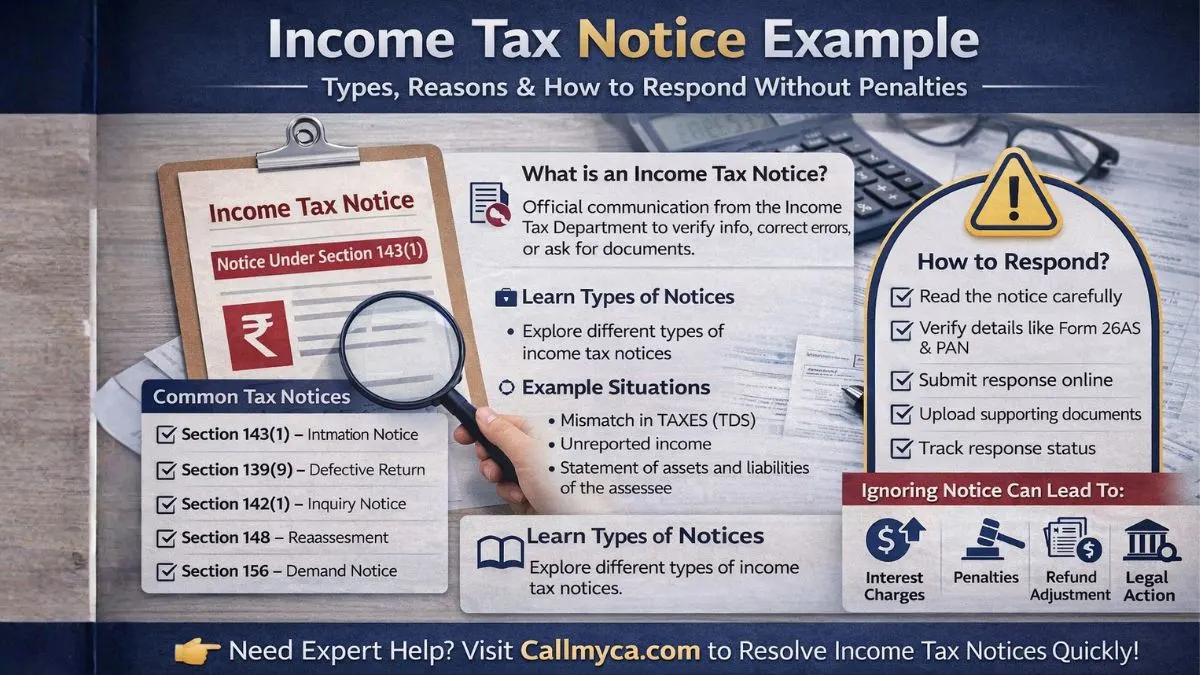
Income Tax Notice Example: Types, Reasons & How to Respond Without Penalties
Have you ever searched for an income tax notice example right after receiving a notice? If yes, you’re not alone. The moment people see a message from the Income Tax Department, panic sets in.
But here’s the reality—not every notice is bad news.
In many cases, an income tax notice is just a simple request for clarification, verification, or correction. It could be due to minor mismatches, calculation errors, or missing details in your return. If you understand income tax, its types, reasons, & how to respond, you can handle it smoothly without stress.
What is an income tax notice?
An income tax notice is an official communication sent by the Income Tax Department to a taxpayer. It is issued when the department finds discrepancies, needs clarification, or wants additional information related to your filed return.
This notice can be related to:
-
Incorrect reporting of income
-
Mismatch in TAXES paid
-
Verification of high-value transactions
-
Pending dues
-
Request for documents
Understanding an income tax notice example helps you stay calm and respond correctly instead of reacting emotionally.
Income Tax Notice Example
Let’s understand an income tax notice example in a simple way.
Suppose you filed your return showing an income of ₹8 lakh. But the department has data showing ₹10 lakh because you forgot to include bank interest or capital gains. This mismatch triggers a notice.
Another common example is when TAXES deducted (TDS) do not match your Form 26AS. The system automatically flags this difference.
These examples clearly show that notices are usually about data mismatch, not wrongdoing.
Statement of Assets and Liabilities of the Assessee
In certain cases, the department may ask for a statement of assets and liabilities of the assessee. This usually happens when your case is selected for scrutiny or your income crosses a specific limit.
This statement includes:
-
Property owned
-
Bank balances
-
Investments
-
Loans and liabilities
It helps the department verify whether your declared income matches your financial position. So, while preparing this, accuracy is very important.
Learn Types of Income Tax Notices
To handle notices confidently, you need to learn types of income tax notices. Every notice has a different purpose, and your response depends on its type.
Here are the most common ones:
1. Section 143(1) – Intimation Notice
This is the most common notice. It is sent after processing your return. It may show no demand, refund, or additional tax payable.
2. Section 139(9) – Defective Return
This notice is issued when your return has errors or missing information.
3. Section 142(1) – Inquiry Notice
The department may ask for additional details, documents, or explanations.
4. Section 148 – Reassessment Notice
Issued when the department believes some income has not been reported.
5. Section 156 – Demand Notice
This is issued when additional TAXES, interest, or penalties are payable.
When you explore different types of income tax notices, you will realize that each notice has a clear purpose and can be handled with proper understanding.
Reasons for Receiving an Income Tax Notice
Many people think receiving a notice means something serious. But most of the time, it’s due to small mistakes.
Here are common reasons:
1. Mismatch in Income
Your income does not match the data available with the department.
2. TDS Mismatch
The taxes claimed in your return are different from Form 26AS.
3. Unreported Income
Interest, capital gains, or freelance income not reported.
4. High-Value Transactions
Large deposits, property purchases, or investments.
5. Incorrect Filing
Errors in calculation or missing details.
Understanding these reasons makes it easier to respond calmly.
How to Authenticate Them
Before responding, you must verify the notice. Knowing how to authenticate them is very important because fraudulent messages are also common nowadays.
Steps to Verify Notice
-
Check the Document Identification Number (DIN)
-
Log in to the Income Tax portal
-
Check under “e-Proceedings.”
-
Match your PAN details
If the notice is not available on the official portal, do not respond to it.
How to Respond to an Income Tax Notice
Now comes the most important part—response.
Once you understand income tax, its types, reasons, & how to respond, the process becomes simple and manageable.
Step 1: Read the Notice Properly
Check:
-
Section number
-
Assessment year
-
Reason for notice
Step 2: Verify Your Data
Compare:
-
Your filed return
-
Form 26AS
-
AIS
Step 3: Decide Your Response
You can:
-
Accept the demand
-
Disagree with the notice
Step 4: Submit Response Online
Go to the e-filing portal and respond under:
“e-Proceedings” or “Response to Outstanding Demand”
Step 5: Upload Documents
Attach all necessary supporting documents.
Step 6: Track Status
Keep checking updates until the issue is resolved.
Income Tax Notice Reply Sample
If you are unsure how to reply, looking at an income tax notice reply sample can help.
Here is a simple example:
Subject: Response to Notice under Section [Section Number]
Dear Sir/Madam,
This is in response to the notice issued for Assessment Year [Year].
We have reviewed the details and submit the following clarification:
[Explain your point clearly]
Supporting documents are attached for your reference.
Kindly consider the same.
Regards,
[Your Name]
Always keep your response clear, factual, and supported by documents.
Common Mistakes to Avoid
While dealing with notices, many taxpayers make avoidable mistakes.
1. Ignoring the Notice
This can lead to penalties or legal action.
2. Missing Deadline
Most notices require a response within 30 days.
3. Providing Wrong Information
Incorrect replies can complicate the situation.
4. Not Checking Records
Always verify Form 26AS and AIS.
5. Not Taking Expert Help
For complex issues, professional guidance is helpful.
Consequences of Ignoring Notice
Ignoring an income tax notice can lead to serious consequences.
-
Interest on unpaid TAXES
-
Penalties
-
Adjustment of refunds
-
Legal proceedings
That’s why a timely response is always important.
Final Thoughts
Getting an income tax notice is not something to panic about. It is simply a communication.
If you understand the income tax notice example, learn the types of income tax notices, explore different types of income tax notices, and know how to authenticate them, you can handle everything confidently.
The key is to stay calm, verify details, and respond correctly.
Need Help With Your Income Tax Notice?
Still confused about your notice or not sure how to respond?
- Don’t take risks with your TAXES—visit Callmyca.com and get expert assistance to handle your income tax notice quickly and professionally.









