
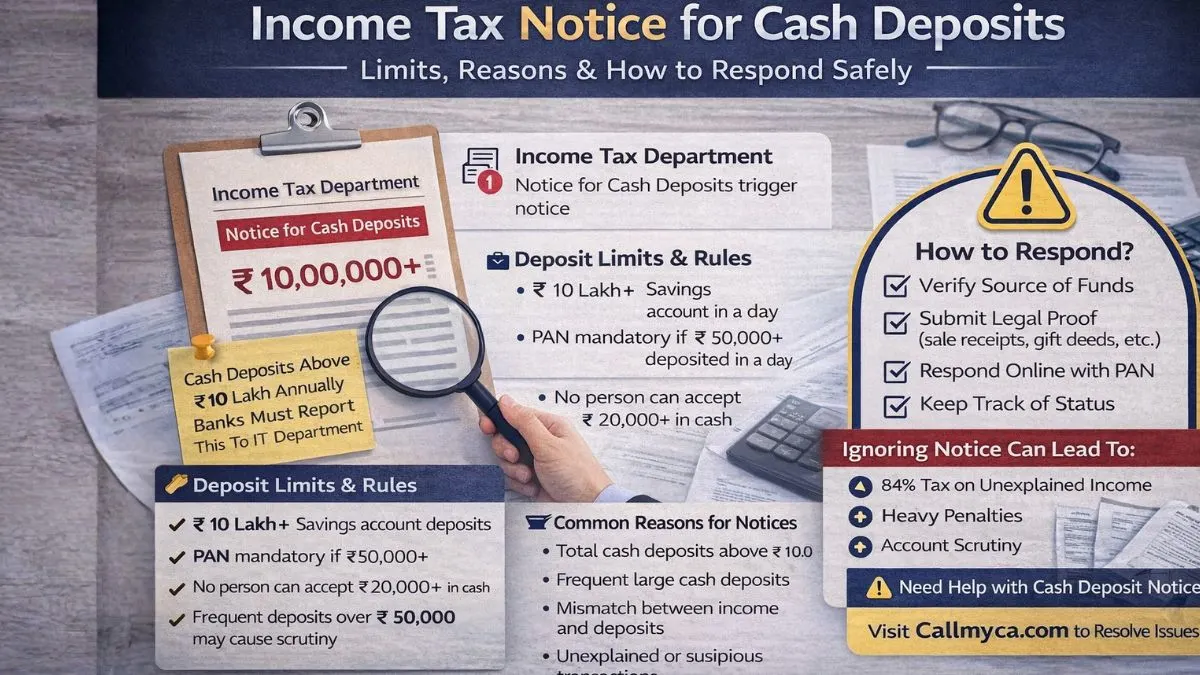
Income Tax Notice for Cash Deposits: Limits, Reasons & How to Respond Safely
Have you received an income tax notice for cash deposits and are unsure what it means? Don’t panic. Many taxpayers face this situation, especially after depositing large amounts of cash in their bank accounts.
With increasing digital tracking, banks must mandatorily report cash deposits above ₹10,00,000 in a financial year. Once this data is shared, the Income Tax Department compares it with your reported income. If a mismatch is found, it can trigger a notice.
Understanding cash deposit limits, income tax rules, and how to respond to such notices is essential to avoid heavy penalties and unnecessary stress.
Why Cash Deposits Trigger an Income Tax Notice
Depositing cash into your bank account may seem normal, but when the amount is high, it attracts scrutiny.
The Income Tax Department monitors financial transactions closely. If your deposits appear inconsistent with your declared income, you may receive an income tax notice for cash deposits.
Key Triggers:
-
Total cash deposits above ₹10,00,000 in a savings account
-
Frequent large deposits
-
Mismatch between declared income and deposits
-
Suspicious or unexplained transactions
Banks regularly report these cash deposits to the department under reporting requirements.
Cash Deposit Limit in Bank as per Income Tax Act
Many people ask about the cash deposit limit in banks as per the Income Tax Act. The truth is—there is no fixed limit on how much cash you can deposit.
However, there are reporting thresholds:
-
₹10,00,000 or more in a financial year → Reported by banks
-
₹50,000 or more in a day → PAN is mandatory
-
Large or unusual transactions → Scrutiny possible
So, while you can deposit any amount, large deposits can lead to an income tax notice if not properly explained.
Cash Deposit and Withdrawal Limit as per Income Tax
Understanding the cash deposit and withdrawal limit as per income tax is important.
There are restrictions under different sections:
-
Section 269ST → No person is permitted to accept Rs. 20,000 or more in cash in certain transactions
-
Section 40A(3) → Business expenses above ₹10,000 in cash are not allowed
-
Section 269SS / 269T → Loans above ₹20,000 cannot be accepted or repaid in cash
These rules aim to reduce unaccounted cash income.
Savings Account Transaction Limit Year Without Tax
Many taxpayers wonder about the savings account transaction limit per year without tax.
There is no direct tax on deposits, but if your cash deposits are not supported by valid income, they may be treated as unexplained income.
This means:
-
You must justify the source of money
-
Income should match your ITR
-
Proper documentation is required
Otherwise, the department may consider it taxable.
New Rules for Cash Deposit in Bank
The government has tightened regulations, and there are new rules for cash deposits in banks to ensure transparency.
Important Rules:
-
Banks must report high-value deposits
-
PAN/Aadhaar linking is mandatory
-
Data is reflected in AIS (Annual Information Statement)
-
Digital tracking of transactions is increasing
These rules make it easier for the Income Tax Department to identify discrepancies.
Income Tax Notice for Cash Deposits – Sections Involved
When you receive an income tax notice for cash deposits, it is usually issued under specific sections.
Section 68 – Unexplained Cash Credits
If you cannot explain the source of cash deposits, it may be treated as unexplained income.
Section 133(6)
The department may ask banks or taxpayers for additional information.
In such cases, you must provide proof of the source of funds.
What Happens If You Cannot Explain Cash Deposits?
If you fail to justify your cash deposits, the consequences can be severe.
-
Tax up to 84% on unexplained income
-
Heavy penalties
-
Possible legal action
This is why maintaining proper records is crucial.
How to Show Cash Deposit in ITR
A common question is how to show a cash deposit in ITR.
Here’s how you can handle it:
-
Declare correct income sources
-
Include business income, if applicable
-
Report capital gains, interest, or gifts
-
Maintain proper documentation
If your deposits are from legitimate sources, there is nothing to worry about.
Cash Deposit Limit per Day
Another important question is the cash deposit limit per day.
-
Deposits above ₹50,000 → PAN required
-
Frequent deposits → May attract scrutiny
While there is no strict daily limit, large deposits should always be supported with valid proof.
Cash Transaction Limit per Day as per Income Tax Act
Understanding the cash transaction limit per day as per the Income Tax Act helps avoid violations.
-
Cash receipts above ₹200,000 are restricted
-
Business payments above ₹10,000 in cash are disallowed
-
Loans above ₹20,000 cannot be taken in cash
Following these rules ensures compliance.
Cash Deposit Notice Income Tax Reply Format
If you receive a notice, knowing the cash deposit notice income tax reply format is essential.
Sample Reply Format:
Subject: Response to Income Tax Notice for Cash Deposits
Dear Sir/Madam,
This is in response to the notice received regarding cash deposits in my bank account for the financial year [Year].
The source of the deposits is explained below:
[Mention source – business income, savings, gift, etc.]
Relevant supporting documents are attached for verification.
Kindly consider the same and oblige.
Regards,
[Your Name]
Always attach:
-
Bank statements
-
Income proof
-
Gift deeds (if applicable)
-
Business records
Documents Required to Explain Cash Deposits
To avoid issues, keep proper documentation ready.
Important Documents:
-
Bank statements
-
Income proof
-
Sale receipts
-
Gift deeds
-
Loan agreements
Proper records can protect you from unnecessary tax demands.
Common Mistakes to Avoid
Many taxpayers make mistakes that lead to notices.
1. Not Reporting Income
Failing to declare income can trigger scrutiny.
2. Depositing Large Cash Without Proof
Always maintain source records.
3. Ignoring Notice
Never ignore an income tax notice for cash deposits.
4. Not Matching ITR with AIS
Mismatch can lead to questions.
How to Avoid Income Tax Notice for Cash Deposits
Here are some practical tips:
-
Always file accurate ITR
-
Avoid unnecessary cash transactions
-
Use digital payments
-
Maintain records
-
Ensure income matches deposits
Being transparent is the best way to stay safe.
Final Thoughts
Receiving an income tax notice for cash deposits can feel stressful, but it is manageable if handled properly.
The key is to:
-
Understand cash deposit rules
-
Keep proper documentation
-
Respond on time
-
Provide clear explanations
If your income and deposits are genuine, there is nothing to worry about.
Need Help With Your Income Tax Notice?
Still confused about your income tax notice for cash deposits or how to reply?
👉 Don’t risk heavy TAXES and penalties—visit Callmyca.com and get expert help to handle your notice quickly and correctly.









