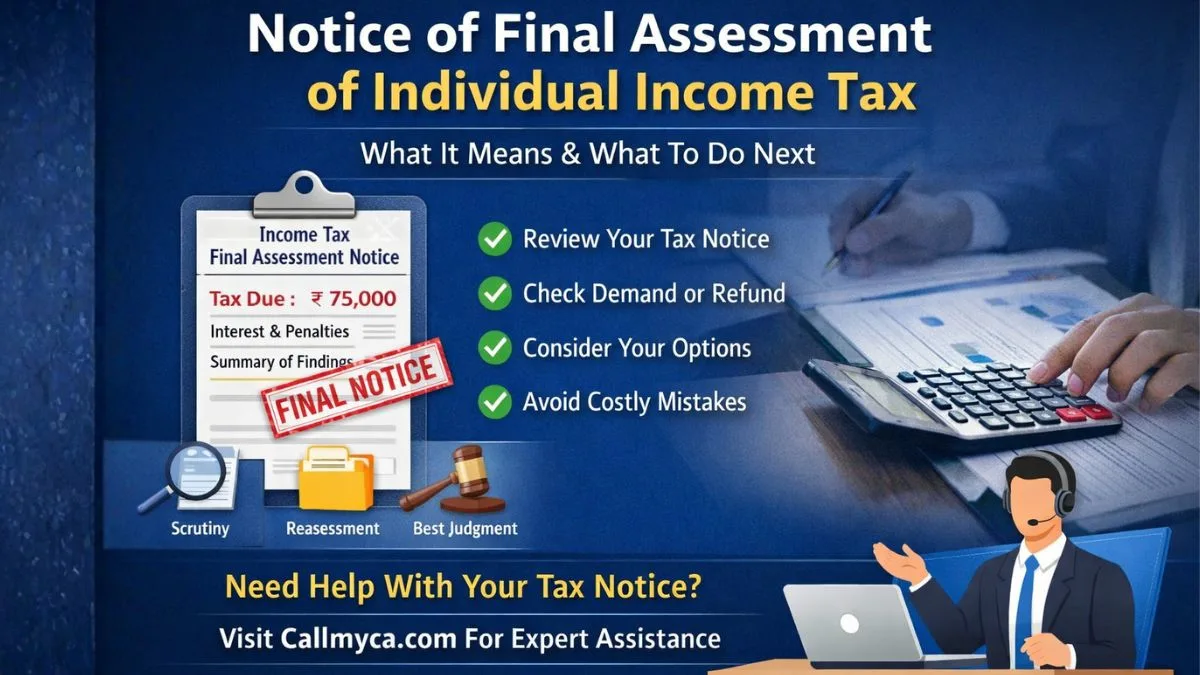
Notice of Final Assessment of Individual Income Tax: What It Means & What To Do Next
You open your email and see a notice of final assessment of individual income tax.
At that moment, one question hits your mind —
“Is this the final decision?”
And honestly, yes… in most cases, it is.
This is not a routine notice. It usually comes after the department has already reviewed your case. Your return has been checked, documents have been examined, and now the final assessment has been made.
The Income Tax Department is basically telling you —
“This is your final tax liability.”
But that doesn’t mean you have no options left.
What is a Notice of Final Assessment?
A notice of final assessment of individual income tax is issued after the department completes its review of your case.
It may arise from:
- Scrutiny assessment
- Reassessment proceedings
- Best judgment assessment
The notice usually contains:
- Final taxable income
- Tax payable (or refund)
- Interest and penalties
- Reasons for adjustments
In simple words, this is the department’s final conclusion on your return.
This notice is often issued through the faceless assessment system, meaning you don’t need to visit any office. Everything is handled online.
When Do You Receive a Final Assessment Notice?
You don’t receive this notice randomly.
It usually comes after a detailed process.
Common situations include:
- Your case was selected for scrutiny assessment in income tax
- The department reopened your case under section 148 of the Income Tax Act.
- You failed to respond to earlier notices
- There were significant discrepancies in your return
So by the time you receive this notice, the department has already reviewed your case in detail.
To understand your notice, you need to know how you got here
1. Summary Assessment (Section 143(1))
A summary assessment in income tax is the first level.
It is automated and usually does not involve deep verification.
You may receive:
- Refund
- No change
- Minor tax demand
This is not a final scrutiny-based decision.
2. Scrutiny Assessment (Section 143(3))
This is where things become serious.
Under scrutiny assessment under income tax section 143(3), your return is examined in detail.
The department may ask for:
- Income proof
- Bank statements
- Investment details
After reviewing everything, they pass a final assessment order.
3. Reassessment (Section 148)
If the department believes income was missed, they can reopen your case under Section 148 of the Income Tax Act.
This can happen even after several years.
Once the reassessment is completed, a final order is issued.
4. Best Judgment Assessment (Section 144)
If you fail to respond or cooperate, the department proceeds with the best judgement assessment in income tax.
Here, they estimate your income based on available data.
The final order in such cases may be higher than expected.
Procedure for Assessment in Income Tax
Many people look for the procedure for assessment in income tax, but it’s actually quite logical.
Here’s the flow:
- You file your return
- The department processes it
- Notice is issued (if required)
- You submit documents
- The department reviews your response
- The final assessment order is passed
This entire journey is part of the assessment procedure of the income tax notes PDF that many taxpayers search for.
Income Tax Scrutiny Time Limit
Timing plays an important role in assessment cases.
The income tax scrutiny time limit decides when notices can be issued.
Generally:
- Scrutiny notices must be issued within a specific time after filing
- Final assessment orders also have deadlines
If timelines are not followed, the notice may become invalid.
So always check dates carefully.
What Should You Do After Receiving the Final Assessment Notice?
Now comes the practical part.
You’ve received the notice. What next?
Step 1: Read the Order Carefully
Understand how the department calculated your income.
Step 2: Compare With Your Return
Check where the differences are.
Step 3: Check Demand or Refund
You may have to pay additional tax or receive a refund.
Step 4: Decide Your Next Step
Either accept the order or challenge it.
Can You Disagree With the Final Assessment?
Yes, you can.
Even though it’s called a final assessment, you still have options.
If you agree:
You can pay the tax demand.
If you disagree:
You can:
- File an appeal
- Submit rectification request
- Seek professional help
But remember—there are strict timelines for appeal.
What Happens If You Ignore This Notice?
Ignoring a notice of final assessment of individual income tax can create serious problems.
Here’s what may happen:
- Interest keeps increasing
- Penalties may be added
- Recovery actions may start
- Bank accounts can be affected
So don’t delay action.
Common Reasons for High Tax Demand
Many taxpayers are surprised when they see a high demand.
Here’s why it happens:
- Unreported income
- Disallowed deductions
- Mismatch in data
- Ignored notices
- Estimated income by department
In cases of best judgement assessment in income tax, the demand can be even higher.
Mistakes You Should Avoid
At this stage, mistakes can be costly.
Avoid these:
Ignoring the notice
Missing appeal deadlines
Not checking calculations
Submitting incomplete responses
Handling complex cases alone
A small mistake can increase your liability.
When Should You Take Professional Help?
Some cases are simple.
But you should seek expert help if:
- Tax demand is high
- The case involves Section 148
- Scrutiny assessment is complex
- You want to file an appeal
Professional guidance can make a big difference.
Final Thoughts
A notice of final assessment of individual income tax is the conclusion of your tax review process.
But it’s not the end of your options.
You can still:
- Verify the calculations
- Accept the demand
- Or challenge the order
The key is to act quickly and correctly.
Because delays can turn a manageable issue into a serious problem.
Don’t Pay Extra Tax Without Checking
Received a final assessment notice and unsure what to do? Don’t risk overpaying or missing deadlines. Let experts review your case—visit Callmyca.com and get professional help to handle your income tax notice the right way.