
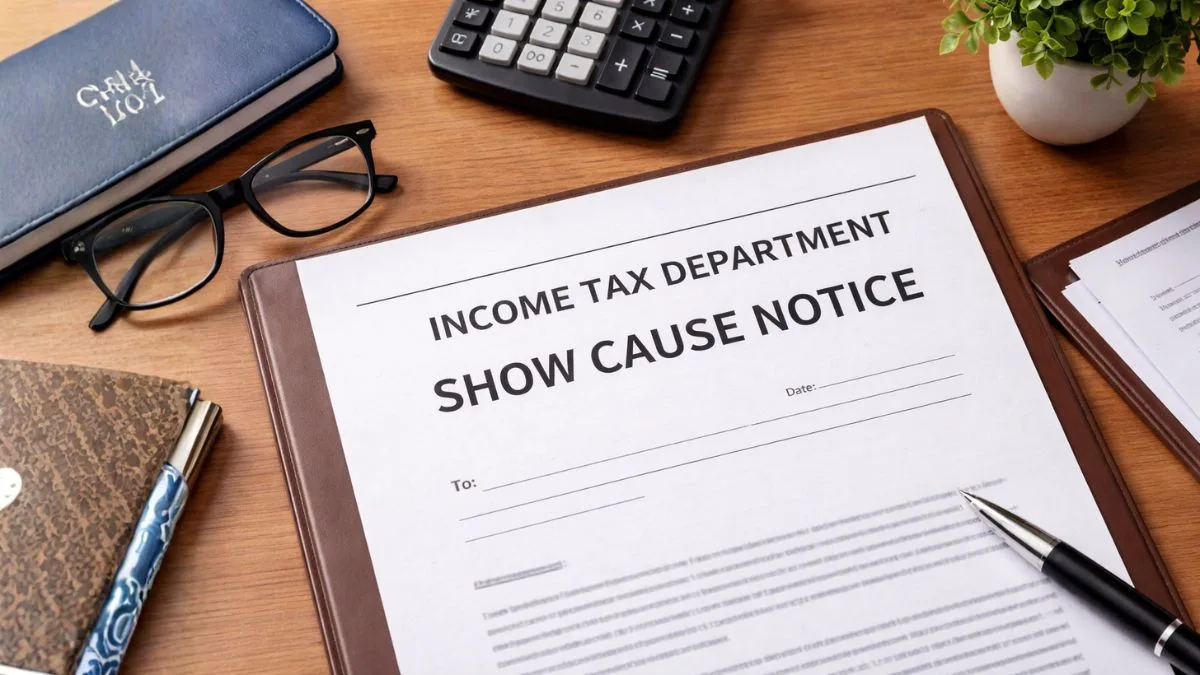
Show Cause Notice Income Tax
What exactly is a Show Cause Notice in income tax?
Let’s not jump to conclusions immediately.
When you see the words Show Cause Notice, it sounds… serious. Almost like something has already gone wrong.
It’s actually a question.
A formal one.
Income Tax Show Cause Notice (SCN) is a legal document that demands the taxpayer to explain the differences in the income tax return, like incorrect deductions or income not reported. This is a mandatory process that the Income Tax Department must follow before any adverse action is taken, like demanding taxes or imposing any kind of penalty. Prompt action must be taken within the given time frame, usually under sections like 143(3) in the case of scrutiny assessments or 147 for reassessment.
That’s the official meaning.
Why do people receive a show-cause notice?
This is where things start making more sense.
A show cause notice doesn’t come randomly. It usually appears when something in your tax records doesn’t quite match what the department expects.
Sometimes it’s obvious. Sometimes it’s subtle.
Common triggers include:
- Claiming deductions that seem unusually high
- Income not matching with reported data
- Mismatch in TDS or Form 26AS
- Large transactions not reflected properly
- Errors in filed returns
And sometimes… it’s just a system flag.
Yes, that happens too.
Let’s pause here
Most people think a notice means guilt.
It doesn’t.
It means doubt.
And the department is giving you a chance to clear that doubt.
That’s exactly why the show cause notice holds immense significance in income tax proceedings.
What does the notice usually contain?
It’s not vague.
A show-cause notice is quite specific in most cases.
You’ll usually find:
- The issue or discrepancy identified
- Relevant section under which the notice is issued
- Details of what explanation is required
- A deadline for response
And here’s something people underestimate…
Deadlines are strict.
Very strict.
Why is it considered so important?
Here’s where things get interesting.
The notice is not just a formality.
It actually acts as a fundamental procedural safeguard.
Think about that for a moment.
Before any penalty, before any tax demand, before any serious action — the department must give you a chance to explain.
That’s the role of this notice.
It protects you as much as it questions you.
What happens if you ignore it?
Short answer?
Not good.
If you don’t respond:
- The department may proceed with their assumption
- Tax demand can be raised
- Penalties may be imposed
- Further notices may follow
And the worst part?
You lose your chance to explain your side.
Which is the whole point of the Show Cause Notice.
How should you respond to it?
Let’s keep this practical.
No overcomplication.
Step-by-step approach:
- Read the notice carefully
- Identify what exactly is being questioned
- Gather all relevant documents
- Prepare a clear explanation
- Submit your response within the deadline
Simple on paper.
But in reality… not always.
A small but important detail
Your response matters more than you think.
This isn’t just about replying.
It’s about how clearly you explain your situation.
Sometimes people submit rushed or incomplete responses.
And that creates more confusion.
Real-life type scenario
Let’s say someone claimed a deduction under a section they misunderstood.
The system flags it.
The department sends a show-cause notice.
Now, if the taxpayer explains with proper documents — issue resolved.
If not… it escalates.
That’s how simple (and complicated) it can be.
One thing people often miss
Tone.
Yes, tone in your response.
You don’t need to be defensive.
You don’t need to sound aggressive.
Just be clear, factual, and structured.
Because the person reading your response is evaluating your explanation — not your emotions.
Is every show-cause notice serious?
Not necessarily.
Some are routine checks.
Some are minor clarifications.
And some can lead to bigger consequences if ignored.
But you won’t know which category yours falls into unless you actually read and understand it.
Quick tips that genuinely help
- Don’t delay reading the notice
- Don’t assume it’s a mistake
- Don’t panic
- Do verify your records
- Do respond properly
And most importantly…
Don’t ignore it.
Final thoughts
A Show Cause Notice in Income Tax isn’t the end of the road.
It’s more like a checkpoint.
A moment where the department pauses and asks, “Can you explain this?”
And your response shapes what happens next.
Sometimes, it’s something you can handle yourself. Other times, things get a bit technical, and clarity becomes important. In such cases, taking guidance from professionals—like the team at Callmyca.com—can help you respond more confidently and avoid unnecessary complications.
Because in tax matters, the difference between confusion and clarity often comes down to how you handle that one notice.









