Credit Card Income Tax Notice: Why It Happens and What You Should Do
Understanding the Credit Card Income Tax Notice
Getting a notice from the Income Tax Department can instantly make anyone uneasy. Even if you’ve filed your return properly, seeing the words “tax notice” in your email or on the income tax portal can make you pause.
But here’s the interesting part.
Not every notice means you’ve done something wrong.
In many cases, it’s simply a verification step triggered by high-value financial transactions. One of the most common triggers today is credit card spending. If your card transactions cross certain thresholds, banks are required to report them to the Income Tax Department.
And once the department receives that information, the system automatically checks whether your declared income reasonably supports that spending.
If it doesn’t, a credit card income tax notice may follow.
Why Credit Card Transactions Are Reported to the Tax Department
Financial institutions in India are legally required to report high-value transactions to the government. This system is called the Statement of Financial Transactions (SFT).
Under this system:
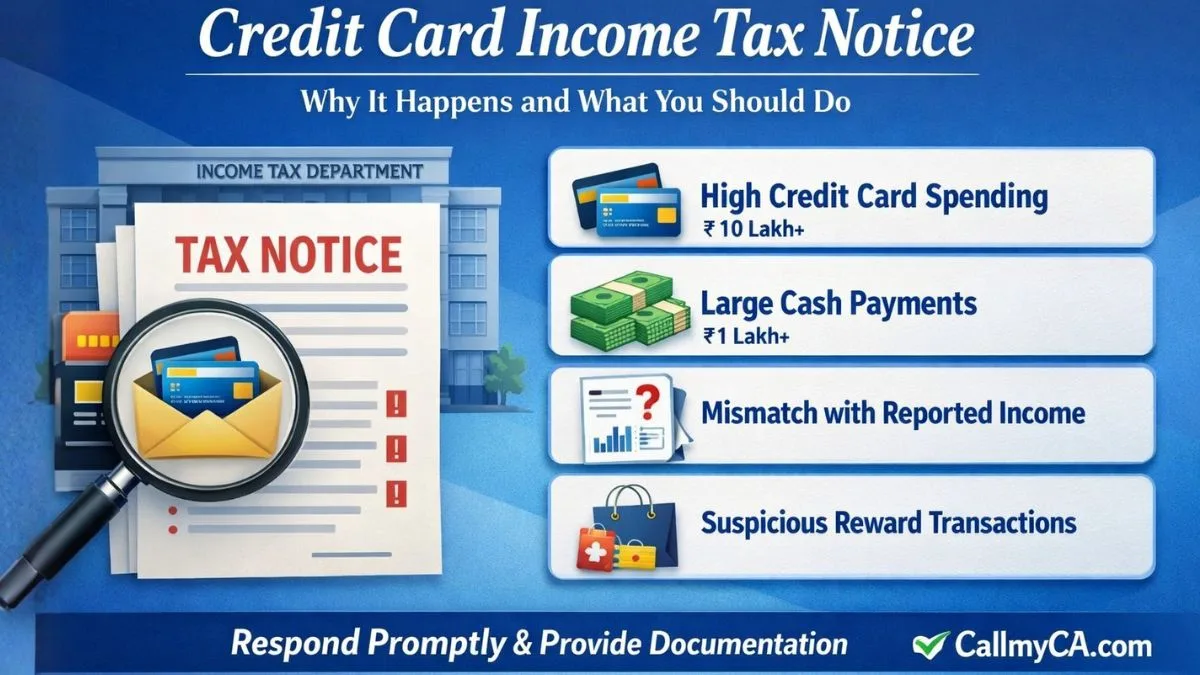
Income tax notices for credit card usage arise when annual spending exceeds ₹10 lakh or cash payments exceed ₹1 lakh, triggering mandatory bank reporting to the IT department.
This means banks automatically share such data with the Income Tax Department.
Now imagine this scenario.
You report an annual income of ₹5 lakh in your income tax return. But your credit card shows transactions worth ₹15 lakh in the same year.
That mismatch raises a question.
Where did the money come from?
This is exactly the type of situation that can trigger a credit card income tax notice.
And the department’s system catches these mismatches quite efficiently today.
When You Might Receive a Credit Card Income Tax Notice
A notice related to credit card transactions usually appears when there is a mismatch between your spending and your reported income.
Here are some common situations where this happens.
1. High Credit Card Spending
As mentioned earlier:
Income tax notices for credit card usage arise when annual spending exceeds ₹10 lakh or cash payments exceed ₹1 lakh, triggering mandatory bank reporting to the IT department.
Once the bank reports this transaction, the income tax department compares it with your filed income tax return.
If the numbers don’t match, a notice may be issued asking for clarification.
2. Large Cash Payments Toward Credit Card Bills
Paying credit card bills in cash is another red flag.
If you pay more than ₹1 lakh in cash toward your credit card bill in a year, the bank must report this to the department.
Cash transactions are closely monitored because they may indicate unaccounted income.
And yes—this can easily lead to a credit card income tax notice.
3. Spending That Doesn’t Match Your Income
Most people don’t realize this.
The Income Tax Department now uses sophisticated data analytics.
So when someone reports an annual income of ₹6 lakh but spends ₹20 lakh on credit cards, the system flags it automatically.
This mismatch can trigger a notice asking you to explain the source of funds.
Sometimes the explanation is simple.
Maybe the spending was funded by savings, family support, or business reimbursements.
But unless you respond, the department may assume the money came from undisclosed income.
4. Suspicious Reward-Hunting Transactions
Here’s another interesting development.
Recently, income tax is cracking down on credit card reward misuse.
Some individuals artificially inflate their card transactions just to earn reward points, cashback, or airline miles.
This practice is often called “manufactured spending.”
For example:
-
Swiping cards repeatedly through payment gateways
-
Circular transactions among multiple accounts
-
Fake purchases to generate reward points
Such activity can attract attention because the transaction patterns look unusual.
And once the system detects it, a credit card income tax notice may be issued for verification.
What Is a Demand Notice Under Section 156?
Sometimes, after reviewing your case, the department may raise a tax demand.
In such cases:
An income tax notice is issued under Section 156 of IT Act
This type of notice is issued when the department determines that additional tax is payable.
The notice generally includes:
-
The amount of tax payable
-
Interest or penalty
-
Deadline for payment
But remember—this usually happens only after an assessment process.
In many situations, taxpayers receive a clarification notice first before any demand is raised.
How the Income Tax Department Tracks Credit Card Spending
Many people wonder how the department even knows about their spending.
The answer lies in multiple reporting systems.
Today, financial data flows into the tax department through several channels:
-
Banks reporting credit card spending
-
Annual Information Statement (AIS)
-
Form 26AS
-
Statement of Financial Transactions (SFT)
When you file your income tax return, these systems automatically compare your declared income with reported financial activities.
So if your AIS shows ₹12 lakh in credit card spending but your income return shows ₹4 lakh income, the system flags the discrepancy.
And that’s often when a credit card income tax notice gets generated.
What To Do If You Receive a Credit Card Income Tax Notice
First of all—don't panic.
Receiving a notice is more common than most people think.
In fact, many are issued simply to confirm financial information.
Here’s what you should do.
Step 1: Read the notice carefully.
Understand:
-
The reason for the notice
-
The assessment year involved
-
The response deadline
Sometimes the notice only asks for clarification regarding transactions.
Step 2: Check Your AIS and 26AS
Before responding, review:
-
AIS (Annual Information Statement)
-
Form 26AS
-
Credit card statements
Compare them with your filed income tax return.
This helps you understand where the mismatch occurred.
Step 3: Prepare an Explanation
Your explanation might include:
-
Spending from past savings
-
Credit card usage for business expenses
-
Family-funded purchases
-
Reimbursements from employer
Supporting documents can strengthen your response.
Step 4: Respond Through the Income Tax Portal
Most notice responses today are submitted online through the Income Tax e-Filing portal.
The process typically involves:
-
Logging into your account
-
Opening the notice
-
Uploading documents
-
Submitting your response
Once submitted, the department reviews the explanation.
In many cases, the matter gets resolved without any penalty.
Can You Get Penalized for Credit Card Spending?
Spending itself is not taxable.
Let’s make that clear.
You can spend ₹50 lakh on a credit card and still not pay extra tax if the income used for spending is properly disclosed and taxed.
Problems arise only when the department suspects undeclared income.
That’s when:
-
A tax demand may arise
-
Interest may be added
-
Penalties could apply
Especially in cases where income tax is cracking down on credit card reward misuse,
So transparency is always the safest approach.
Simple Tips to Avoid Credit Card Tax Notices
Avoiding a credit card income tax notice is actually quite straightforward.
Here are some practical tips.
Keep Spending Consistent With Income
If your lifestyle and spending look significantly larger than your declared income, it may trigger scrutiny.
Make sure your income reporting reflects your financial reality.
Avoid Large Cash Payments
Cash payments toward credit card bills can look suspicious.
Try using:
-
Bank transfers
-
UPI
-
Net banking
These methods create clear financial trails.
File Accurate Income Tax Returns
Many notice issues arise because people forget to include some income sources.
Always include:
-
Freelance income
-
Interest income
-
Capital gains
-
Side business income
Even small omissions can trigger system alerts.
Track AIS Before Filing Returns
Checking AIS before filing your return is a smart habit.
It shows what the tax department already knows about your financial activity.
This helps you avoid surprises later.
Final Thoughts
Receiving a credit card income tax notice doesn’t automatically mean trouble.
Often it simply means the Income Tax Department wants clarification about certain financial transactions.
Remember this key point:
Income tax notices for credit card usage arise when annual spending exceeds ₹10 lakh or cash payments exceed ₹1 lakh, triggering mandatory bank reporting to the IT department.
Once banks report such transactions, the department compares them with your declared income.
If the numbers match, nothing happens.
If they don’t, a notice may arrive asking for an explanation.
With proper documentation and a timely response, most cases get resolved smoothly.
And if the issue becomes complex, getting expert tax guidance can make the process much easier.
If you ever receive an income tax notice related to credit card spending and want professional help responding correctly, you can explore expert assistance through Callmyca.com, where tax professionals regularly help taxpayers handle notices and compliance issues efficiently.