Understanding Credit Card Income Tax Notice in India
Credit cards have become a normal part of everyday spending. From groceries to travel bookings, people swipe cards without thinking twice. But many taxpayers are surprised when they suddenly receive a credit card income tax notice from the Income Tax Department.
Why does this happen?
The department monitors high-value financial transactions across the country. Banks and financial institutions are legally required to report certain transactions to the government. If your spending looks unusually high compared to your declared income, the system may flag it.
For example, if someone with a modest income shows very high spending patterns through cards, the department may send an income tax notice on credit card usage asking for clarification.
Receiving a notice does not always mean something is wrong. In many cases, it simply means the department wants to understand the source of funds used for those expenses.
When Can Credit Card Transactions Trigger an Income Tax Notice?
The Income Tax Department uses a reporting system called Statement of Financial Transactions (SFT). Under this system, banks must report high-value card activity.
A credit card income tax notice can arise mainly in the following situations:
-
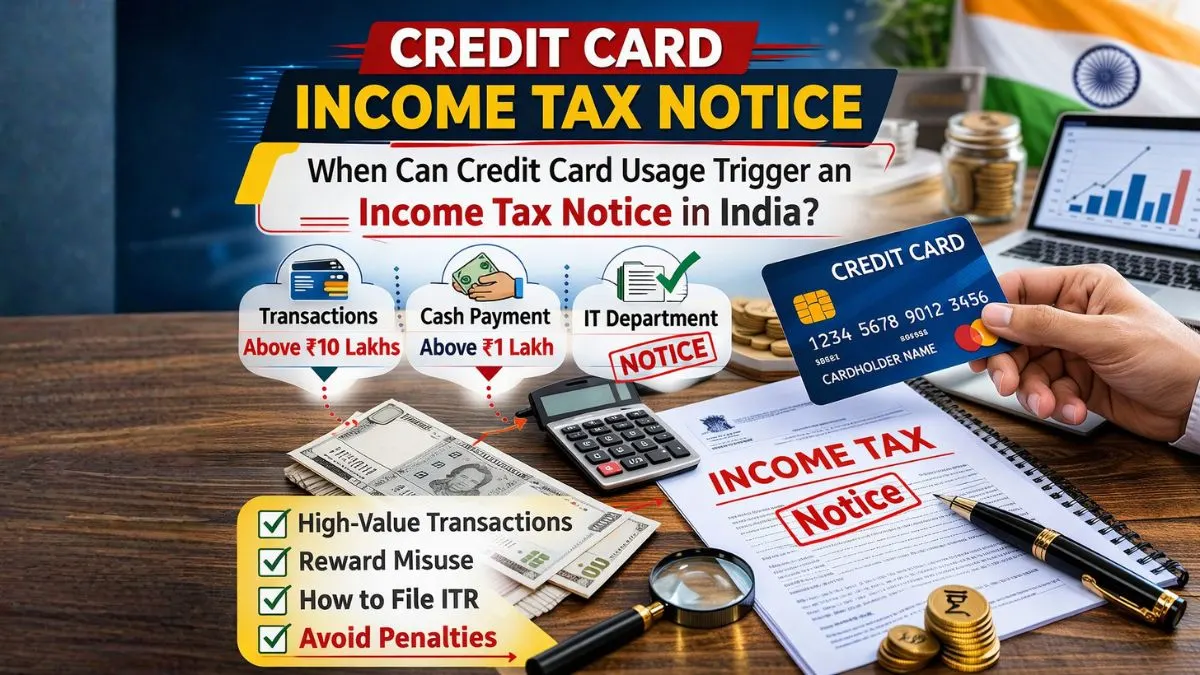
Credit card transactions more than 10 lakhs in a financial year
-
Cash payment through credit card above ₹1 lakh in a year
-
Large payments that do not match declared income
-
Multiple cards used for unusually high spending
-
Suspicious or unusual transaction patterns
When such transactions are reported, the department compares them with the income declared in your return. If the numbers don’t align, an income tax notice on credit card usage may be issued asking for details.
This is part of the government’s effort to track unreported income and improve tax compliance.
Tax on Credit Card Transactions in India – Do You Pay Tax on Spending?
One of the biggest myths is that there is direct tax on credit card transactions India.
That is not exactly true.
You do not pay tax simply because you spent money using a card. Taxes are applied on income, not on spending. However, spending becomes important when it indicates income that was not reported earlier.
For example:
-
If your annual income is ₹4 lakh but your credit card spending is ₹12 lakh, the department may ask how you financed that spending.
-
If the money came from savings, family support, or a loan, you can explain it.
-
If it came from unreported income, then tax and penalties may apply.
So while there is no direct tax on credit card transactions India, large or unexplained spending can still attract scrutiny.
Credit Card Reward Misuse and Income Tax Notices
Recently, authorities have also started monitoring people who misuse reward systems. Some users rotate money between cards or accounts just to earn cashback or points.
This practice is sometimes called “manufactured spending.”
For instance:
-
Swiping large amounts and immediately reversing transactions
-
Using payment platforms to rotate money repeatedly
-
Paying bills artificially to earn rewards
If such patterns are detected, they may trigger a credit card income tax notice because the transactions appear suspicious.
In some cases, authorities may treat it as financial manipulation rather than genuine spending.
Income Tax Notice Under Section 156 – What It Means
When the department finds discrepancies, it may issue a demand notice. In certain cases, a notice under Section 156 of the Income Tax Act can be sent.
A Section 156 notice is basically a demand for tax payment after an assessment. It informs the taxpayer that some amount of tax, interest, or penalty is payable.
This type of notice may arise if:
-
Income was under-reported
-
Transactions were unexplained
-
Previous notices were ignored
If you receive such a notice related to credit card income tax notice, it’s important to respond quickly and provide supporting documents.
Ignoring it can lead to further penalties.
How Banks Report Credit Card Transactions to the Income Tax Department
Many people assume their spending remains private. But banks have legal reporting obligations.
Every year, banks submit information about high-value transactions to the Income Tax Department through SFT reporting.
These include:
-
Credit card payments above ₹10 lakh in a financial year
-
Cash payments toward card bills exceeding ₹1 lakh
-
High-value deposits or transfers
Once reported, the system automatically matches this data with the taxpayer’s PAN and income tax return.
If the numbers look inconsistent, a credit card income tax notice may be generated.
How to Show Credit Card Transactions in ITR
Many taxpayers worry about how to show credit card transactions in ITR.
The truth is that you normally do not report credit card spending directly in your return. What matters is the source of funds used to pay the credit card bill.
For example:
-
If the payment came from your salary, it is already reflected in your income.
-
If it came from business income, it should be part of your books.
-
If someone transferred money to you, it may be treated as a gift or loan.
To avoid issues, always maintain records such as:
-
Bank statements
-
Credit card statements
-
Income proofs
-
Loan agreements (if applicable)
When the department asks how to show credit card transactions in ITR, these documents help explain your financial trail.
What To Do If You Receive an Income Tax Notice on Credit Card Usage
Receiving an income tax notice on credit card usage can feel stressful at first. But in most cases,
Here’s what you should do:
-
Read the notice carefully – Understand the reason behind the notice.
-
Check your credit card transactions – Compare them with your reported income.
-
Collect supporting documents – Bank statements, salary slips, etc.
-
Respond within the deadline – Most notices require a reply within 30 days.
-
Seek professional advice if needed – A tax expert can help draft a proper response.
Remember, the department usually wants clarification rather than punishment.
Common Reasons People Receive Credit Card Income Tax Notices
Let’s look at a few real-world situations that often trigger a credit card income tax notice:
-
Spending far beyond declared income
-
Using multiple credit cards with large combined limits
-
Frequent high-value transactions
-
Cash payments toward credit card bills
-
Transactions linked to suspicious financial activity
In many cases, the issue arises simply because people forget that high spending leaves a financial trail.
Tips to Avoid Credit Card Tax Issues
If you want to avoid problems related to income tax notice on credit card usage, a few simple habits can help.
Keep these points in mind:
-
Always file your income tax return on time
-
Ensure your declared income reflects your lifestyle
-
Avoid unusual or artificial transaction patterns
-
Keep financial records organized
-
Don’t ignore tax notices
These small steps reduce the chances of receiving a credit card income tax notice.
Final Thoughts
Credit cards make life easier. But they also create a transparent record of your spending. When your transactions cross certain limits or look inconsistent with your reported income, the system may generate a credit card income tax notice.
This doesn’t necessarily mean wrongdoing. Often, it’s simply the department asking for clarification.
The key is to maintain proper documentation and ensure that your financial activity matches your declared income. When things are transparent, handling such notices becomes straightforward.
Need help replying to a tax notice or understanding your credit card transaction reporting? Our experts at Callmyca.com assist taxpayers in handling notices and staying compliant with income tax rules — check our services to resolve your issue quickly.