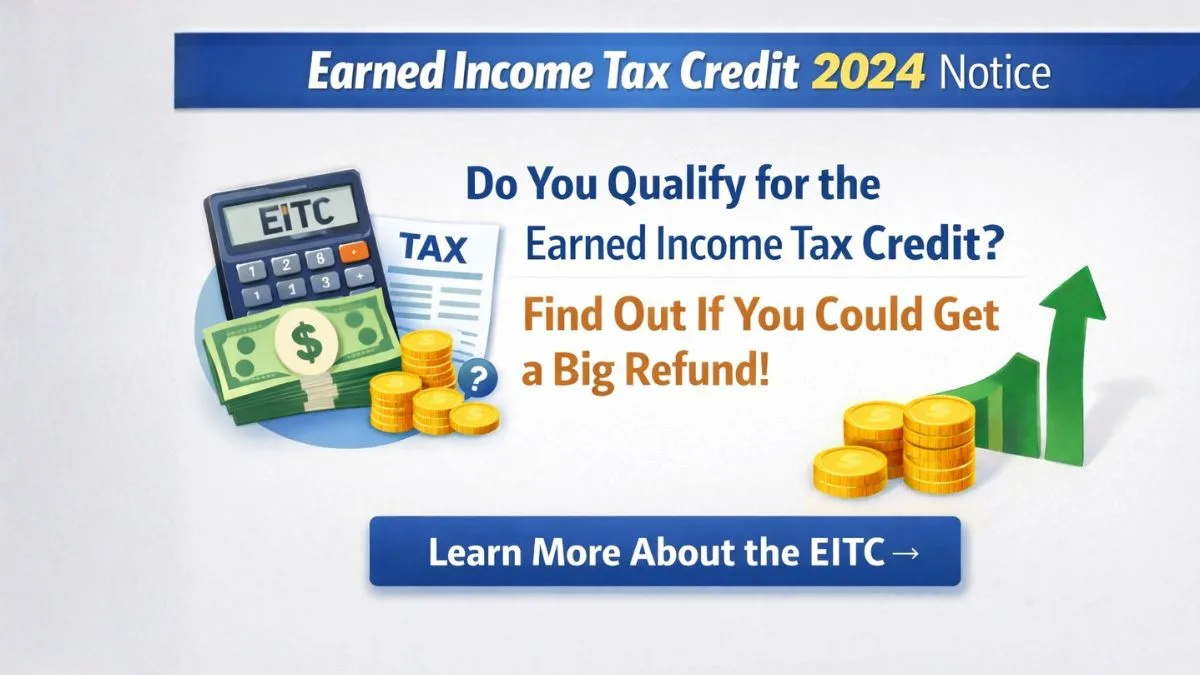
Earned Income Tax Credit 2024 Notice
what is the Earned Income Tax Credit (EITC) actually?
For the 2024 tax year (filed in 2025), the Earned Income Tax Credit (EITC) is a refundable credit. That word “refundable” matters.
It means even if your tax comes out to zero, you might still receive money back."
Yes. Actual money.
And then comes the notice…
You file your return.
Everything seems fine."
Then suddenly, there’s communication mentioning Earned Income Tax Credit (EIC).
Why these notices happen
Sometimes your income reported by your employer doesn’t perfectly align with what you filed.
Sometimes a dependent gets claimed in more than one return."
Sometimes documents were missing. Or maybe not uploaded properly."
And sometimes… nothing major happened. Just a system check."
That’s enough to trigger a notice."
The timeline part
Those dates mentioned in the notice?
They matter more than the notice itself.
You might see lines like:
- Action may be required by February 5, 2024
- on or before December 31, 2024
- no later than March 1st of each year
These aren’t random.
They define your response window.
Miss them, & suddenly a simple clarification becomes a bigger issue.
How the credit actually works?
The Earned Income Tax Credit (EITC) is based on earned income.
Not passive income. Not investments.
Work-based income:
- Salary
- Wages
- Self-employment
Then come limits.
Your eligibility depends on:
- How much you earn
- Your filing status
- Whether you have qualifying children
More children often means higher credit. But income limits still apply.
So how do you find out if you qualify for the Earned Income Tax Credit (EITC)?
Not by guessing.
And definitely not by assuming.
You have to check:
- Your earned income range
- Filing category
- Whether dependents meet the criteria
- Consistency across your records
Because here’s the thing.
Even if you technically qualify, inconsistent details can still trigger a review.
Something small… but important
Most people think tax issues come from big mistakes.
They don’t.
They come from small misalignments.
A number slightly off.
A child claimed twice.
An update that didn’t reflect everywhere.
state-level things can also show up
Sometimes the notice might include references beyond federal credit.
For example, systems like the CT Department of Revenue Services (DRS) may appear if state-level checks are involved.
This doesn’t always mean action is required at the state level—but it can be part of the verification chain.
What happens if you ignore it?
Ignoring an Earned Income Tax Credit (EITC) notice can lead to:
- Credit being removed
- Refund adjustments
- Delays that stretch unnecessarily
What should you actually do?
Just handle it step by step.
- Read the notice fully
- Understand what is being asked
- Check your filed return
- Match it with your documents
- Respond clearly
Final note
In case, at any moment, there is anything not clear, such as whether you qualify or have sufficient documentation, having someone else’s view on the matter can be helpful. Websites such as callmyca.com can assist you in interpreting the notification in a practical manner.