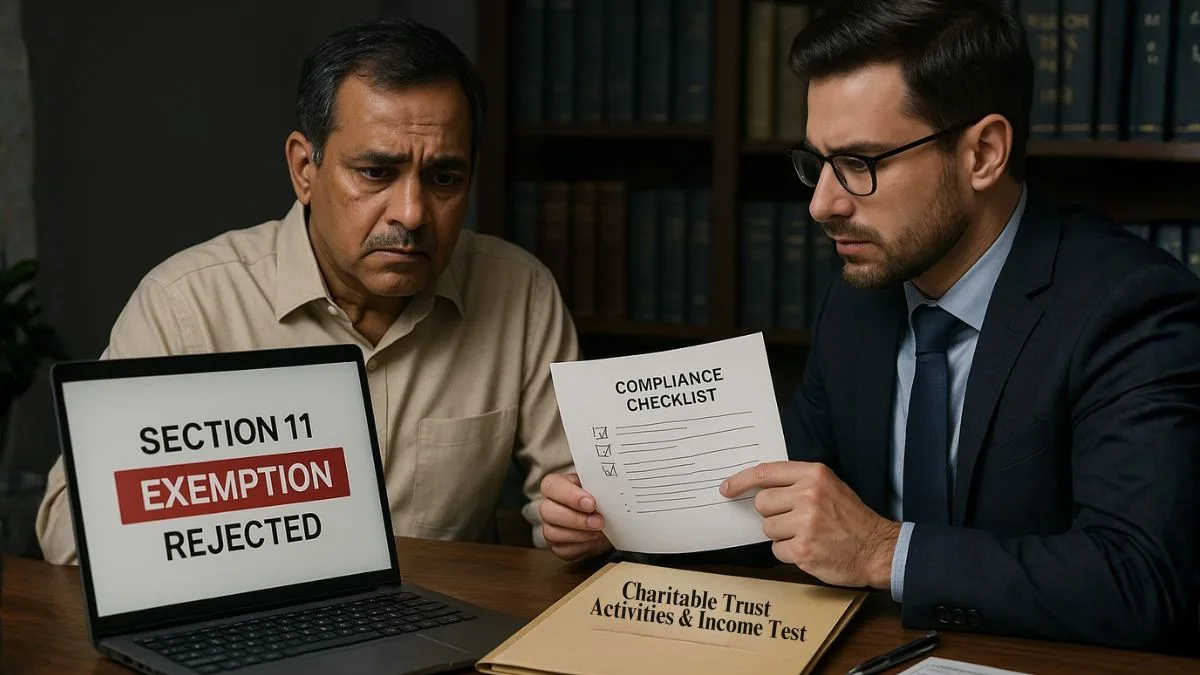
Charitable and religious trusts in India enjoy significant tax exemptions, but these benefits come with strict conditions. The government wants to ensure that only genuinely charitable institutions receive exemptions—not those functioning like commercial enterprises behind the label of charity. To maintain this balance, the Income Tax Act includes several safeguard provisions, one of which is Section 13(8).
Even though it looks like a short clause, Section 13(8) has a deep impact on how charitable organizations operate, earn revenue, and manage their compliance. It is especially important for NGOs, temples, educational bodies, societies, and trusts that receive income from events, donations, or business-like activities.
What Section 13(8) of the Income Tax Act Actually Says
In simple terms:
Section 13(8) states that charitable or religious trusts and institutions automatically lose the tax exemptions available under Sections 11 & 12 if their aggregate commercial receipts exceed the prescribed limit during the previous year.
In other words, if a trust earns too much money from business-like or commercial activities, the Income Tax Act will treat it as a commercial entity for that year. This means the trust will not receive exemptions on income applied to charitable purposes.
This rule applies even when the trust is registered under Section 12AB or Section 12A. Registration alone is not enough—compliance with Section 13(8) is mandatory.
Why Was Section 13(8) Introduced?
There was a time when many trusts started earning huge amounts of money from commercial activities such as running shops, book stalls, coaching classes, auditoriums, or business events. Some organizations earned crores from these ventures while still claiming full charitable exemption under Sections 11 & 12.
To stop this misuse, lawmakers added Section 13(8).
The intention behind the section is simple:
If a trust is earning more from business than from true charity, it should be taxed like a business."
This ensures fairness & prevents organizations from hiding business operations behind a charitable structure.
How Section 13(8) Works in Real Life
The most important phrase in Section 13(8) is “aggregate commercial receipts.”
This means the total income earned from:
- commercial activities
- trade
- business events
- rendering services for a fee
- income from transactions treated as business or commercial in nature
If these receipts cross the limit prescribed in the Income Tax Rules (currently linked to the 20% threshold under the proviso to Section 2(15)), the trust loses exemption.
Example:
A charitable trust conducts educational programs but also rents out its hall for marriage functions.
If hall rentals (a commercial activity) exceed the prescribed limit during the previous year, then:
❌ The trust loses exemption under Section 11 & Section 12 for that year.
❌ It will be taxed like a regular commercial entity.
All income, even donations, becomes taxable.
Also Read: Why Compliance Matters for Charitable Trusts
Who Does Section 13(8) Apply To?
This section applies to:
- religious trusts
- charitable trusts
- educational institutions
- public charitable societies
- temples, mosques, gurudwaras, churches
- any institution registered under Section 12AB
- institutions previously registered under Section 12A/12AA
If the trust is claiming exemption under Sections 11 & 12, Section 13(8) becomes automatically relevant. Even one violation can remove exemption for the entire previous year.
What Happens When Exemption Is Lost?
When a trust violates Section 13(8):
- It loses exemption for that year
- Its total income becomes taxable
- Expenditure applied to charity cannot be deducted
- Complications arise during audits"
- Notices may be issued
- Donors may get impacted if deductions depend on trust status
A trust may still continue to exist legally, but the tax benefits disappear for that year.
Section 13(8) and Commercial Receipts – Understanding the Limit
The limit for commercial receipts is indirectly governed by Section 2(15). According to the proviso, a trust engaged in “advancement of any other object of general public utility” must ensure that commercial receipts do not exceed 20% of its total receipts.
If they exceed the limit:
- The trust stops being considered as charitable for that year
- Section 13(8) removes exemption
- Section 11 & Section 12 cannot be claimed
This is why trusts must maintain careful accounts separating charitable receipts from business income.
Simple Example to Understand Section 13(8)
Case Study:
A charitable trust runs free medical camps but also prints & sells medical handbooks.
Total receipts (previous year): ₹1 crore
Commercial receipts (book sales): ₹30 lakh
Commercial receipts = 30% of total receipts
The limit = 20%
Since 30% > 20%:
❌ Section 13(8) applies
❌ Trust loses exemptions under Sections 11 & 12
❌ Entire ₹1 crore (minus allowable expenditure) becomes taxable
A mistake like this can turn a compliant trust into a taxable entity overnight.
Also Read: When Charitable Trusts Lose Their Tax Exemptions
Why Section 13(8) Is Important for Trust Management
Trustees & administrators must always monitor commercial earnings. Many trusts unintentionally cross the threshold because they do not track business-like receipts such as:
- auditorium rentals
- sales of publications
- cafeteria revenue
- coaching classes
- sponsorship income
- event-based charges
- parking fees
- consultancy offered by the trust
These are not donations; they count as commercial receipts.
Once the limit is crossed, exemption is gone — even if the intention was charitable.
Section 13(8) and Compliance – What Trusts Should Do
Trusts must follow a few basic rules:
✔ Maintain separate ledgers for commercial receipts
✔ Compare commercial income with the 20% threshold every quarter
✔ Avoid excessive reliance on business income
✔ Keep proper documentation for all charitable activities
✔ Review revenue sources regularly with a CA
✔ File ITR-7 accurately
A small mistake in calculation can lead to a massive tax liability.
Does Section 13(8) Permanently Remove Exemption?
No. The exemption is removed only for the year in which the trust violates the rule. "
If the trust stays within the limit the following year, it can reclaim exemption under Sections 11 & 12.
So Section 13(8) does not cancel charitable status permanently — it only “switches off” exemption for that particular previous year.
Why Section 13(8) Matters in Today’s Environment
More trusts today earn through:
- online classes
- event sponsorship
- digital publications
- booking platforms
- advertising
- institutional tie-ups
These activities blur the line between charity & business. Section 13(8) ensures that trust operations stay true to the objective for which they were established.
It protects both taxpayers and the charitable framework of the country.
Also Read: When a Charitable Trust Loses Its Tax Exemption for Personal Benefit
Final Thoughts
Section 13(8) of the Income-tax Act, 1961 plays a crucial role in keeping the charitable ecosystem clean & transparent. When charitable, religious, or educational trusts cross the prescribed commercial receipt limit in any previous year, they automatically lose their tax exemptions under Sections 11 and 12. This section encourages trusts to focus on genuine charity rather than business activities disguised as social work. And understanding it is essential for trustees, administrators, NGOs, & anyone handling compliance for a charitable institution.
📌 Want expert guidance for trust taxation, registration, or compliance? Visit Callmyca.com — your trusted CA partner for smooth, accurate, and stress-free support!