2017 NJ Earned Income Tax Credit Notice: Why It Shows Up Years Later (And What It Actually Means)
It usually starts with confusion.
You see “2017” in the notice.
And instantly your brain goes: Why now?
It doesn’t feel logical. You probably don’t even remember what you filed back then. Most people don’t. Life moves on, jobs change, income changes… and suddenly something from years ago shows up again like it never left.
That’s the part no one talks about.
Old tax years don’t always stay buried.
So what is this notice really about?
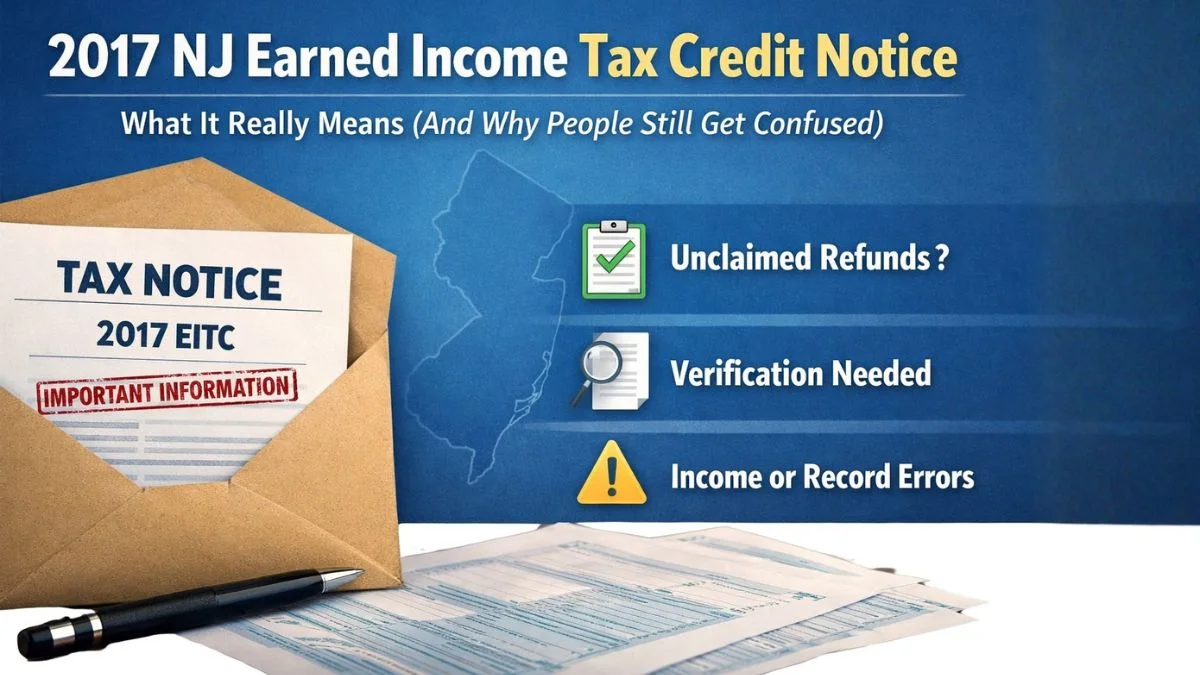
For tax year 2017, the New Jersey Earned Income Tax Credit (NJ EITC) will be 35% of the federal credit. If you received a notice relating to your 2017 NJ EITC, it may be for those who have unclaimed refunds. This is because many NJ residents were eligible for these credits around this time.
Now here’s the thing most people miss.
This line alone can mean two completely different things:
-
You might be owed money
-
Or something in your return didn’t match
And until you actually read the notice properly, you won’t know which one it is.
The part no one explains clearly
The New Jersey Earned Income Tax Credit sounds complicated, but it isn’t.
It’s basically extra money given to people earning within certain limits. It connects directly to the federal Earned Income Tax Credit.
Think of it like this.
You work. You earn within a certain range. The system says, “You qualify.” And instead of just reducing your tax, you can actually receive a tax credit as a refund.
Yes, even if you didn’t owe anything.
That’s where people get surprised.
Why are notices still coming for 2017?
This is where people get slightly frustrated.
Because in their mind, 2017 is over.
But in the system’s mind, it’s not always “closed.”
Let’s slow down and think about why this happens.
1. Missed credit
You were eligible. But it wasn’t claimed.
Maybe your preparer skipped it. Maybe you didn’t know. Maybe it just… didn’t happen.
Years later, data matching improves, and suddenly the system realizes something was left behind.
2. Something didn’t match
Income records, dependent details, filing status—small mismatches can trigger a review.
Nothing dramatic. But enough to reopen the case.
3. Delayed review
Not everything gets processed instantly.
Sometimes a return gets flagged and sits in a queue. And then, much later, it gets reviewed properly.
4. Adjustment or correction
Your tax credit might have been recalculated based on updated information.
Let’s pause here for a second
Most people see the word “notice” & immediately assume trouble.
That reaction is almost automatic.
But a notice is just communication.
It could mean:
-
You’re getting a refund
-
Something needs clarification
-
A correction has been applied
That’s it.
Nothing dramatic by default.
What the tax credit actually meant in 2017
Back in 2017, New Jersey offered 35% of whatever federal EITC you received.
So if someone got a federal credit, they automatically qualified for an additional state-level benefit.
And here’s the detail that changes everything:
It was refundable.
Which means even if your tax liability was zero, you could still receive money.
That’s why so many people missed out.
Not because they weren’t eligible.
Because they didn’t realize they were.
Here’s where things get interesting
Sometimes people receive these notices & ignore them.
They assume it’s either a mistake or something irrelevant.
But in many cases…
It’s literally money they never claimed.
And if they don’t respond?
They lose it again.
That part is frustrating.
How to tell what your notice is about
You don’t need to overanalyze it.
Just look at the tone & wording.
If it mentions:
-
Adjustment
-
Eligibility
-
Refund
-
Credit recalculation
Then it’s probably about money or a correction.
If it mentions:
-
Discrepancy
-
Overclaim
-
Documentation required
Then it needs your attention more carefully.
Still manageable. Just different.
A very real situation
Someone files taxes in 2017.
They qualify for EITC.
But the New Jersey Earned Income Tax Credi isn’t included.
No one notices at the time.
Years later, the system flags it.
A notice is sent.
And suddenly, there’s money waiting.
It sounds unlikely, but it happens more often than people think.
What should you actually do now?
Not theory. Just practical steps.
-
Read the notice slowly
Not once. Twice. -
Understand what it’s asking
Refund? Correction? Proof? -
Pull out your 2017 return
Yes, it feels old. But it matters here. -
Check income & dependent details
These are the most common error points. -
Respond on time
Delays complicate things unnecessarily.
One small thing most people ignore
Your contact details might have changed.
Address, email, phone number…
Which means earlier notices might not have reached you.
So this one might not be the first communication.
It might just be the one you finally saw.
Should you be worried?
Honestly?
Not immediately.
If it’s a refund, it’s good news.
If it’s a correction, it’s fixable.
If it’s repayment-related, then yes—you need to understand the numbers properly.
But worry doesn’t help.
Understanding does.
Common mistakes that make things worse
People don’t always make mistakes in filing.
They make mistakes after receiving the notice.
Ignoring it
This is the biggest one.
Responding without reading properly
Quick replies often lead to wrong replies.
Assuming it’s fake
Scams exist, yes. But not every notice is fraud.
Verify first. Then decide.
Now think about this
Why would the system go back to 2017?
Because systems improve.
Because data gets matched better over time.
Because missed credits don’t just disappear—they get rediscovered.
So this isn’t random.
It’s delayed accuracy.
Quick self-check before you move on
Ask yourself:
-
Did you file your 2017 return?
-
Were you within the EITC income range?
-
Did you claim every available credit?
-
Do you remember your filing details clearly?
If even one of these feels uncertain, the notice matters more than you think.
One honest observation
People don’t really understand credits."
They understand paying tax."
But credits?
They’re often ignored, misunderstood, or missed completely.
And that’s why notices like this exist."
Final thought
There’s something about official notices that makes them feel heavier than they actually are."
Maybe it’s the language. Maybe it’s the formatting."
But underneath all of that, it’s just information."
Sometimes helpful. Sometimes corrective. Rarely catastrophic."
Take your time with it. Read it properly. Don’t rush your response.
And if something feels unclear, getting a second opinion isn’t overreacting—it’s just being careful. Platforms like Callmyca.com can help you understand what’s actually happening, especially when it comes to older returns & credits that aren’t always straightforward.