CIB 403 Income Tax Notice: What It Means and What You Should Actually Do
It usually starts with a simple search.
You type something like “cib 403 income tax notice” into Google.
And instantly… a bit of panic.
Because the wording feels serious. Technical. Almost like you’ve done something wrong.
But here’s the truth.
Not every notice means trouble.
Sometimes it just means the system knows something… and wants you to confirm it.
What is a CIB-403 notice, really?
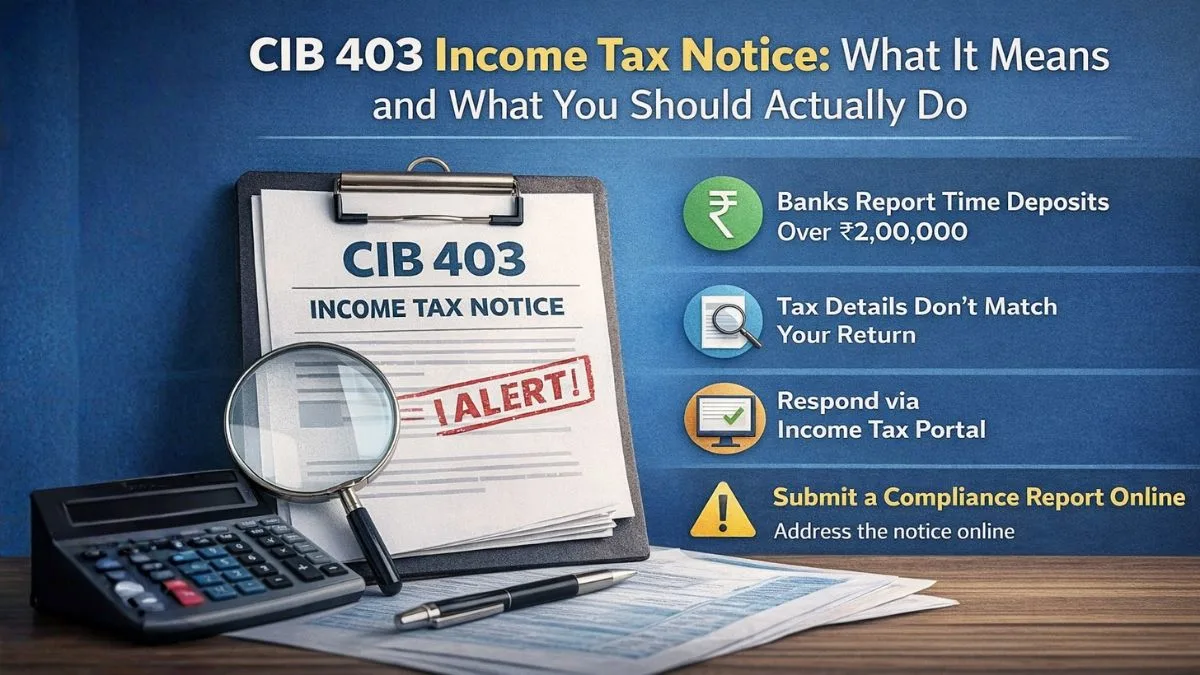
A CIB 403 income tax notice indicates that the department has received information about a time deposit exceeding ₹2,00,000 with a bank during a specific financial year that may not match your filed income tax return (ITR). You must respond to this notice by submitting a compliance report online through the Income Tax e-filing portal.
Now pause."
Read that again slowly."
This is not about guessing."
This is about data mismatch.
The department already has information.
They’re just checking if your side matches.
Where does this information come from?
This is where things get interesting.
Banks, financial institutions, & other entities report high-value transactions to the Income Tax department.
These reports are part of something called:
-
Annual Information Return (AIR)
-
Statement of Financial Transactions (SFT)
Earlier, it was commonly referred to as CIB-403 reporting.
So if you made a time deposit above ₹2 lakh…
The system already knows.
Let’s pause for a second
Think about this.
You made a deposit."
You didn’t hide it."
It’s sitting in your bank."
So why the notice?
Because your tax return didn’t reflect it properly.
That’s the key point.
What exactly triggers a CIB-403 notice?
There’s no single reason.
But most cases fall into these situations:
1. Time deposit not reflected in ITR
You made a fixed deposit, but your return didn’t show corresponding income or source.
2. Income mismatch
Your declared income doesn’t justify the deposit amount.
3. Missed reporting
You simply forgot to include certain income details.
4. System verification
Even if everything is correct, the system may still ask for confirmation.
“Does this mean I did something wrong?”
Not necessarily.
Let’s be clear.
Receiving a CIB-403 notice does NOT automatically mean fraud.
It simply means:
👉 “We have data. Please confirm or explain.”
That’s it.
How to identify if your case is serious
Here’s a quick way to understand your situation.
Low-risk situation:
-
You actually made the deposit
-
Your income supports it
-
You just didn’t report it clearly
Medium-risk:
-
Income declared is lower than expected
-
Source of deposit is unclear
Higher-risk:
-
Large deposits with no income backing
-
No explanation available
Most people fall in the first two categories.
What should you do after receiving the notice?
No overthinking. Just follow this.
Step-by-step process:
-
Login to the Income Tax portal
Go to compliance section. -
Check the transaction details
The notice will show exactly what triggered it. -
Select the correct response option
Usually options like:-
Information is correct
-
Information is partially correct
-
Information is incorrect
-
-
Submit explanation if needed
Keep it simple & factual.
Here’s where people mess up
They either ignore it…
Or over-explain it.
Both are mistakes.
Let’s be honest.
The system doesn’t need your life story.
It needs clarity.
Common responses people give
And some of them are not helpful.
❌ “I don’t remember”
Not acceptable.
❌ “It’s not mine” (when it actually is)
Risky.
✔️ “It was from savings / documented source”
Clear & acceptable.
Now think about this
The system is not trying to trap you.
It’s trying to match records.
That’s all.
But if you don’t respond…
It assumes the worst.
What if the person has some taxable income?
This is important.
Sometimes the notice reveals something you overlooked.
Yes.
The person has some taxable income that wasn’t reported properly.
In that case:
-
You may need to revise your return
-
Or accept the mismatch & pay applicable tax
Ignoring this stage makes things worse later.
Small detail most people overlook
Even if the deposit itself is not taxable…
The interest earned on it is.
And that’s where mismatches usually happen.
Not the deposit.
The income from it.
Common mistakes to avoid
This part matters more than you think.
Ignoring the notice
This is the biggest mistake.
Giving incorrect information
Always verify before responding.
Delaying response
Deadlines exist for a reason.
Assuming it’s a scam
Always verify through the official Income Tax portal.
“Do I need professional help?”
Sometimes yes.
Sometimes no.
If your case is simple, you can handle it.
But if:
-
Amount is large
-
Income mismatch is significant
-
You’re unsure about the explanation
Then getting help is a smart move.
One honest observation
Most people don’t track their financial data properly.
They:
-
Invest without planning
-
File returns quickly
-
Forget details
And later…
Notices like CIB-403 appear.
It’s not about mistakes.
It’s about gaps.
Final thought
A CIB-403 notice looks serious.
And yes, it should be taken seriously.
But it’s not something to panic about.
It’s simply a checkpoint.
A moment where the system asks:
“Does your story match ours?”
Take your time. Check your records. Respond clearly.
And if things feel even slightly confusing, getting clarity from a professional can save you a lot of stress later. Platforms like Callmyca.com can help you understand the situation practically & respond correctly—especially when financial details & Income Tax compliance start overlapping in ways that aren’t always obvious at first glance.