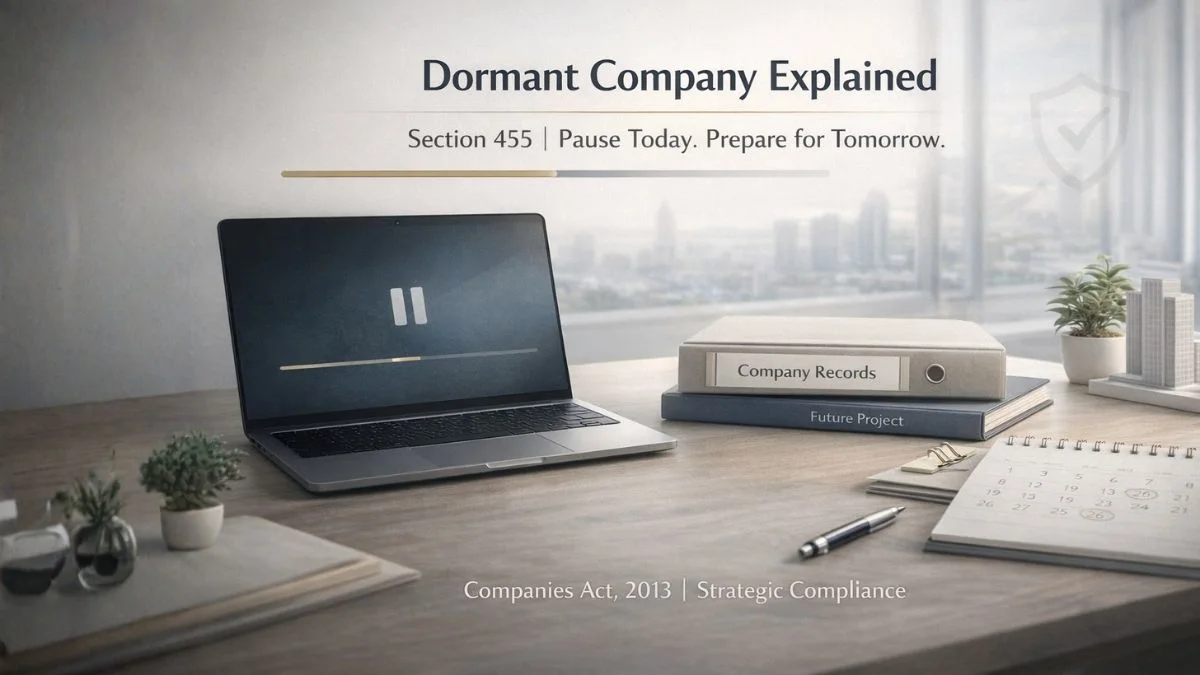
Dormant Company Section Explained Simply (Section 455 of Companies Act, 2013)
If you’ve ever registered a company with big plans but later paused operations, or you’re planning to start a company for future use, chances are you’ve searched the dormant company section.
And that’s a smart search.
Because instead of letting an unused company become non-compliant, the Companies Act gives you a legal pause button—called Dormant Company status.
This concept is governed by Section 455 of the Companies Act, 2013, and it is one of the most practical (yet misunderstood) provisions in company law.
Let’s understand it properly—without legal jargon, without fear, and exactly how it works in real life.
What Is a Dormant Company? (Simple Meaning)
A dormant company is a company that:
- Is not carrying on any significant business or operations, and
- Is formed for:
- A future project, or
- Holding an asset or intellectual property, or
- Any future business activity
- A future project, or
In short:
A dormant company is a legally existing company that is temporarily inactive—but intentionally so.
Dormant Company Section in Companies Act, 2013
The concept of dormant company is governed by:
👉 Section 455 of Companies Act, 2013
This is why people often search:
- dormant company section in companies act, 2013
- dormant company section 455
- section 455 of companies act, 2013
All of them refer to the same provision.
Why Section 455 Was Introduced
Before Section 455:
- Inactive companies still had to follow full compliance
- Many companies became non-compliant unintentionally
- ROC would strike off companies even if owners wanted to retain them
Section 455 was introduced to:
- Protect genuine companies
- Reduce unnecessary compliance burden
- Allow promoters to hold a company safely for the future
That’s why it’s often called an excellent opportunity to start a company for a future.
Dormant Company Definition (As per Law)
As per Section 455, a company can apply to become dormant if it is:
- Formed for a future project, or
- Formed to hold an asset or intellectual property, and
- Has no significant accounting transactions
This is the official dormant company definition.
What Is “No Significant Accounting Transaction”?
This is a very important concept.
A company is considered dormant if it has no significant accounting transactions, except:
- Payment of ROC fees
- Payment to comply with Companies Act
- Allotment of shares
- Payment for maintaining office records
Any other business transaction can disqualify dormancy.
Dormant Company Example (Real-Life Scenarios)
Let’s understand with a dormant company example.
Example 1: Future Startup Idea
You register a private limited company for a startup idea.
- Project is delayed by 2–3 years
- No business activity yet
Instead of annual heavy compliance:
👉 You apply for dormant status.
Example 2: Holding Intellectual Property
A company is formed only to:
- Hold a trademark
- Hold software IP
- Hold land or building
No revenue, no operations:
👉 Perfect case for dormant company.
Who Can Apply for Dormant Company Status?
A company can apply for dormant status if:
- It is already registered under Companies Act
- It is not carrying on business
- It has no pending statutory dues
- It has no inspection or prosecution pending
Both:
- Private companies
- Public companies
can apply.
Dormant Company Procedure (Step-by-Step)
This is one of the most searched topics:
dormant company procedure
Let’s break it down practically.
Step 1: Board Resolution
The Board of Directors must:
- Approve the proposal to apply for dormant status
Step 2: Shareholders’ Approval
A special resolution must be passed by shareholders.
Step 3: File Application With ROC
The company must file:
- Form MSC-1
- Along with prescribed fees and documents
Step 4: ROC Verification
ROC will:
- Verify records
- Check compliance status
- Ensure no pending issues
Step 5: Dormant Status Granted
If satisfied:
- ROC issues a certificate
- Company is marked as Dormant
Dormant Company Rules (Post-Approval Compliance)
Once dormant status is granted, dormant company rules apply.
The company must:
- Have minimum 2 directors (private) / 3 (public)
- Hold one board meeting per year
- File annual dormant return
- Maintain basic records
That’s it. No heavy compliance.
What Are the Benefits of Dormant Company Status?
This is why Section 455 is so popular.
Major Benefits
- Reduced compliance cost
- No business pressure
- No strike-off risk
- Company name protected
- Legal existence maintained
Dormant status is far better than letting a company become non-compliant.
Dormant Company vs Inactive Company (Important Difference)
Many people confuse these two.
Difference Between Dormant and Inactive Company
|
Basis |
Dormant Company |
Inactive Company |
|
Legal status |
Recognised under law |
Not a legal status |
|
Governing section |
Section 455 |
Not defined |
|
Compliance |
Minimal |
Full compliance |
|
Risk of strike off |
Low |
High |
|
Voluntary choice |
Yes |
No |
An inactive company is risky.
A dormant company is protected.
Small Company Section vs Dormant Company
Another common confusion:
small company section vs dormant company
They are completely different concepts.
- Small company → Based on size (turnover, capital)
- Dormant company → Based on inactivity
A company can be:
- Small but active
- Large but dormant
Can a Dormant Company Become Active Again?
Yes—very easily.
When you’re ready to start business:
- Pass board resolution
- File Form MSC-4
- ROC restores active status
Dormancy is reversible, not permanent.
How Long Can a Company Remain Dormant?
A company can remain dormant for:
- Up to 5 consecutive years
After that:
- ROC may initiate strike-off
- Unless company becomes active again
Dormancy is a pause, not a forever shelter.
Common Mistakes Companies Make
From real compliance experience:
- Assuming dormant status is automatic
- Doing business transactions while dormant
- Not filing annual dormant return
- Ignoring board meeting requirement
Dormant status still needs basic discipline.
Penalty for Misuse of Dormant Status
If a company:
- Carries business while dormant
- Files incorrect information
ROC can:
- Remove dormant status
- Impose penalties
- Initiate strike-off
Dormant is a privilege—not a loophole.
Who Should Consider Dormant Company Status?
Dormant status is ideal for:
- Startup founders waiting for funding
- Promoters holding brand names
- Companies holding land or IP
- Businesses paused temporarily
It is not meant for active businesses.
Dormant Company Section 455 in One Line
If we had to explain dormant company section in one sentence:
Section 455 allows a company with no current operations to legally pause business with minimal compliance, while preserving its existence for future use.
Why Section 455 Is a Smart Compliance Tool
Section 455 shows that:
- Law understands business realities
- Not every company is active all the time
- Compliance should match activity level
It’s one of the most business-friendly provisions in the Companies Act.
Final Thoughts: Dormant Company Is a Strategic Choice, Not a Failure
Choosing dormant status does not mean your company failed.
It means:
- You’re planning responsibly
- You’re protecting compliance
- You’re keeping future options open
Used correctly, dormant company status is a powerful strategic tool—especially for long-term planners.
Need help with dormant company registration, revival, or ROC compliance?
Visit callmyca.com for clear, practical guidance on Companies Act procedures and compliance—explained simply and professionally.