Notice from Income Tax Department: Meaning, Reasons & What To Do
You receive a notice from the income tax department.
The moment you see it, your heartbeat goes up.
You start thinking.
“Did I do something wrong?”
“Will I get a penalty?”
“Is this serious?”
Most people panic without even opening the notice properly.
Here’s the reality.
Not every notice is bad news.
In many cases, it’s just part of the process
where the department verifies your information.
Sometimes everything is fine.
They just need clarification.
So instead of stressing,
You need to understand what the notice actually means.
What Exactly Is an Income Tax Notice?
An income tax notice is an official communication
sent by the department.
In simple words —
Your details are being checked.
This notice can be sent through:
-
Email
-
Income tax portal
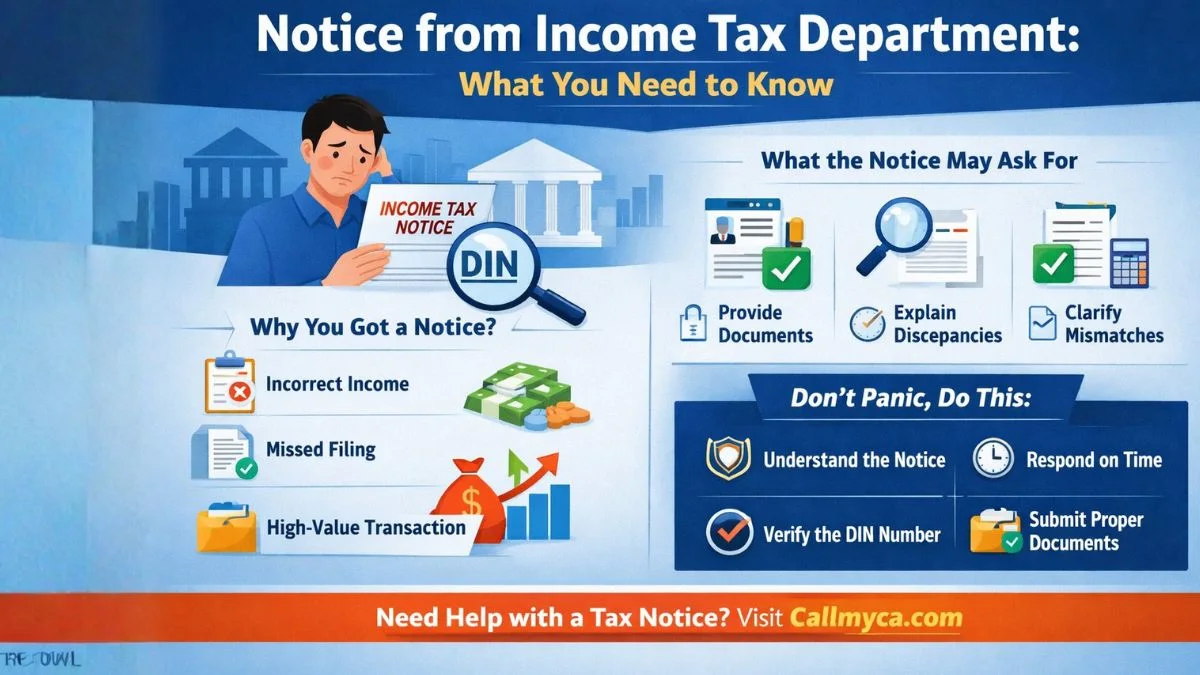
It may ask you to:
-
Confirm details
-
Provide documents
-
Explain transactions
-
Clarify mismatches
It is not always a penalty.
Often, it is just to verify your information.
What a Notice Actually Means
The department already has your financial data:
-
TDS details
-
AIS / TIS
-
Bank transactions
They compare this data with your return.
If everything matches, there is no issue.
If something doesn’t match,
You receive a notice.
This is part of the assessment process.
Why You Received This Notice
There are a few common reasons.
You may have:
-
Not filed your return
-
Reported incorrect income
-
Claimed wrong deductions
-
Done high-value transactions
-
Been selected randomly
Yes, random selection also happens.
So receiving a notice does not always mean something is wrong.
First Thing You Should Do
Before taking any action,
Check whether the notice is genuine.
Every valid notice comes with a
Document Identification Number (DIN)
If your notice does not have a DIN,
Be careful.
You can verify it on the income tax portal.
This step takes just a few minutes
but can save you from fraud.
How to Download Income Tax Notice
Many people get confused here.
The process is simple.
- Go to the income tax website
- Log in using your PAN
- Click on “Pending Actions."
- Open “e-Proceedings” or notices section
- Select your notice
- Download the PDF
Always keep a copy saved.
You may need it later.
How to Read the Notice
Most people read the notice in panic.
Instead, break it down.
Every notice has a simple structure:
-
Your details
-
Section under which notice is issued
-
Reason for notice
-
Action required
-
Deadline
Focus only on:
-
The reason
-
What you need to do
Ignore the complicated language.
How to Respond to the Notice
Once you understand the notice,
Respond carefully.
Here is the process:
- Log in to the income tax portal
- Go to pending actions
- Select the notice
- Upload required documents
- Submit your response
Everything is done online.
There is no need to visit any office.
Common Mistakes to Avoid
Many taxpayers make simple mistakes.
These can create bigger problems.
Avoid these:
-
Ignoring the notice
-
Responding after the deadline
-
Uploading incorrect documents
-
Giving incomplete answers
-
Not understanding the issue
Even small mistakes can lead to further notices.
What Happens If You Ignore the Notice?
Ignoring a notice can be risky.
Here is what may happen:
-
Additional tax demand
-
Penalties
-
Best judgment assessment
-
Legal action
The department assumes
You are not cooperating.
So always respond, even if you disagree.
Why Notices Are Increasing
Earlier, notices were limited.
Now they are increasing.
The reason is data tracking.
The department now tracks:
-
Bank transactions
-
Investments
-
Mutual funds
-
Credit card usage
Everything is linked.
Even small mismatches are detected.
That is why notices are more common now.
Documents You May Need
Depending on your case, keep the following ready:
-
Form 16 or salary proof
-
Bank statements
-
Investment proofs
-
Capital gain reports
-
AIS / TIS data
Proper documentation makes the process easier.
Special Case: Notice Under Different Sections
Every notice comes under a section.
Each section has a different meaning.
For example:
Section 139(9) – Defective return
Section 142(1) – Inquiry notice
Section 148 – Income escaped assessment
Always check the section carefully.
It helps you understand the seriousness of the notice.
How to Avoid Notices in Future
You cannot avoid notices completely.
But you can reduce the chances.
Follow these steps:
- File your return on time
- Report all income
- Match AIS and Form 26AS
- Avoid incorrect deductions
Maintain proper records
Simple discipline can prevent future issues.
When Should You Take Expert Help?
Some notices are simple.
You can handle them yourself.
But in certain cases, expert help is better.
For example:
-
High tax demand
-
Scrutiny cases
-
Multiple notices
-
Complex income
Professional guidance can save time and mistakes.
Final Thoughts
A notice from the income tax department
is not something to fear.
It is part of the system.
The goal is to ensure
Your income is correctly reported.
So remember:
Stay calm
Understand the notice
Respond on time
That’s all you need to do.
Need Help? Don’t Risk It
Received a notice and not sure how to respond?
Do not take chances.
Let professionals handle it for you.
Visit Callmyca.com
Get your notice resolved quickly and safely