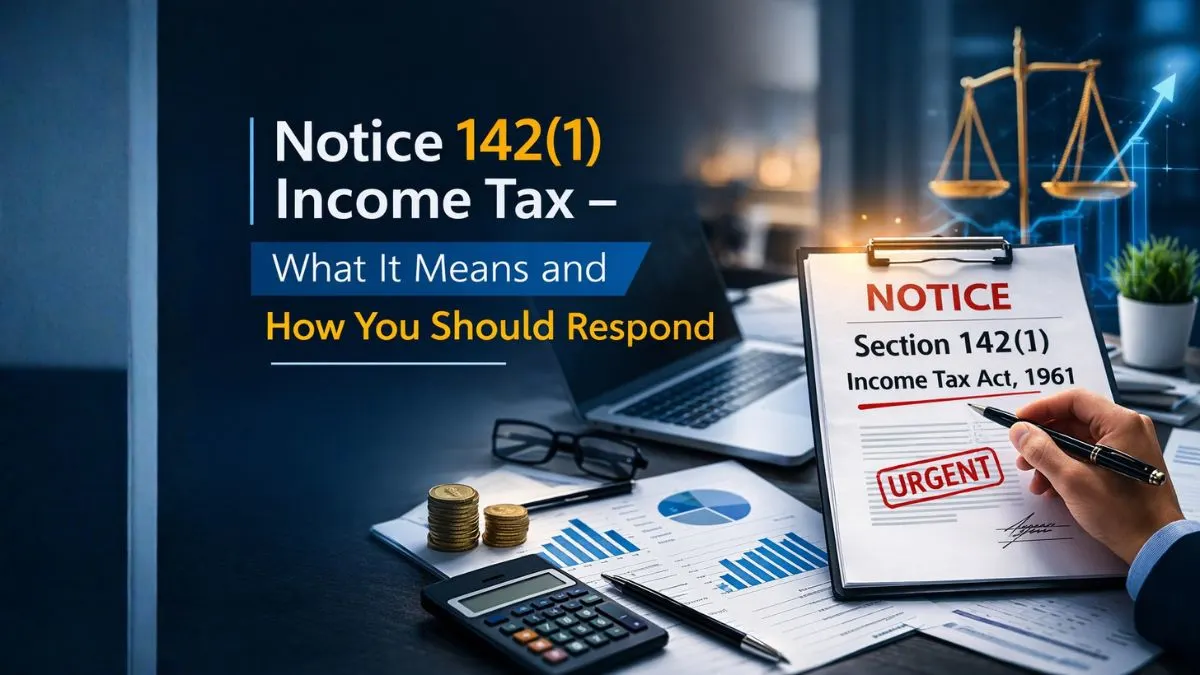
Notice 142(1) Income Tax – What It Means and How You Should Respond
Receiving a notice 142 1 income tax can feel unexpected, especially if you were not expecting any communication from the department. Most people see the notice and immediately assume there is a serious issue.
That is not always the case.
A Notice under Section 142(1) is essentially a request. It is issued when the Assessing Officer needs more information to complete an assessment. It may be about your return, your income, or certain transactions that need clarification.
So while it should not be ignored, it is not something to panic about either. What matters is how you respond.
What is Notice under Section 142(1)?
A notice 142 1 income tax is a formal communication from the department asking for details.
It can be issued:
- When you have not filed your return
- When additional information is required
- When documents need to be verified
It is often referred to as an Inquiry notice under section 142(1).
Legal Basis – Section 142 of the Income Tax Act
The authority to issue this notice comes from the law itself.
You may see wording like:
“142. (1) For the purpose of making an assessment under this Act,”
This means the notice is issued specifically to collect information required for completing the assessment process.
It is also described as a Notice under sub-section (1) of Section 142 of the Income Tax Act, 1961.
Why Do You Receive Notice 142(1)?
There are several reasons why you may receive a notice 142 1 income tax.
Some common situations include:
- You have not filed your return
- There is missing information in your return
- The department needs supporting documents
- There are high-value transactions
- There is a mismatch in reported income
Time Limit for Notice under Section 142(1) of Income Tax Act
A common question is about the time limit for notice under section 142(1) of income tax act.
Unlike some other notices, this notice can be issued during the assessment process.
The timeline depends on:
- The assessment year
- The stage of proceedings
However, once you receive the notice, you will be given a specific deadline to respond. It is important to follow that timeline carefully.
What Information is Requested in Notice 142(1)?
A Notice under Section 142(1) may ask for different types of information.
This can include:
- Books of accounts
- Bank statements
- Investment details
- Proof of deductions
- Details of transactions
In some cases, it may also ask you to file your return if it has not been filed.
This is why it is called an inquiry notice. It is asking for clarification.
Section 142 Income Tax Notice – Types of Requirements
A section 142 income tax notice may include different clauses.
You may come across:
- section 142(1)(ii of income tax act) – asking for documents
- section 142(1 iii of income tax act) – asking for additional information
Each clause specifies what is required from you.
Understanding this helps you respond correctly.
How to Reply to Notice under Section 142(1) of Income Tax Act
The next step is understanding reply to notice under section 142(1) of income tax act.
This is where many people feel unsure.
The key is to stay simple and accurate.
Step 1: Read the Notice
Understand what is being asked.
Step 2: Gather Documents
Collect all required information.
Step 3: Prepare Response
Answer each point clearly.
Step 4: Submit Online
Upload your reply on the portal.
A clear and complete response is important.
Reply to Notice u/s 142(1) Format Word
Some people prefer preparing their response in a document.
You may come across reply to notice u/s 142(1) format word templates.
While formats can help, do not rely blindly on them.
Your response should be based on your specific case. Copying a generic format may not address the actual issue.
Sample Reply to Notice under Section 142(1) of Income Tax Act
Looking at a sample reply to notice under section 142(1) of income tax act can give you an idea of structure.
Typically, it includes:
- Reference to notice
- Explanation of facts
- Supporting documents
- Declaration of accuracy
However, every case is different. So your reply should reflect your own situation.
What Happens If You Ignore the Notice?
Ignoring a notice 142 1 income tax is not advisable.
If you do not respond:
- The department may proceed with assessment
- They may make assumptions based on available data
- Additional tax or penalties may be imposed
So even if you are unsure, it is better to respond.
Common Mistakes to Avoid
Most problems arise due to simple mistakes.
For example:
- Not reading the notice properly
- Missing the deadline
- Providing incomplete information
- Submitting incorrect documents
These issues can make the situation more complicated than necessary.
Practical Approach to Handling the Notice
Handling a Notice under Section 142(1) does not have to be complicated.
Take it step by step:
- Read the notice carefully
- Understand what is required
- Collect accurate information
- Submit your response on time
That approach usually works.
Final Thoughts
A notice 142 1 income tax is essentially an inquiry. It is part of the process of completing an assessment.
It is not a penalty by itself. It is a request for information.
The key is to respond properly and within time.
If your records are clear and your reply is accurate, the process can be handled smoothly.
Received a notice 142 1 income tax and not sure how to reply? A small mistake can lead to serious consequences. Visit Callmyca.com and get expert help before your notice turns into a bigger issue.