
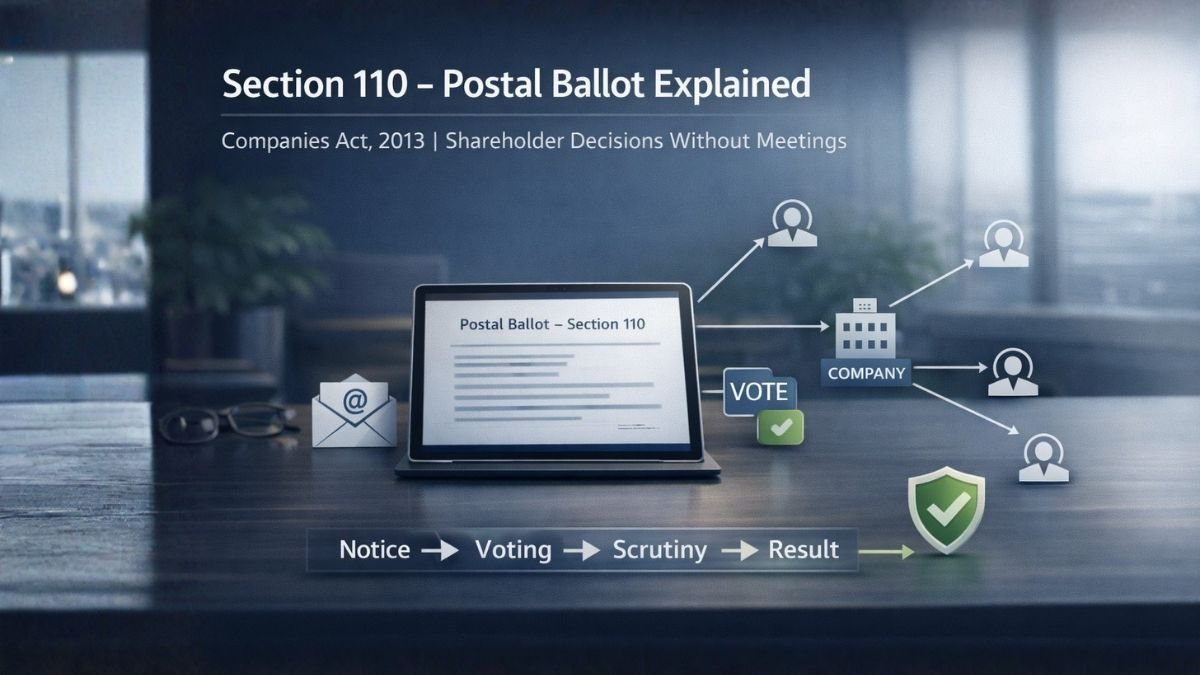
Section 110 of Companies Act 2013: Postal Ballot Explained Like a Human
There was a time when every important company decision meant calling a general meeting.
- Venue booking
- Physical attendance
- Proxies
- Long discussions
- And often… very few shareholders actually showing up
But company law evolved.
Shareholding became scattered.
Investors moved cities, countries, and even continents.
That’s when Section 110 of Companies Act 2013 stepped in.
This section quietly changed how shareholder decisions are taken—by introducing and strengthening the concept of the postal ballot.
Let’s understand it practically, not like a bare Act paragraph.
What Is Section 110 of the Companies Act 2013?
In simple language, section 110 of the Companies Act 2013:
👉 allows certain company resolutions to be passed
👉 without holding a physical general meeting
👉 by taking shareholders’ approval through:
- postal ballot (physical mail), or
- electronic voting (e-voting)
The official idea behind the section is
Wider shareholder participation with proper procedure.
What Is a Postal Ballot (In Real Life)?
Forget the legal definition for a moment.
A postal ballot simply means:
- the company sends a proposal to shareholders
- shareholders vote from wherever they are
- votes are counted
- resolution is passed or rejected
No hall.
No crowd.
No compulsory physical meeting.
That’s the beauty of Section 110.
Why Was Section 110 Introduced?
Because expecting thousands of shareholders to attend a meeting is unrealistic.
Section 110:
- makes decision-making practical
- protects shareholder rights
- increases participation
- reduces cost and logistics
It is especially useful when:
- shareholders are geographically spread
- resolutions are technical
- physical discussion is not essential
What Kind of Resolutions Can Be Passed Under Section 110?
This is the most important part.
Section 110 of the Companies Act 2013 mainly applies to:
- non-ordinary business, and
- specific matters prescribed by law
These are usually important decisions, such as
- change of company name
- alteration of MOA/AOA
- related party transactions
- sale of substantial assets
- shifting registered office (in some cases)
The idea is
Important decisions must still go to shareholders—but not necessarily in a meeting.
Is Postal Ballot Mandatory for Certain Matters?
Yes.
For some items, the law mandates approval only through postal ballot (or e-voting), not through a normal general meeting.
That’s how Section 110 ensures seriousness and transparency.
Section 110 and Shareholder Participation
One major benefit of Section 110 is inclusion.
Earlier:
- small shareholders were ignored
- attendance was low
- decisions were dominated by a few
Now:
- every shareholder gets equal voting access
- voting can be done from home
- participation improves significantly
This is why Section 110 is often seen as a shareholder-friendly provision.
Step-by-Step Postal Ballot Process
Let’s walk through how Section 110 works in practice.
Step 1: Board Approval
The Board:
- approves the proposal
- decides to pass it through postal ballot
This decision is recorded in the board minutes.
Step 2: Notice to Shareholders
The company sends a postal ballot notice, which must include:
- details of the resolution
- explanatory statement
- draft resolution
- voting instructions
- last date for voting
This ensures shareholders understand what they are voting for.
Step 3: Voting Period
Shareholders are given a fixed period (usually 30 days):
- to vote by post
- or through electronic means
No rush.
No pressure.
Step 4: Scrutinizer Appointment
The company appoints an independent scrutinizer to:
- oversee the voting process
- ensure fairness
- prepare a report
This maintains credibility.
Step 5: Declaration of Results
After voting ends:
- votes are counted
- scrutinizer submits a report.
- results are declared
If majority approval is achieved:
- resolution is deemed passed
Section 110 and E-Voting (Connection with Section 108)
Modern postal ballots are rarely “postal” anymore.
That’s because Section 110 works closely with Section 108, which deals with e-voting.
So today:
- most companies use electronic voting platforms
- physical ballots are minimal
This combination makes the process:
- faster
- transparent
- technology-driven
Do All Companies Have to Use Postal Ballots?
No.
Section 110:
- applies mainly to listed companies
- and other prescribed classes of companies
Small private companies may not need postal ballots for every decision.
The law balances compliance with practicality.
Postal Ballot vs General Meeting (Simple Comparison)
|
Aspect |
General Meeting |
Postal Ballot |
|
Physical presence |
Required |
Not required |
|
Cost |
Higher |
Lower |
|
Shareholder reach |
Limited |
Wide |
|
Convenience |
Low |
High |
|
Participation |
Often low |
Usually higher |
This is why Section 110 is preferred for specific resolutions.
Common Mistakes Companies Make Under Section 110
From practical experience, these errors are common:
- incomplete notice
- vague explanatory statement
- incorrect voting period
- improper scrutinizer appointment
- mixing ordinary business with postal ballot
These can invalidate the resolution.
Why Procedure Matters So Much in Section 110
Postal ballot resolutions are often challenged.
Courts and regulators look closely at:
- notice content
- voting process
- fairness
- shareholder information
So procedure is everything under Section 110.
Section 110 in One Simple Line
If you remember only one thing, remember this:
Section 110 of the Companies Act 2013 allows companies to pass certain resolutions through postal ballot or e-voting instead of holding a general meeting.
Quick Human-Friendly Summary
- Section 110 deals with postal ballots.
- Allows shareholder decisions without physical meetings
- Applies mainly to non-ordinary and prescribed matters
- Requires proper notice, voting period, and scrutiny
- Enhances shareholder participation
- Works along with Section 108 (e-voting)
Final Thoughts (Real Talk)
Section 110 reflects a simple truth:
Corporate decisions should not be limited by geography.
By allowing postal ballots and e-voting, the law:
- empowers shareholders
- modernizes governance
- reduces unnecessary formalities
But because this section deals with important resolutions, it demands strict procedural discipline.
If you’re planning to pass a resolution through postal ballot and want to ensure:
- correct applicability
- valid notice
- smooth voting
- zero legal risk
Getting professional guidance early makes the process stress-free.
For expert help with postal ballot resolutions, e-voting compliance, and Companies Act matters, visit callmyca.com.









