Section 148(1) of Companies Act, 2013: Cost Accounting and Cost Audit Explained in Simple Terms
Corporate compliance today isn’t just about ticking boxes or filing financial statements on time. Regulators now want visibility into how businesses actually operate, how resources are consumed, and whether pricing truly reflects costs. That’s exactly where Section 148(1) of the Companies Act, 2013 steps in.
Unlike financial accounting, which largely focuses on profit and loss numbers, cost accounting goes much deeper. It looks at how money is spent — on materials, labour, overheads, and production processes. It shows what’s happening behind the scenes.
And that’s why this provision exists.
Section 148(1) empowers the Central Government to ensure that certain companies maintain detailed cost records, especially those operating in sectors that affect public interest, pricing, or economic stability.
This is not a routine compliance rule. It’s a governance tool.
Why Section 148(1) Exists in the First Place
Some industries play a much larger role in the economy than others. Think manufacturing, infrastructure, power, telecom, or sectors where pricing impacts millions of consumers.
In such cases, knowing only the final profit number is not enough.
The government needs clarity on:
-
Whether prices are fair
-
Whether resources are being used efficiently
-
Whether inefficiencies are being passed on to consumers
That’s exactly why Section 148(1) exists.
It allows authorities to look beyond surface-level financials and understand cost behaviour at the ground level.
It also discourages manipulation, improves accountability, and pushes companies toward disciplined cost management.
Government’s Power Under Section 148(1)
One important thing to understand is that this section does not apply to every company.
The Central Government has the authority to notify specific classes of companies that must maintain cost records. These notifications are usually based on factors such as:
-
Nature of the industry
-
Scale of operations
-
Public interest involvement
-
Sensitivity of pricing
Once notified, compliance becomes mandatory — whether the company is listed or unlisted, public or private.
This targeted approach ensures that only relevant businesses face this additional compliance burden.
Which Companies Are Covered?
Section 148(1) generally applies to companies engaged in:
-
Manufacturing activities
-
Infrastructure and utilities
-
Regulated or price-sensitive industries
The idea is simple: where cost transparency matters the most, regulation steps in.
This selective approach balances compliance pressure with regulatory necessity.
What Kind of Cost Records Are Required?
Cost records under Section 148(1) are not just basic ledgers.
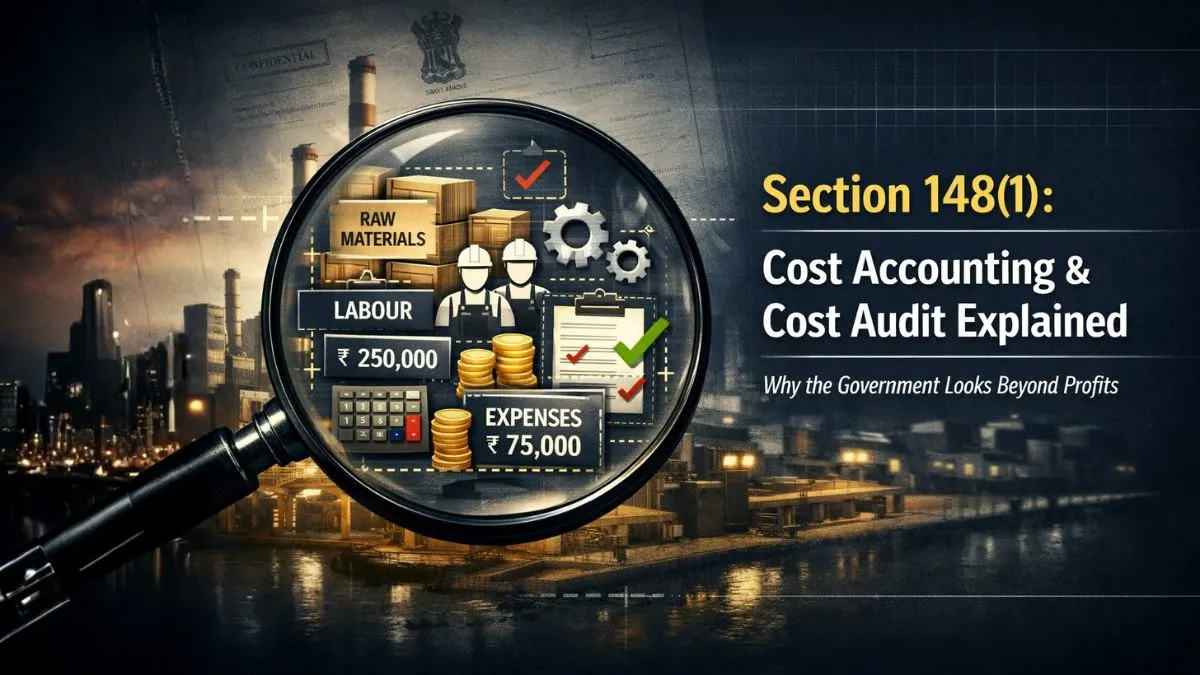
They include detailed information on:
-
Raw materials consumed
-
Labour utilisation
-
Overheads and indirect costs
-
Production efficiency
-
Cost variations and wastage
These records must be maintained in a structured and verifiable manner. They act as the backbone for cost audits and help identify inefficiencies before they become financial risks.
How Cost Accounting Links to Cost Audit
Section 148(1) doesn’t operate in isolation.
It forms the foundation for cost audits prescribed under related provisions of the Companies Act. Without proper cost records, a cost audit becomes meaningless.
Think of it this way — cost records are the raw data, and cost audit is the independent verification of that data.
Together, they create accountability.
Why Cost Accounting Strengthens Corporate Governance
Strong governance isn’t built on assumptions. It’s built on clarity.
Cost accounting gives management deeper visibility into operations. It supports better pricing decisions, improved efficiency, and stronger internal controls.
From a governance perspective, this reduces information gaps between management, regulators, and stakeholders. Decisions become data-driven rather than assumption-based.
Compliance Responsibilities for Companies
Once notified under Section 148(1), companies must:
-
Implement proper cost accounting systems
-
Maintain records in prescribed formats
-
Appoint qualified professionals where required
-
Ensure consistency between cost and financial records
Any mismatch can invite scrutiny. And in today’s compliance-driven environment, even small lapses can raise big red flags.
Role of Cost Auditors
Cost auditors act as independent reviewers of cost data. Their role is not limited to compliance; they also highlight inefficiencies, unusual cost trends, and operational gaps.
Their effectiveness, however, depends entirely on the quality of records maintained under Section 148(1).
Why This Section Matters for Regulators
For regulators, Section 148(1) is a powerful analytical tool.
It provides:
-
Real cost data instead of estimates
-
Better visibility into industry practices
-
Inputs for pricing regulation and policy decisions
This helps balance corporate profitability with public interest — something increasingly important in today’s economy.
Business Impact Beyond Compliance
Many companies initially see cost accounting as a burden. But over time, it often becomes a strategic advantage.
Clear cost insights help businesses:
-
Improve margins
-
Reduce inefficiencies
-
Make smarter operational decisions
Those who use cost data proactively tend to outperform those who treat it as just another compliance checkbox.
Challenges in Implementation
Implementing cost accounting systems does require effort. Smaller entities may find it resource-intensive at first. But once systems are in place, compliance becomes smoother and audits help improve internal discipline.
Regulatory guidance and standardised formats have also made implementation easier over the years.
Penalties and Consequences of Non-Compliance
Failure to comply with Section 148(1) can attract penalties under the Companies Act, 2013. In serious cases, it may also trigger investigations or regulatory scrutiny.
Directors and officers responsible for compliance may face personal accountability. This alone makes adherence non-negotiable.
How Section 148(1) Fits into the Bigger Picture
This provision works alongside other accounting and governance requirements under the Companies Act. Financial statements show results. Cost records explain how those results were achieved.
Together, they create a transparent and accountable corporate ecosystem aligned with global best practices.
Final Thoughts
Section 148(1) of the Companies Act, 2013 is far more than a compliance provision. It is a framework that promotes transparency, accountability, and long-term sustainability.
Companies that take it seriously don’t just stay compliant — they gain clarity, control, and strategic advantage.
For professional support in cost accounting, cost audits, and compliance under the Companies Act, 2013, connect with experts at Callmyca.com and ensure your compliance journey remains smooth and stress-free.