Section 17 of the RERA Act (Transfer of Title & Promoter Obligations)
If you are a homebuyer waiting for possession, a member of a housing society, or a real estate professional, chances are you’ve searched Section 17 of the RERA Act after hearing words like
“conveyance deed pending” or “builder hasn’t transferred title yet.”
And that concern is very real.
Many buyers assume that once they get possession of a flat, ownership is complete. But legally, ownership is not complete until the title is transferred—and that’s exactly where Section 17 of RERA comes into play.
Let’s understand this provision slowly, clearly, and practically—without legal jargon and without confusion.
What Is Section 17 of the RERA Act?
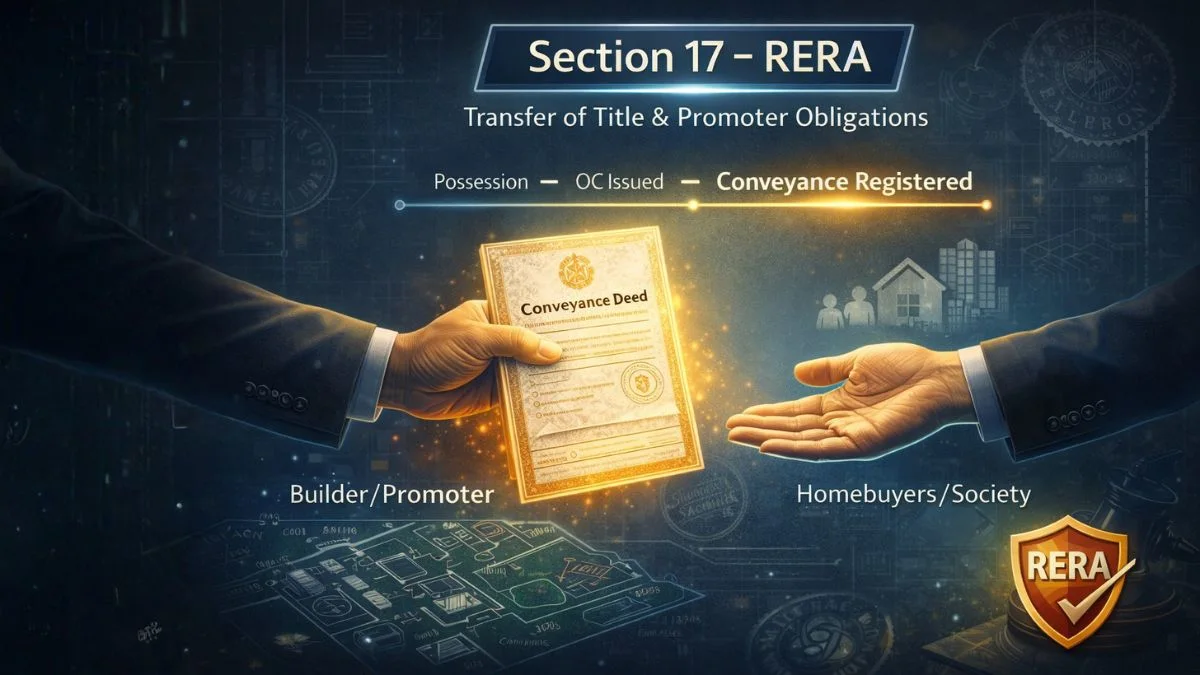
Section 17 of the Real Estate (Regulation and Development) Act, 2016 (RERA), deals with the transfer of title from the promoter (developer) to:
- The homebuyer (allottee), or
- The association of allottees (society, association, or cooperative body)
In simple words:
Section 17 ensures that the developer legally hands over ownership, possession, and control of the project—along with essential documents—to the buyers or their association.
This section exists because, historically, many builders:
- Gave possession
- Collected full money
- But delayed or avoided transferring legal title
RERA fixed this gap.
Why Section 17 Is One of the Most Important RERA Provisions
Section 17 directly affects:
- Legal ownership
- Housing society formation
- Maintenance control
- Redevelopment rights
- Sale, mortgage, and resale of flats
Without compliance under Section 17:
- Buyers live in houses they don’t legally own
- Societies exist without land title
- Builders retain unnecessary control
Transfer of Title—What Does It Mean Under RERA?
Under Section 17—Transfer of Title, the promoter must:
- Execute a registered conveyance deed
- In favor of:
- The allottee (individual buyer), OR
- The association of allottees, OR
- A competent authority (where applicable)
- The allottee (individual buyer), OR
This is not optional. It is mandatory.
Promoter Shall Execute a Registered Conveyance Deed
This is the most powerful line in Section 17.
The promoter shall execute a registered conveyance deed in favor of the allottee or association.
Key points:
- Conveyance must be registered
- A mere agreement or possession letter is not enough
- Registration gives legal ownership
Without a registered conveyance deed:
- The buyer does not get full legal title
- Society cannot claim land ownership
When Must the Title Be Transferred? (Timeline Under Section 17)
Section 17 clearly states that:
The title is to be transferred within the specified period under local laws.
This means:
- RERA respects state laws
- If local laws prescribe a time limit, that applies
- If local laws are absent, RERA rules apply
In most states:
- Conveyance is expected within 3 months of:
- Occupancy Certificate, or
- Formation of society
- Occupancy Certificate, or
Delay is a violation of RERA.
Handover of Physical Possession Under Section 17
Section 17 does not talk only about paperwork.
It also mandates:
- Handover of physical possession
- Along with:
- Common areas
- Facilities
- Amenities
- Common areas
Possession must be:
- Lawful
- Complete
- Usable
Incomplete possession does not satisfy Section 17.
Handover of Common Areas—A Critical Obligation
One major issue before RERA was
- Builders retaining control over common areas
- Charging maintenance indefinitely
- Delaying society control
Section 17 fixes this by requiring:
- Transfer of common areas
- Along with essential project documents
- To the association of allottees
This ensures community management, not builder dominance.
Documents to Be Handed Over Under Section 17
Under Section 17, the promoter must hand over:
- Approved plans
- Completion certificate
- Occupancy certificate
- Title documents
- Project drawings
- Insurance documents
- Common area details
This ensures transparency and long-term security.
Obligations of Promoter Regarding Insurance of Real Estate Project
Section 17 is closely connected with:
- Obligations of promoter regarding insurance of real estate project
Promoters must:
- Insure the project
- Transfer insurance benefits to allottees
- Hand over insurance documents
This protects buyers against:
- Structural defects
- Project-related risks
Who Receives the Conveyance Deed?
Depending on the stage of the project:
- Individual Allottee
- In case of plotted development
- Or where society is not yet formed
- In case of plotted development
- Association of Allottees
- Housing society
- Cooperative society
- Apartment owners’ association
- Housing society
- Competent Authority
- In special cases under local laws
- In special cases under local laws
RERA allows flexibility—but not delay.
Section 17 and Housing Societies—Why It Matters
For housing societies, Section 17 is critical because:
- Land title determines redevelopment rights
- Society cannot redevelop without conveyance
- Banks hesitate to fund without clear title
Section 17 gives societies:
- Legal ownership
- Control over property
- Power to manage and redevelop
What Happens If the Promoter Does Not Transfer the Title?
If a promoter fails to comply with Section 17:
- Buyers or society can file a complaint under RERA
- Authority can:
- Order execution of conveyance
- Impose penalty
- Issue directions
- Order execution of conveyance
In many states, RERA authorities actively enforce Section 17.
Is Section 17 Applicable to Old Projects?
Yes, if:
- The project is registered under RERA
- Conveyance is still pending
RERA applies to:
- Ongoing projects
- Registered projects
- Even if possession was given earlier
This has helped thousands of old societies.
Section 17 vs Agreement for Sale—Important Difference
Agreement for Sale:
- Gives contractual rights
- Not ownership
Conveyance Deed under Section 17:
- Transfers ownership
- Creates legal title
Many buyers confuse the two. Section 17 corrects that misunderstanding.
Real-Life Problems Section 17 Solves
Before RERA:
- Builders delayed conveyance for decades
- Societies had no land ownership
- Redevelopment was blocked
- Builders misused common areas
Section 17 addresses all of this in one stroke.
Common Excuses Promoters Give (And Why They Fail)
Promoters often say:
- “Society not formed”
- “Pending approvals”
- “Internal issues”
Under RERA:
👉 These are not valid excuses for indefinite delay.
The promoter must facilitate society formation and title transfer.
How Homebuyers Can Enforce Section 17
If you’re a buyer or society:
- Check RERA registration details
- Verify OC and possession date
- Demand conveyance in writing
- Approach RERA Authority if delayed
RERA complaints under Section 17 are common and effective.
Section 17 in One Simple Line
If we had to explain section 17 of the RERA Act in one sentence:
It ensures that the developer legally hands over ownership, possession, common areas, and documents to the buyers or their association within a fixed time.
Why Section 17 Is a Game-Changer in Indian Real Estate
Section 17 transformed Indian real estate by:
- Ending perpetual builder control
- Protecting buyer ownership
- Enabling society governance
- Supporting redevelopment
It converts “possession” into real ownership.
Final Thoughts: Section 17 Protects What Matters Most—Ownership
Section 17 of the RERA Act is not just a procedural rule. It protects:
- Your home
- Your land
- Your legal rights
- Your future value
If you own a flat and don’t have conveyance, Section 17 exists for you.
Understanding it empowers buyers to demand what is rightfully theirs.
Need help with RERA compliance, conveyance deed issues, or homebuyer rights?
Visit callmyca.com for clear, practical guidance on RERA, property law, and real estate compliance.