
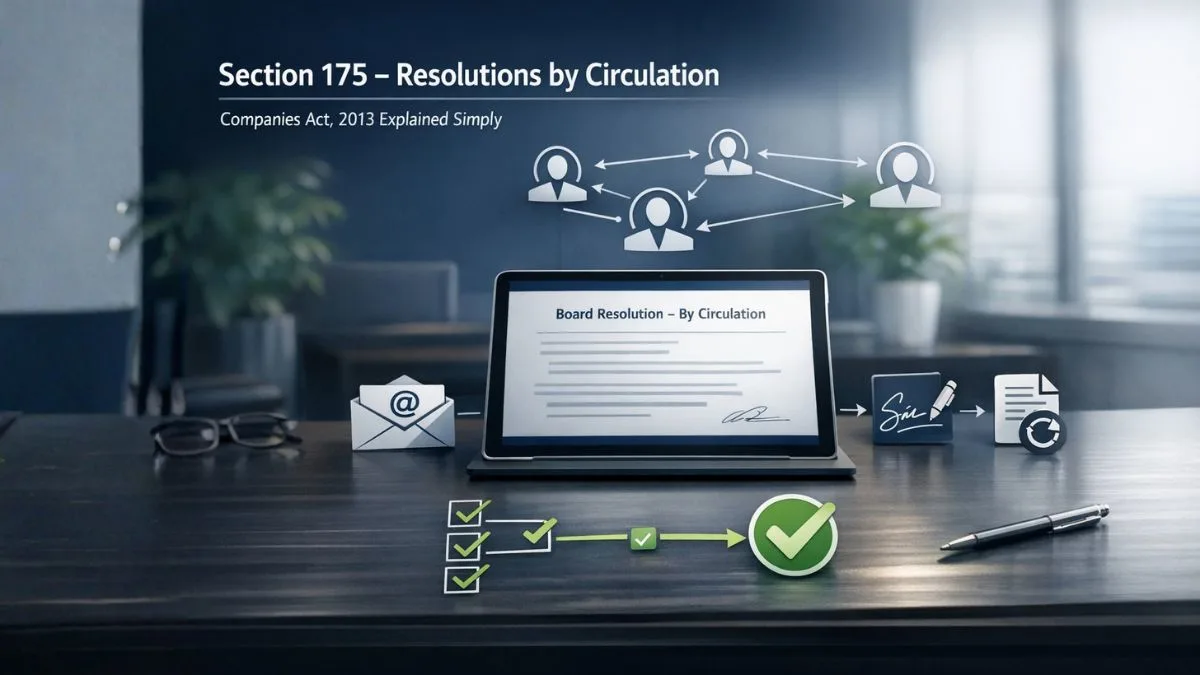
Section 175 of the Companies Act 2013 Explained Simply (Passing Resolutions by Circulation)
If you’ve ever been a company director or worked closely with one, you know this situation very well:
“It’s a small decision. Do we really need to call a board meeting for this?”
That exact practical problem is why Section 175 of the Companies Act 2013 exists.
In real life, companies cannot call a physical board meeting for every minor or urgent decision. Business moves faster than meeting schedules. Section 175 recognizes this reality and provides a legal shortcut—without compromising governance.
Let’s understand Section 175 in a way directors actually use it, not the way it’s memorized for exams.
What Is Section 175 of the Companies Act 2013?
Section 175 of the Companies Act 2013 deals with the passing of resolutions by circulation.
In simple words:
It allows the Board of Directors or a committee of the Board to pass resolutions without holding a physical meeting by circulating the resolution to all directors or members of the committee for approval.
This is commonly called a circular resolution.
Why Section 175 Was Introduced
Before the Companies Act, 2013:
- Decisions required frequent meetings
- Directors faced logistical delays
- Urgent matters got stuck waiting for a quorum.
Section 175 was introduced to:
- Reduce procedural burden
- Enable faster decision-making
- Maintain written records and accountability
It balances speed with compliance.
What Is a Circular Resolution?
A circular resolution is:
- A resolution proposed in writing
- Circulated to all directors or committee members
- Approved by a majority
- Recorded officially
Once passed, it has the same legal effect as a resolution passed in a board meeting.
Passing the Resolution by Circulation – Core Rule
Under Section 175:
- The resolution must be circulated to all directors
- Circulation can be done:
- By hand
- By post
- By courier
- By electronic means (email, digital platforms)
- By hand
- Approval must come from a majority of directors entitled to vote
This is the legal backbone of Section 175.
Who Can Pass a Circular Resolution?
Circular resolutions can be passed by:
- Board of Directors, or
- Committee of the Board
It cannot be passed by:
- Shareholders (unless specific provisions apply)
- Individual directors acting alone
What Is the Majority Required Under Section 175?
This is a common confusion.
The majority is calculated based on:
- Total number of directors entitled to vote
- Not just those who respond
Example:
- Total directors: 6
- Majority required: 4
- If only 3 approve, resolution fails
Silence does not count as approval.
Important Proviso Under Section 175 (Very Crucial)
Section 175 contains a very important safeguard.
It states that:
If one-third of the total directors (or a minimum of 2 directors, whichever is higher) require the resolution to be decided at a meeting, the resolution cannot be passed by circulation.
This ensures:
- Important or controversial matters are discussed
- Minority directors are not ignored
This proviso protects governance quality.
Why This Proviso Matters in Practice
Without this proviso:
- The majority of directors could push decisions silently
- Minority opinions could be suppressed
Section 175 ensures:
- Transparency
- Collective discussion when required
- Respect for dissent
Procedure Under Section 175 (Step-by-Step)
Let’s look at how circular resolutions work in real companies.
Step 1: Draft the Resolution
The resolution must be:
- Clear
- Complete
- Properly worded
Supporting notes or documents should be attached.
Step 2: Circulate to All Directors
Send the resolution:
- To all directors
- At their registered email or address
- With sufficient explanation
Partial circulation is invalid.
Step 3: Obtain Approvals
Directors respond with:
- Approval
- Dissent
- Or request for discussion in meeting
Responses must be recorded.
Step 4: Check Majority
If the majority approves and there is no valid objection under the proviso:
- The resolution is passed
Step 5: Record in Minutes
The resolution must be:
- Noted in the minutes of the next board meeting
- Properly documented
This step is mandatory.
Section 175 vs Board Meeting (Section 173)
|
Basis |
Circular Resolution (Section 175) |
Board Meeting (Section 173) |
|
Physical presence |
Not required |
Required |
|
Speed |
Faster |
Slower |
|
Discussion |
Limited |
Full discussion |
|
Ideal for |
Routine/urgent matters |
Strategic matters |
Both are equally legal—but used differently.
What Types of Matters Are Suitable for Circular Resolutions?
Section 175 is usually used for:
- Opening or closing bank accounts
- Routine authorisations
- Signing agreements
- Minor operational decisions
- Urgent approvals
It is not ideal for:
- Major policy decisions
- Matters involving heavy debate
- Issues affecting director interests
Matters NOT Allowed by Circular Resolution (Practical Reality)
Even if Section 175 allows circular resolutions, other laws restrict their use.
Certain matters must be passed at a meeting, such as:
- Approval of financial statements
- Board’s report
- Matters requiring audit committee discussion
- Certain transactions under Section 177
Always cross-check before using Section 175.
Relation With Other Sections (173–179)
Section 175 does not stand alone.
It is closely connected with:
- Section 173 – Board meetings
- Section 174 – Quorum
- Section 176 – Interested directors
- Section 177 – Audit Committee
- Section 179 – Powers of Board
Together, these sections define how boards function.
Section 175 and Interested Directors
If a director is
- Interested in the matter
- Disqualified from voting
Then:
- That director should not vote
- Majority is calculated excluding such director
Transparency is essential.
Is Section 175 Mandatory or Optional?
Section 175 is optional.
Companies:
- May use it
- Are not forced to use it
It is a facility, not a compulsion.
Section 175 of Companies Act 2013 – Applicability
Section 175 applies to:
- Public companies
- Private companies
- OPCs (with practical limitations)
There is no exemption based on company size.
Common Mistakes Companies Make Under Section 175
From real compliance experience:
- Not circulating to all directors
- Counting silence as approval
- Ignoring the one-third objection rule
- Failing to record in next meeting minutes
- Using circular resolutions for restricted matters
These mistakes can invalidate decisions.
Legal Value of a Circular Resolution
Once properly passed:
- It is legally valid
- Binding on the company
- Enforceable like any board resolution
Courts recognize circular resolutions when:
- The procedure is followed strictly
Section 175 and Digital Governance
Section 175 is especially relevant today because:
- Directors are in different locations
- Virtual operations are common
- Speed matters
It aligns well with:
- Email approvals
- Digital signatures
- Paperless governance
Practical Tips for Using Section 175 Safely
If you are a director or compliance professional:
- Use Section 175 only for suitable matters
- Circulate to every director
- Track responses carefully
- Watch for objection requests
- Always record in next board meeting
Good documentation prevents disputes.
One-Line Explanation for Easy Recall
If we simplify section 175 of the Companies Act 2013 into one sentence:
It allows the Board to pass resolutions without a meeting, by circulation, provided majority approval is obtained and minority rights are respected.
Why Section 175 Is a Practical Lifesaver
Section 175:
- Saves time
- Reduces procedural burden
- Supports fast business decisions
- Maintains governance standards
Used correctly, it is one of the most director-friendly provisions in the Companies Act.
Final Thoughts: Section 175 Balances Speed and Governance
Section 175 of the Companies Act 2013 proves that law doesn’t have to slow business down.
It acknowledges a simple truth:
Not every decision needs a conference table.
But it also reminds us:
Governance must never be compromised for convenience.
When used thoughtfully, Section 175 makes boards more efficient—and more responsible.
Need help with board resolutions, circular approvals, or Companies Act compliance?
Visit callmyca.com for clear, practical guidance on corporate governance, board procedures, and MCA compliance—explained simply and professionally.









