
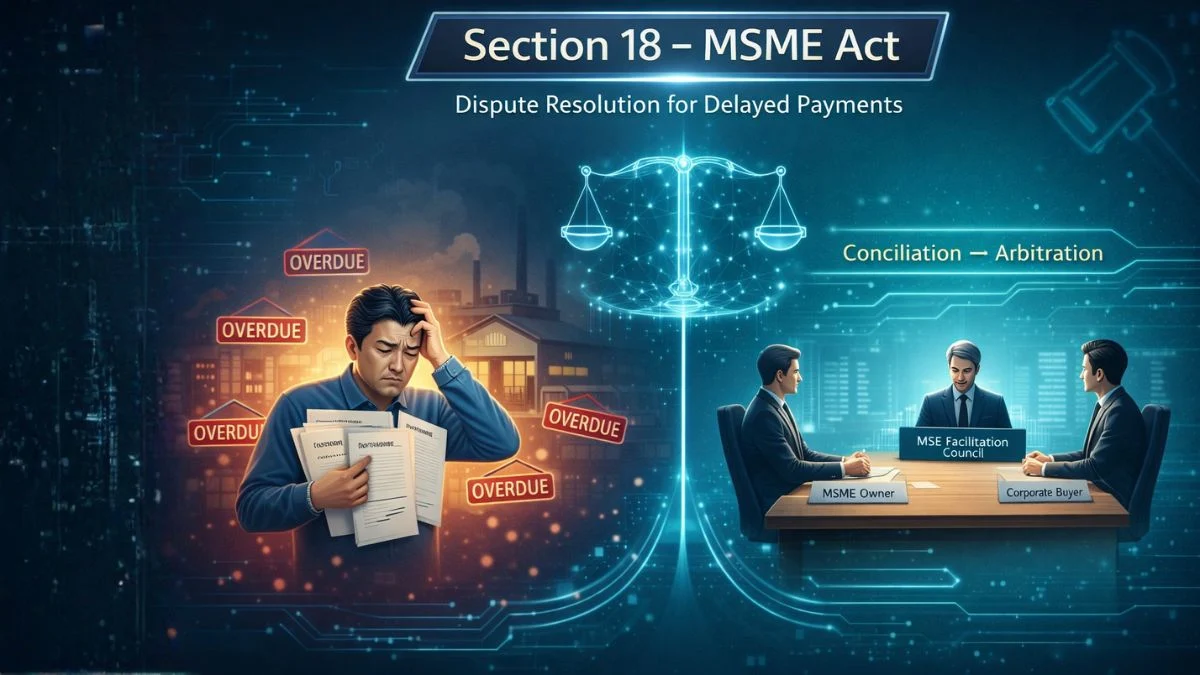
Section 18 of MSME Act – Dispute Resolution Mechanism for Delayed Payments
Delayed payments are one of the biggest silent killers of small businesses in India. I’ve personally seen Micro and Small Enterprises (MSEs) shut down not because they lacked orders, but because their money was stuck with large buyers for months—sometimes years. That is exactly why section 18 of the MSME Act exists.
This section is not just another legal provision buried inside an act. It is a powerful recovery and dispute resolution tool specifically designed to protect micro and small enterprises from delayed payments and unfair treatment by buyers.
Why Section 18 of MSME Act Was Introduced
The MSME sector is often called the backbone of the Indian economy, yet it is also the most vulnerable when it comes to cash flow. Large corporates, PSUs, and even government departments often delay payments, knowing very well that small businesses don’t have the resources to fight long legal battles.
The MSME Act recognized this imbalance.
So, the Act envisages a dispute resolution mechanism that is
- Faster than courts
- Cost-effective
- Favourable to MSEs
- Legally binding
This mechanism is laid down under section 18 of the MSME Act.
What Is Section 18 of the MSME Act, in Simple Terms?
In plain language, section 18 of the MSME Act says:
If there is any dispute regarding delayed payment to a micro or small enterprise, the dispute must first go through conciliation, and if that fails, it will be resolved through arbitration.
This creates a two-tiered dispute resolution mechanism for delayed payments to Micro & Small Enterprises (MSEs).
And the most important part?
👉 This process is mandatory.
Two-Tiered Dispute Resolution Mechanism Under Section 18 of MSME Act
Let’s break this down step by step.
Tier 1: Mandatory Conciliation (Mediation)
The first step under section 18 of the MSME Act is conciliation.
- The dispute is referred to the Micro and Small Enterprises Facilitation Council (MSEFC)
- The Council attempts to resolve the matter amicably
- This is similar to mediation, where both parties try to settle without litigation
The law clearly mandates conciliation before moving to arbitration.
Many buyers don’t realize this and directly approach courts—which usually backfires.
Tier 2: Arbitration (If Conciliation Fails)
If conciliation does not result in a settlement:
- The dispute automatically moves to arbitration
- Arbitration may be conducted:
- By the MSEFC itself, or
- Through an appointed institution
- By the MSEFC itself, or
- The proceedings follow the Arbitration & Conciliation Act, 1996 provisions
This second stage ensures that disputes are decided quickly and decisively.
Role of Micro and Small Enterprises Facilitation Council (MSEFC)
The reference to the Micro and Small Enterprises Facilitation Council is a central feature of section 18 of the MSME Act.
What Does MSEFC Do?
- Receives references from MSEs for delayed payment disputes
- Conducts or facilitates conciliation
- Initiates arbitration if conciliation fails
- Passes legally enforceable awards
The MSEFC acts as a specialized forum—much faster and more MSME-friendly than traditional courts.
Why Conciliation Is Mandatory Under Section 18
One of the most misunderstood aspects is why disputes must first go through conciliation/mediation and then to arbitration.
The idea is simple:
- Encourage settlement without hostility
- Reduce legal costs
- Preserve business relationships
In practice, many disputes get resolved at the conciliation stage itself, especially when buyers realize the legal strength of Section 18 of the MSME Act.
Can Parties Skip Conciliation and Go to Court?
Short answer: No.
Courts across India have repeatedly held that:
- If a dispute falls under section 18 of the MSME Act
- Parties cannot bypass the MSEFC
- Civil courts or even arbitration clauses in contracts take a backseat
This is because the MSME Act has an overriding effect over other laws.
Arbitration Under Section 18 of MSME Act
Once conciliation fails, arbitration begins automatically.
Key Features of Arbitration Under Section 18
- Governed by the Arbitration & Conciliation Act, 1996
- Faster timelines compared to civil suits
- Limited scope for delay tactics
- The award is executable like a court decree
This makes Section 18 of the MSME Act a very strong recovery mechanism.
A Real-Life Scenario
Imagine this:
A small manufacturer supplies goods worth ₹25 lakhs to a large corporation. Payment is due in 45 days. Six months pass. No payment.
Instead of sending endless emails, the MSME:
- Files a reference before MSEFC under section 18 of the MSME Act
- Buyer receives notice
- Conciliation begins
- The buyer suddenly becomes responsive
In many cases, the matter settles even before arbitration begins.
Common Misconceptions About Section 18 of MSME Act
Let’s clear a few myths:
❌ “Only government buyers are covered.”
Wrong. Any buyer—private or public—is covered.
❌ “Contract clause overrides MSME Act”
No. The MSME Act overrides contract terms.
❌ “It takes years, like court cases.”
In reality, it’s much faster than civil litigation.
Practical Tips for MSMEs Using Section 18
If you’re an MSE, here’s how to use section 18 of the MSME Act effectively:
- Ensure MSME Registration
Only micro and small enterprises can invoke this section. - Maintain Proper Documentation
Invoices, delivery proofs, agreements—everything matters. - Don’t Delay Filing Reference
Early action creates pressure on buyers. - Participate Actively in Conciliation
Many disputes resolve here itself. - Seek Professional Guidance
Procedural clarity avoids unnecessary delays.
Why Section 18 of MSME Act Is a Game-Changer
The Act envisages a dispute resolution mechanism that finally gives small businesses a voice. Earlier, legal recovery was expensive and slow. Today, section 18 of the MSME Act levels the playing field.
It sends a strong message:
Delaying payments to MSMEs is no longer risk-free.
Final Thoughts
Section 18 of the MSME Act is not just a legal remedy—it’s a survival tool for micro and small enterprises. If used correctly, it can unlock stuck payments, improve cash flow, and restore confidence in doing business.
If you are an MSME facing delayed payments, don’t ignore your rights. And if you’re a buyer, take MSME dues seriously—because the law certainly does.
For expert help with MSME registration, MSEFC references, conciliation, or arbitration proceedings, visit callmyca.com—where compliance meets practical solutions.









