
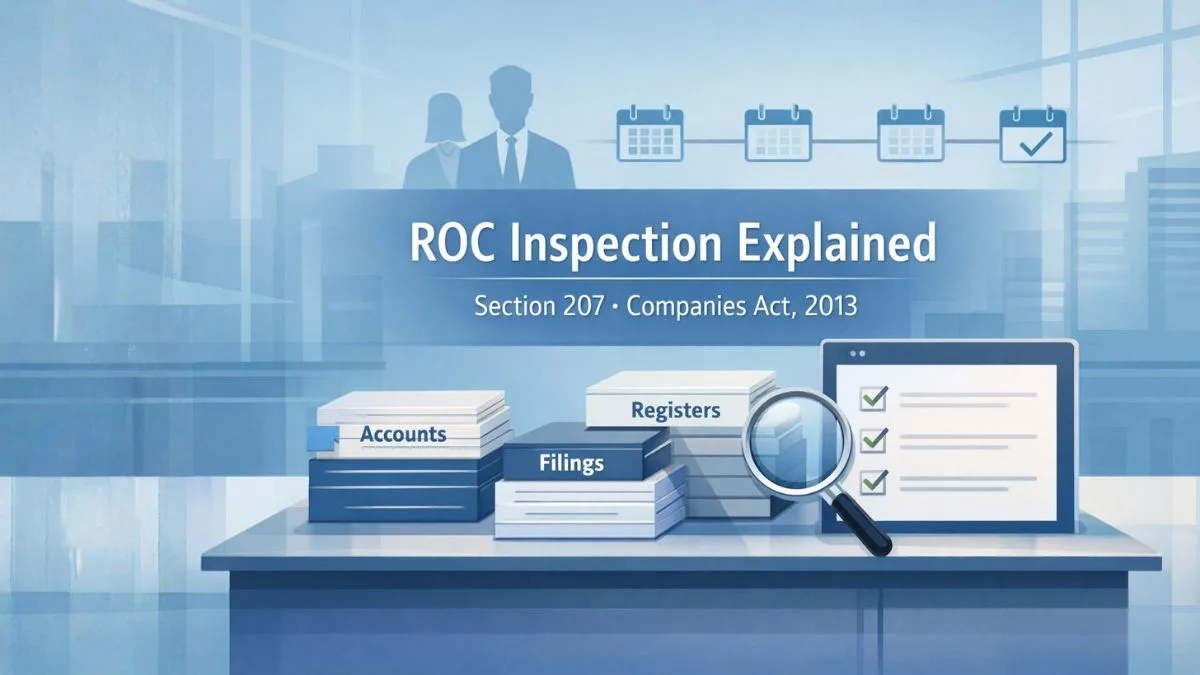
Section 207 of Companies Act 2013: What Really Happens During ROC Inspection
If you ever receive an email or notice saying “documents are required by the Registrar,” one thought immediately hits the mind:
“Ab kya problem ho gayi?”
This is exactly where Section 207 of the Companies Act 2013 comes into the picture.
Many directors panic when they hear words like "inspection" or "inquiry." They assume it means fraud, penalties, or prosecution. In reality, that’s not always true.
Section 207 is not about punishment.
It’s about cooperation, transparency, and accountability.
Let’s understand this section the way it actually works on the ground—calmly, practically, and without legal jargon.
What Is Section 207 of the Companies Act 2013?
In simple terms, section 207 of the Companies Act 2013:
👉 governs the conduct of inspection and inquiry
👉 carried out by the Registrar of Companies (RoC) or an Inspector
👉 into the affairs of a company
It clearly lays down:
- what powers the Registrar or inspector has
- what duties the company and its people have
- how the inspection or inquiry must be conducted
That’s why it’s officially titled:
Conduct of inspection and inquiry
Why Does Section 207 Exist?
The government does not want to run companies.
But it does want to ensure companies are
- following the law
- maintaining proper records
- not misleading shareholders or the public
So Section 207 of the Companies Act 2013 exists to give authorities a legal way to verify facts, not to harass businesses.
Who Can Conduct an Inspection or Inquiry Under Section 207?
Under Section 207, inspection or inquiry can be conducted by:
- the Registrar of Companies (RoC), or
- an Inspector appointed under the Act
This usually happens when:
- there are irregular filings
- complaints are received
- discrepancies are noticed
- random verification is initiated
What Do “Inspection” and “Inquiry” Mean in Practice?
Let’s demystify these words.
Inspection
Inspection usually means:
- checking books of accounts
- verifying statutory registers
- examining filings and records
Inquiry
Inquiry is slightly broader and may include:
- asking explanations
- verifying transactions
- understanding company structure
Both are covered under section 207 of the Companies Act 2013.
Powers of Registrar or Inspector Under Section 207
This is the part companies must take seriously.
Under Section 207 of the Companies Act 2013, the Registrar or inspector has the authority to:
- Examine business records
- Call for books of account
- Ask for statutory registers
- Seek contracts, agreements, and papers
- Question officers or employees
In short:
The registrar or inspector has the authority to examine business records and verify company affairs.
When a Registrar or Inspector Requests Company Documents
This is the most common situation.
Under section 207 of the Companies Act 2013, when a registrar or inspector requests company documents, the company must:
- produce all requested documents
- provide them within the prescribed time
- ensure documents are complete and accurate
Ignoring or delaying this can create unnecessary trouble.
Obligations of Directors, Officers, and Employees
Section 207 is very clear about responsibilities.
It requires:
- company directors
- officers
- employees
to:
- furnish information
- produce documents
- provide necessary assistance
This cooperation is not optional.
That’s why the law clearly states:
Directors, officers, and employees must provide all assistance during inspection or inquiry.
What Kind of Assistance Is Expected?
Practical assistance includes:
- explaining records
- clarifying transactions
- providing access to systems
- answering questions honestly
The idea is fact-finding, not interrogation.
What Section 207 Does NOT Mean
This is important to understand.
Section 207:
- ❌ does not automatically mean fraud
- ❌ does not mean prosecution has started
- ❌ does not mean the company is guilty
Most inspections are:
- routine
- verification-based
- compliance-driven
Understanding this helps reduce unnecessary panic.
Practical Example (Real-Life Situation)
Imagine this:
Your company:
- filed annual returns late
- showed mismatch between turnover and GST data
RoC sends an email asking for:
- books of accounts
- bank statements
- explanation of discrepancy
This is a classic Section 207 inspection.
If you:
- cooperate
- submit documents
- clarify properly
The matter often ends there.
Consequences of Non-Cooperation
Here’s where things can go wrong.
If a company
- refuses to provide documents
- gives misleading information
- obstructs inspection
then:
- further action can be initiated
- penalties may follow
- investigation under other sections may begin
So while Section 207 of the Companies Act 2013 is procedural, non-compliance can escalate matters.
Section 207 vs Investigation Under Section 210
Many people confuse inspection with investigation.
Here’s the difference:
- Section 207 → inspection/inquiry (preliminary)
- Section 210 → investigation (serious cases)
Think of Section 207 as
“Let’s first check the facts.”
How Companies Should Prepare for Section 207
From practical experience, these steps help immensely:
1. Keep Records Updated
- books of account
- statutory registers
- filings
2. Respond on Time
Never ignore RoC communication.
3. Be Transparent
An honest explanation works better than silence.
4. Take Professional Help
If documents are technical, expert support helps.
Common Mistakes Companies Make
Some common errors I’ve seen:
- ignoring emails from RoC
- submitting incomplete documents
- giving casual replies
- assuming inspection will “go away”
Section 207 exists to verify, not to scare—but negligence creates problems.
Why Section 207 Is Important for Corporate Governance
This section ensures:
- companies remain accountable
- records are maintained properly
- public interest is protected
That’s why Section 207 of the Companies Act 2013 plays a key role in maintaining trust in the corporate system.
Section 207 in One Simple Sentence
If you remember only one thing, remember this:
Section 207 of the Companies Act 2013 empowers the registrar or inspector to inspect company records and requires full cooperation from the company.
Quick Human-Friendly Summary
- Section 207 of Companies Act 2013 governs inspection and inquiry
- It applies when RoC or inspector examines company affairs
- The Registrar or inspector has the authority to examine business records
- Directors, officers, and employees must cooperate
- It outlines procedures and obligations during inspection or inquiry
- Non-cooperation can lead to further action
Final Thoughts (Real Talk)
Inspections are part of doing business in a regulated environment.
A company that:
- maintains proper records
- files returns honestly
- responds transparently
has nothing to fear from Section 207 of the Companies Act 2013.
In most cases, inspection is simple:
“Show us your records so we can close the file.”
If you’ve received an ROC notice or expect an inspection and want to handle it calmly, correctly, and professionally, the right guidance can make all the difference.
For expert help with ROC inspections, compliance management, and Companies Act matters, visit callmyca.com.









