
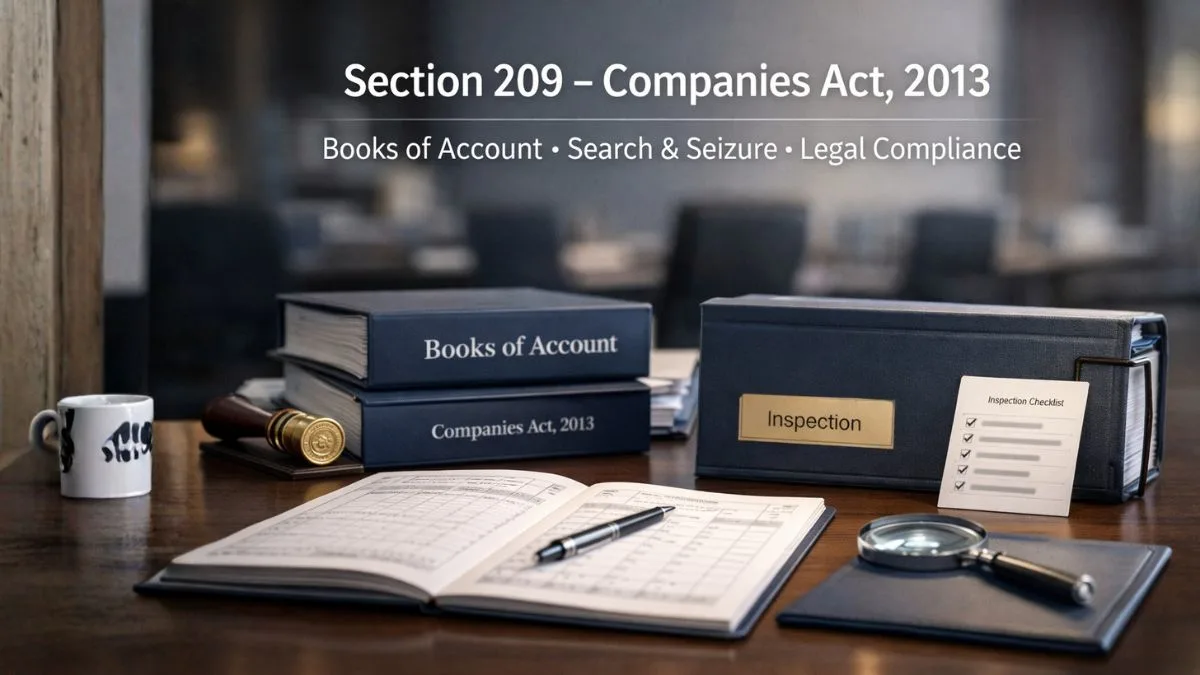
Comprehending Section 209 of the Companies Act 2013: Books of Account and Search & Seizure
In reality, compliance at the corporate level is hardly about checking the boxes. It is all about discipline, clarity, and readiness in response to queries that might arise. Among the most useful provisions in the Companies Act, 2013 that do justice to the reality is Section 209.
At first glance, Section 209 looks like a straightforward accounting requirement. Maintain books of account, keep them at the registered office, and move on. But anyone who has dealt with audits, inspections, or regulatory queries knows that this section goes much deeper. It lays down the backbone of financial accountability and gives authorities the power to step in when things don’t add up.
Let’s understand Section 209 in plain language—without legal jargon, but with real-world context.
Why Section 209 Matters More Than Most Companies Realise
Every company talks about transparency, but transparency only exists when financial records are accurate, accessible, and complete. Section 209 of the Companies Act, 2013 exists to ensure exactly that.
The law expects companies to maintain proper books of account that clearly show:
-
What the company owns
-
What it owes
-
What it earns
-
What it spends
These records are not meant only for statutory compliance. They form the base for audits, tax filings, investor confidence, and internal decision-making. When books are poorly maintained, problems rarely stay small. They snowball into notices, inspections, and sometimes even search and seizure actions.
Books of Account: What Companies Are Actually Expected to Maintain
Under Section 209, every company—regardless of size—is required to keep its books of account at its registered office. These books should accurately reflect the financial position of the company at any point in time.
In practice, this means maintaining:
-
Records of all money received and spent
-
Details of assets and liabilities
-
Information relating to share capital and reserves
-
Supporting vouchers and documents
The emphasis here is on accuracy and consistency, not just record-keeping for the sake of it. Books should be updated regularly and preserved safely. When companies delay entries, rely on incomplete data, or treat accounting as an afterthought, they expose themselves to serious legal risk.
Poor maintenance of books is often the first trigger for regulatory scrutiny.
When Section 209 Moves Beyond Accounting
Section 209 doesn’t stop at telling companies what they should do. It also addresses what happens when there is reason to believe that something is wrong.
If authorities suspect financial irregularities or non-compliance, the law empowers them to act.
This is where the search and seizure aspect of Section 209 comes into play.
Understanding Search and Seizure Under Section 209
Search and seizure is not a routine action, and it is not meant to intimidate compliant businesses. It is a corrective mechanism used when there is reasonable suspicion that financial records are being manipulated, concealed, or not maintained properly.
Under Section 209:
-
A Registrar or Inspector appointed under the Companies Act can initiate action
-
A Special Court order is mandatory before conducting any search
-
Only relevant books of account and papers can be seized
Once authorised, the officer can enter the company’s premises and seize documents considered necessary for investigation. This power exists to ensure that companies cannot hide or destroy evidence when faced with regulatory action.
Safeguards Built Into the Law
One common fear among business owners is misuse of search powers. Section 209 addresses this concern by embedding legal safeguards directly into the provision.
All search and seizure actions must follow the procedures laid down in the Criminal Procedure Code (CrPC). This ensures:
-
Due process is followed
-
Searches are properly documented
-
Seizures are legally justified
Additionally, seized books and papers are not meant to be held indefinitely. The law generally requires that documents be returned within 180 days. During this period, companies are allowed to take copies or extracts of seized records at their own cost, so that daily operations are not brought to a halt.
This balance protects both regulatory interests and business continuity.
Who Can Conduct Searches and Seize Records?
The authority under Section 209 is not open-ended. Only specific officers can exercise these powers:
-
The Registrar of Companies, or
-
An Inspector appointed under the Companies Act
These officers are trained to examine corporate records and identify discrepancies. While they have wide powers, their actions are closely regulated. Any deviation from prescribed procedures can be challenged legally.
From a company’s perspective, cooperation during inspections is crucial. Obstruction or non-cooperation often worsens the situation and can lead to stricter consequences.
Why Compliance Under Section 209 Is Non-Negotiable
Section 209 is not optional. It is a mandatory provision, and non-compliance carries serious implications.
Proper compliance helps companies:
-
Complete audits smoothly
-
File accurate income tax and GST returns
-
Respond confidently to regulatory queries
-
Protect directors and officers from personal liability
On the other hand, failure to maintain proper books can result in penalties, prolonged investigations, and operational disruptions. In extreme cases, it can damage a company’s reputation and strain relationships with investors and lenders.
How Section 209 Plays Out in Real Life
Consider a situation where a company is flagged for inconsistencies in its financial statements. The discrepancies raise suspicion, and an inspection is ordered.
If books of account are well-maintained, reconciled, and supported by documentation, the matter often resolves quickly. But if records are incomplete or unclear, authorities may proceed with search and seizure under Section 209.
While this sounds serious, companies that maintain discipline are rarely caught off guard. They can provide copies, explain transactions, and demonstrate compliance without panic.
Repeated negligence, however, almost always leads to deeper scrutiny.
Practical Compliance Tips for Companies
From experience, companies that handle Section 209 well usually follow a few simple principles:
-
Maintain books of account regularly, not just at year-end
-
Keep records organised and accessible at the registered office
-
Conduct internal reviews to identify gaps early
-
Ensure directors and key officers understand their responsibilities
-
Cooperate fully during inspections or inquiries
These small habits go a long way in preventing legal complications.
Final Thoughts
Section 209 of the Companies Act, 2013 is not designed to trouble businesses—it is designed to discipline them. By insisting on proper books of account and providing a regulated mechanism for search and seizure, the law strengthens corporate accountability without stifling genuine operations.
Companies that take this provision seriously rarely fear inspections. Instead, they view compliance as protection—against penalties, disputes, and reputational damage.
If your business focuses on accurate record-keeping and transparent governance, Section 209 becomes a safeguard rather than a threat.
For professional assistance with maintaining books of account, preparing for inspections, and managing compliance under the Companies Act, platforms like Callmyca.com help companies stay compliant with clarity and confidence—without unnecessary stress.









