Section 22 of the Income Tax Act—A Practical Understanding of Income from House Property
For most people, property is far more than just bricks and cement. It represents security, hard work, memories, and sometimes even lifelong savings.
However, when it comes to taxation, this is all secondary. Emotions come last. It is all about how this property is assessed under the Income Tax Act. And this is precisely where the importance of Section 22 of the Income Tax Act lies.
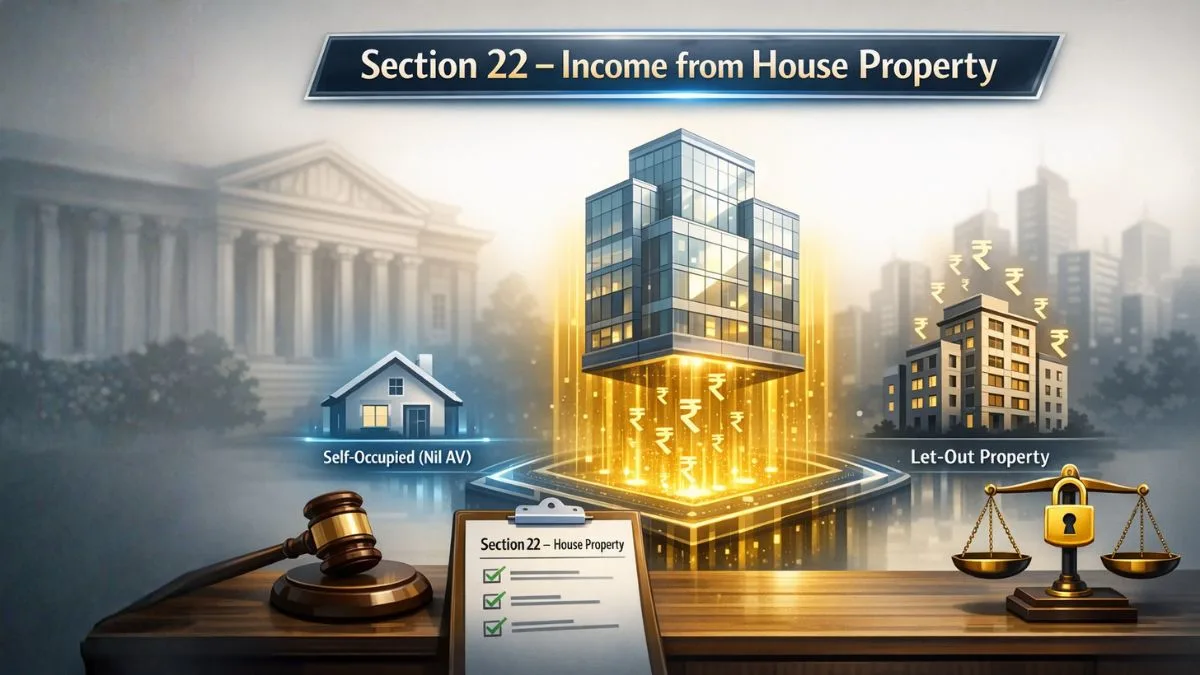
Section 22 is the charging section for "Income from House Property." It is not a part of the tax code that either carries sanctions or raises red flags because it quietly impacts the lives of millions of taxpaying citizens each year—homeowners, landlords, investors, and people who may own property but receive zero rent from it.
Let’s understand this in a clear, practical, and logical way—just like a professional would explain it.
What Section 22 Really Means
At its core, Section 22 determines when and how income from house property shall be taxable.
It does not concern itself with how actively you manage the property or whether you personally work on it. If income arises from ownership of a property, Section 22 steps in and brings it under the tax net.
This is the foundation. Everything else—such as valuation, exemptions, and deductions—builds upon this section.
Ownership is the Deciding Factor
One of the most misunderstood aspects of property taxation is this:
Under Section 22, tax liability depends on ownership, not on who receives the rent.
This means:
-
If you own the property, the income belongs to you for tax purposes.
-
It does not matter if rent is collected by a family member, credited to someone else’s bank account, or managed by an agent.
The tax department looks at legal ownership, not banking transactions.
That is how the law operates under income from house property provisions.
What Qualifies as House Property?
Section 22 applies to all types of immovable property, including:
-
Residential houses
-
Flats and apartments
-
Commercial shops
-
Office buildings
-
Warehouses or godowns (if not used for the owner’s business)
-
Land attached to a building (such as parking space or garden)
If you own such property and it is not used for your own business, it generally falls under this head of income.
When Section 22 Does NOT Apply
There is a crucial exception.
If you use your property exclusively for your own business or profession, then it is not taxed under income from house property.
For example:
If you own an office building and run your consulting firm from it, the benefit you derive from it is treated as business income—not house property income.
Section 22 recognizes this distinction and does not tax such property under this head.
Self-Occupied Property: A Common Misconception
Many taxpayers believe that if they live in their own house, there is no tax implication at all.
This is only partially correct.
In the case of self-occupation, the annual value will be taken as nil. This implies that there will be zero notional income. It may happen that the person has taken a home loan. In such circumstances, the interest portion will still apply.
So even though there is no taxable income, the property still needs to be reported correctly.
Let-Out Property: Where Tax Actually Applies
If your property is rented out, the rental income becomes taxable under the principle that income from house property shall be taxable.
Here, factors such as
-
Actual rent received
-
Municipal value
-
Fair rent
-
Standard rent
come into play while determining the taxable value.
This is where Section 22 truly establishes the framework for taxing income derived from house property in a structured and consistent manner.
Deemed Let-Out Property: The Hidden Challenge
This is one of the most overlooked aspects of property taxation.
If you own more than one house and are not renting all of them out, the law may treat one or more properties as deemed let-out.
This means:
Even if you are not receiving any rent, the law assumes that you could have earned rental income—and taxes you accordingly.
Section 22 focuses on potential income, not just actual income.
Why Section 22 Exists
Without Section 22, property taxation would be inconsistent and chaotic.
Some people might treat rental income as business income, others might ignore it completely, and some might claim personal use to avoid tax.
Section 22 ensures that:
-
Similar cases are treated similarly
-
Ownership remains the key determinant
-
Income from property is taxed in a structured and predictable manner
It brings clarity and uniformity to property taxation.
Deductions: Where Relief is Given
Tax law is not only about taxing income—it also recognizes legitimate expenses.
Section 22 works together with provisions that provide for deductions from income from house property, such as:
Standard Deduction (30%)
A flat 30% deduction is allowed for repairs and maintenance, regardless of actual expenditure. No bills or receipts are required.
Home Loan Interest Deduction
Interest paid on borrowed capital for acquiring or constructing the property is deductible.
This is especially beneficial for:
-
First-time homebuyers
-
Investors in rental properties
-
Individuals repaying long-term home loans
In many cases, this significantly reduces taxable income.
A Simple Practical Example
Suppose you own a flat in Pune and rent it out for ₹25,000 per month (₹300,000 per year).
After applying deductions that provide for deductions from income from house property, your taxable rental income reduces considerably.
Even if you are salaried, this rental income is added separately under the head “Income from House Property.”
This is Section 22 working in the background.
Common Mistakes Taxpayers Make
Some frequent errors include:
-
Not reporting self-occupied property correctly
-
Ignoring deemed let-out rules
-
Claiming incorrect deductions
-
Mixing property income with business income
-
Assuming small rent means no tax
Section 22 may be simple, but non-compliance often leads to notices.
Joint Ownership and Taxation
If a property is jointly owned, income is divided based on ownership share—not on who pays the EMI or who collects rent.
Once again, ownership remains the decisive factor.
Why Understanding Section 22 Matters
Property transactions are long-term, and tax mistakes here can compound over time.
Section 22 determines:
-
How income is classified
-
How deductions apply
-
How scrutiny may arise
Understanding it helps taxpayers stay compliant and avoid unnecessary disputes.
Final Thoughts
Section 22 of the Income Tax Act is the foundation of property taxation in India.
It is the charging section for "Income from House Property," clearly states that income from house property shall be taxable, applies to all types of immovable property, provides for deductions from income from house property, and has established the framework for taxing income derived from house property in a fair and structured manner.
Once you understand Section 22, property taxation no longer feels intimidating.
It becomes logical, manageable, and predictable.
And that is exactly how tax law should be.
For expert guidance on Income from house property, tax planning, and compliance, visit callmyca.com