
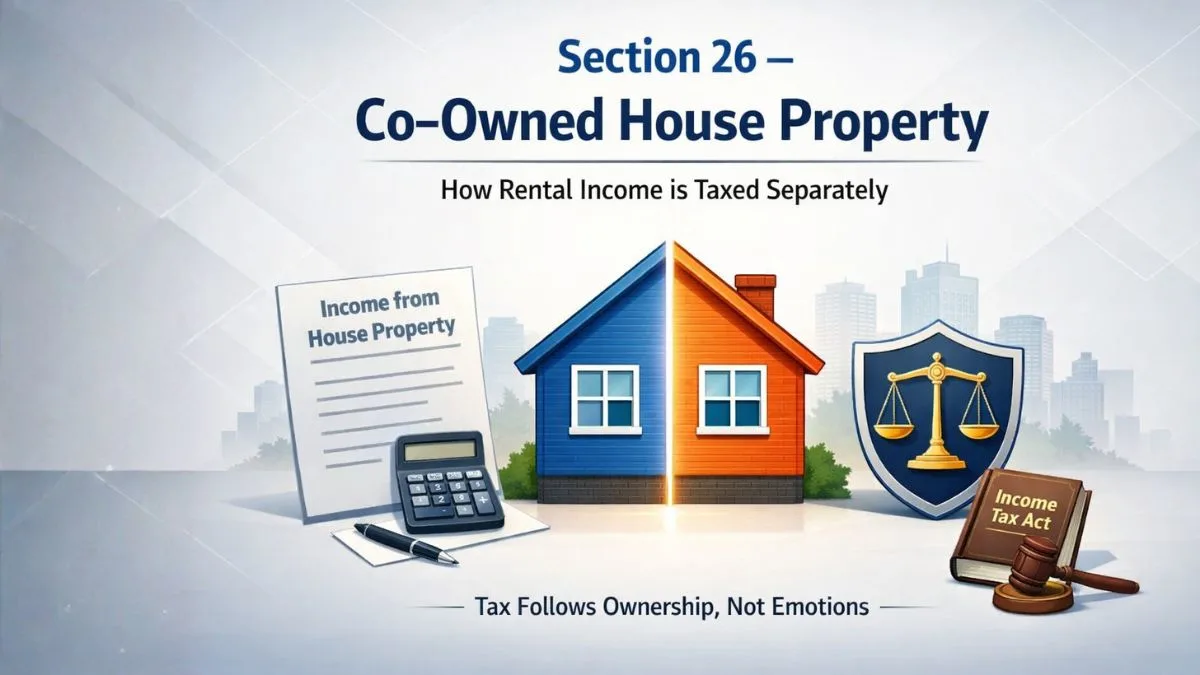
Section 26 of Income Tax Act: Complete Guide on Co-Owned House Property Taxation
If you and your spouse, sibling, parent, or business partner jointly own a house property, one question always comes up during tax filing season: “How will the rental income be taxed?”
Many people assume that when a property is jointly owned, income tax will be calculated collectively. That assumption often leads to confusion, wrong reporting, or even unnecessary tax notices.
This is exactly where Section 26 of the Income Tax Act becomes important.
In this detailed guide, I’ll break down Section 26 of the Income Tax Act in plain, practical language—no legal jargon, no copy-paste explanations. Think of this as advice from someone who has actually seen these issues play out in real tax filings.
Why Section 26 Matters More Than You Think
Joint ownership of property is extremely common in India today:
- Husband and wife buying a flat together
- Parents adding children as co-owners
- Siblings inheriting ancestral property
- Partners investing in rental real estate
But taxation does not follow emotional ownership. It follows legal ownership and defined shares.
That’s why property is owned by co-owners. 2 (as mentioned in the law) is treated differently under income tax.
What Is Section 26 of the Income Tax Act?
In simple words, Section 26 of Income Tax Act
👉 deals with the taxation of income from a house property owned by co-owners. It specifies how rental income is assessed when a property is jointly owned by two or more people.
The key idea is very clear:
Even though two or more people co-own a property, they will not be taxed as a group.
Each co-owner is taxed individually, based on their ownership share.
Core Principle of Section 26
Under Section 26 of the Income Tax Act:
- The property must be co-owned
- Each co-owner’s share should be definite and ascertainable
- Income is taxed separately in each co-owner’s hands
- No clubbing of income just because ownership is joint
This is why the law clearly states that even though they co-own the property, they will not be taxed as a group.
Meaning of Co-Owned Property Under Income Tax
A property is considered co-owned when:
- It is owned by two or more persons
- Each owner has a clearly defined share
- Ownership may arise from purchase, inheritance, or gift
This directly falls under property owned by co-owners. 2 as per the Income Tax Act.
If ownership share is not defined, Section 26 benefits may not apply properly.
How Taxation Works for Co-Owned Property
Let’s break down the taxation of the income-tax-on-income concept with a practical example.
Example 1: Simple Rental Income Case
- Property rented for ₹60,000 per month
- Annual rent: ₹720,000
- Owned by two co-owners (50% each)
Under Section 26 of the Income Tax Act:
- Owner A reports ₹3,60,000
- Owner B reports ₹3,60,000
- A standard deduction of 30% is applied individually
- Each co-owner files income under “Income from House Property” separately
There is no combined assessment.
How Income From House Property Is Computed
Section 26 doesn’t work alone. It lays down the rules for the computation of income from house property when co-ownership exists.
Here’s the step-by-step flow:
Step 1: Determine Gross Annual Value (GAV)
Rental income or expected rent of the property.
Step 2: Deduct Municipal Taxes
Paid by owners during the year.
Step 3: Apply Standard Deduction
A 30% deduction is allowed to each co-owner individually.
Step 4: Deduct Interest on Home Loan
Each co-owner can claim an interest deduction in proportion to ownership share.
This structured approach ensures fair taxation of income tax on income for each individual.
Important Rule: Ownership Share Must Be Defined
This is where many people make mistakes.
For Section 26 of the Income Tax Act to apply smoothly:
- Ownership percentage must be mentioned in sale deed
- Loan documents should reflect ownership ratio
- Rental agreement should ideally show owner shares
If shares are not clearly defined, the tax officer may:
- Reject individual claims
- Treat income differently
- Ask for clarifications or documents
What If the Property Is Self-Occupied?
If the co-owned property is self-occupied:
- No rental income is taxed
- Each co-owner can still claim:
- Interest on home loan (up to ₹2 lakh individually)
- Subject to ownership and loan share
- Interest on home loan (up to ₹2 lakh individually)
Again, the benefit flows individually, not jointly.
What If the Property Is Vacant?
If the property is vacant but capable of being rented:
- Expected rent is calculated
- Income is still apportioned between co-owners
- Section 26 continues to apply
This avoids confusion in taxation of income tax on income even when cash flow is zero.
Section 26 vs Joint Assessment: Common Myth
Many people believe:
“Since the property is jointly owned, the tax will be calculated together.”
This is completely wrong.
The law clearly says:
even though they co-own the property, they will not be taxed as a group
Each co-owner is treated as a separate assessee.
Special Mention: Exemption for Scheduled Tribes
There is often confusion here, so let’s clarify honestly.
While Section 26 of the Income Tax Act mainly talks about co-owned property, people also associate it with the fact that the Income Tax Act exempts certain income earned by members of Scheduled Tribes (ST) from tax.
In practice:
- Certain incomes of ST members in specified areas enjoy exemption
- Conditions apply based on location and source of income
- Proper documentation is critical
This exemption is not automatic and must be evaluated case-by-case during filing.
Practical Mistakes People Make Under Section 26
From real tax filings, these mistakes are very common:
1. Declaring Full Rent in One Person’s Return
Even when ownership is shared.
2. Claiming 100% Home Loan Interest
Despite owning only 50%.
3. Not Mentioning Ownership Ratio in Deed
Which creates trouble later.
4. Assuming Joint Filing Is Allowed
It is not.
All these lead to incorrect taxation of income tax on income.
Actionable Tips to Stay Compliant
If you own property jointly, do this:
- ✔ Clearly define ownership shares in documents
- ✔ Split rental income exactly as per share
- ✔ Claim deductions proportionately
- ✔ Keep loan statements and agreements aligned
- ✔ File returns separately, not jointly
These steps ensure smooth compliance with Section 26 of the Income Tax Act.
Section 26 in Inherited Property Cases
Inherited properties often have:
- Multiple legal heirs
- Defined shares under succession laws
Once shares are determined:
- Income is taxed individually
- Section 26 applies fully
- No clubbing of income
This is especially helpful in ancestral property situations.
Why Section 26 Is Taxpayer-Friendly
Despite sounding technical, Section 26 of the Income Tax Act actually protects taxpayers.
It ensures:
- Fair taxation
- No double taxation
- Clear separation of income
- Individual benefit of deductions
It respects the principle that tax follows ownership, not emotions.
Final Thoughts
To summarize:
- Section 26 of Income Tax Act governs co-owned house property
- Property owned by co-owners. 2 is taxed individually
- It defines taxation income-tax on income clearly
- It lays down the rules for the computation of income from house property
- Even though they co-own the property, they will not be taxed as a group
- Certain cases also touch upon exemption, where law exempts certain income earned by members of Scheduled Tribes (ST) from tax
If you own property jointly and want to avoid mistakes, understanding Section 26 is not optional—it’s essential.
For personalized guidance, accurate tax filing, and expert help on property taxation, visit callmyca.com.









